MCQ
As the temperature increases, the electrical resistance 
  • A
    decreases for both conductors and semiconductors
  • increases for conductors but decreases for semiconductors
  • C
    decreases for conductors but increases for semiconductors
  • D
    increases for both conductors and semiconductors
Answer

Correct option: B.
increases for conductors but decreases for semiconductors
b
For conductors $\alpha$ is $(+)ve$

For semiconductors and Insulators $\alpha$ is $(-)ve$

Need a full question paper?

Generate a complete, print-ready paper with questions like this in minutes — across 16+ boards, with answer keys.

Start Generating Free

Similar questions

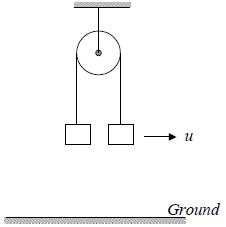
As shown in the figure, two equal masses hang on either side of a pulley at the same height from the ground. The mass on the right is given a horizontal speed. After some time :-
A sample of radioactive element containing $4 \times 10^{16}$ active nuclei. Half life of element is $10$ days, then number of decayed nuclei after $30$ days is  ........ $\times 10^{16}$ 
The ratio of Young's modulus of the material of two wires is $2 : 3.$ If the same stress is applied on both, then the ratio of elastic energy per unit volume will be
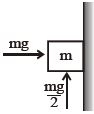
A block pressed against the vertical wall is in equilibrium. The minimum coefficient of  friction is:-
For a normal eye, the cornea of eye provides a converging power of $40\,\, D$ and the least converging power of the eye lens behind the cornea is $20\,\, D.$ Using this information, the distance between the retina and the cornea­eye lens can be estimated to be.........$ cm$
A spherical black body with a radius of $12\ cm$ radiates $450\ watt$ power at $500\ K$. If the radius were halved and the temperature doubled, the power radiated in watt would be
What average horsepower is developed by an  $80 \;kg $ man while climbing in $10\; s$  a flight of stairs that rises $6 m$  vertically ..............$HP$
$A$ particle is moving in a circular orbit of radius $r_1$ with an angular velocity $\omega_1$ . It jumps to another circular orbit of radius $r_2$ and attains an angular velocity $\omega_2$ . If $r_2 = 0.5\, r_1$ and assuming that no external torque is applied to the system, then the angular velocity $\omega_2$, is given by :
If two vectors $\vec{A}$ and $\vec{B}$ having equal magnitude $\mathrm{R}$ are inclined at an angle $\theta$, then
Light of frequency $1.5$ times the threshold frequency Is incident on a photosensitive material. What will be the photoelectric current if the frequency is halved and intensity is doubled$?$