Question
Light of frequency $1.5$ times the threshold frequency Is incident on a photosensitive material. What will be the photoelectric current if the frequency is halved and intensity is doubled$?$

Answer

$K _{1}=1.5 hv _{0}-\phi_{0}=0.5 hvo$

$K _{2}=\frac{1.5}{2} h { v }_ 0- h v_ 0=-0.25 h v_{ 0}$

$\because$ Kinetic energy can never be negative So, no emission and $i=0$

OR

In second case the incident frequency is halved

Incident frequency $=\frac{1.5}{2} v_{0}=0.75 v _{0}$

Now the incident frequency is less than threshold frequency so no emission of electron take place therefore no current. $(i=0)$

Need a full question paper?

Generate a complete, print-ready paper with questions like this in minutes — across 16+ boards, with answer keys.
Start Generating Free

Similar questions

In the hysteresis cycle, the value of $H$  needed to make the intensity of magnetisation zero is called
Two identical mass $M$ moving with velocity $\mu_1$ and $\mu_2$ collide perfectly inelastically. The loss in energy is
A soap bubble is blown with the help of a mechanical pump at the mouth of a tube. The pump produces a certain increase per minute in the volume of the bubble, irrespective of its internal pressure. The graph between the pressure inside the soap bubble and time $t$ will be-
A coaxial cable consists of an inner wire of radius $'a'$ surrounded by an outer shell of inner and outer radii ' ${b}$ ' and '$c$' respectively. The inner wire carries an electric current is, which is distributed uniformly across cross-sectional area. The outer shell carries an equal current in opposite direction and distributed uniformly. What will be the ratio of the magnetic field at a distance ${x}$ from the axis when $(i)$ ${x}<{a}$ and $(ii)$ ${a}<{x}<{b}$ ?
A piece of metal of mass $5\ kg$ and temperature $-50\ ^oC$ is dropped in $20\  kg$ water at $52\ ^oC$ temperature. In thermal equilibrium temperature of water decreases by $2\ ^oC$, then specific heat of metal is ...... $ Cal/g\,^oC$
At a given temperature the ratio of $r.m.s.$ velocities of hydrogen molecule and helium atom will be
A block of mass $M$ rests on a rough horizontal table. A steadily increasing horizontal force is applied such that the block starts to slide on the table without toppling. The force is continued even after sliding has started. Assume the coefficients of static and kinetic friction between the table and the block to be equal. The correct representation of the variation of the frictional force $f$, exerted by the table on the block with time $t$ is given by
In hydrogen spectrum, the shortest wavelength in the Balmer series is $\lambda$. the shortest wavelength in the Paschan series is:
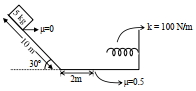
A block is simply released from the top of an inclined plane as shown in the figure above. The maximum compression in the spring when the block hits the spring is :
Which of the following statement(s) is$/$(are) correct