MCQ
As the temperature increases, the electrical resistance 
  • A
    decreases for both conductors and semiconductors
  • increases for conductors but decreases for semiconductors
  • C
    decreases for conductors but increases for semiconductors
  • D
    increases for both conductors and semiconductors
Answer

Correct option: B.
increases for conductors but decreases for semiconductors
b
For conductors $\alpha$ is $(+)ve$

For semiconductors and Insulators $\alpha$ is $(-)ve$

Need a full question paper?

Generate a complete, print-ready paper with questions like this in minutes — across 16+ boards, with answer keys.

Start Generating Free

Similar questions

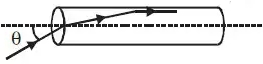
A transparent solid cylindrical rod has a refractive index of  $\frac{2}{{\sqrt 3 }}$ It is surrounded by air. A light ray is incident at the mid-point of one end of the rod as shown in the figure. The incident angle $\theta$ for which the light ray grazes along the wall of the rod is
When a current is passed through water, acidified with a dilute sulphuric acid, the gases formed at the platinum electrodes are
One bar magnet is kept in the direction of north-south such that its north pole is towards north.The direction of points of zero magnetic field is towards which side of the centre of the magnet:
When the modulating frequency is doubled, the modulation index is halved and the modulating voltage remains constant, the modulation system is
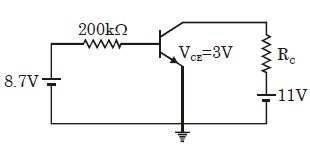
In the shown common emitter amplifier circuit, $\beta = 80$ , $V_{BE} = 0.7\,volt $ . The value of $R_C$ is 
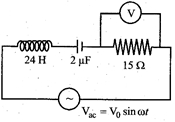
An $LCR$ circuit as shown in the figure is connected to a voltage source $V_{ac}$ whose frequency can be varied.

The frequency, at which the voltage across the resistor is maximum, is......$Hz$

The work done in carrying a charge of 5μC from a point A to a point B in an electric field is 10mJ. The potential difference $(V_B-V_A)$ is then
When a PN junction diode is reverse biased
An important spectral emission line has a wavelength of $21 cm$. The corresponding photon energy is

$(h = 6.62 \times {10^{ - 34}}Js;\;\;c = 3 \times {10^8}m/s)$

Deuterium is the most common isotope of hydrogen. How many neutrons does it have?