MCQ
When a PN junction diode is reverse biased
  • A
    Electrons and holes are attracted towards each other and move towards the depletion region
  • Electrons and holes move away from the junction depletion region
  • C
    Height of the potential barrier decreases
  • D
    No change in the current takes place

Answer

Correct option: B.
Electrons and holes move away from the junction depletion region

Need a full question paper?

Generate a complete, print-ready paper with questions like this in minutes — across 16+ boards, with answer keys.

Start Generating Free

Similar questions

The unit of inductance is
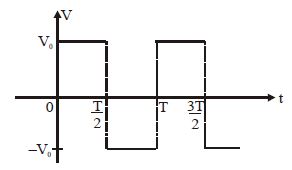
The mean and $rms$ value of an alternating voltage for half cycle as shown in figure are  respectively:-
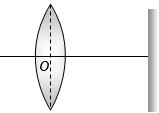
The distance between a convex lens and a plane mirror is $10 \,cm$. The parallel rays incident on the convex lens after reflection from the mirror form image at the optical centre of the lens. Focal length of lens will be.....$cm$
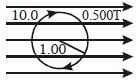
A single circular loop of radius $1.00\, m$ carries a current of $10.0\, mA$. It is placed in $a$ uniform magnetic field of magnitude $0.500\, T$ that is directed parallel to the plane of the loop as suggested in the figure. The magnitude of the torque exerted on the loop by the magnetic field is.
A lamp is hanging at a height $40\, cm$ from the centre of a table. If its height is increased by $10\, cm $ the illuminance on the table will decrease by.....$\%$
Identify the mismatched pair:
Which of the following is the definition for magnetic meridian of Earth?
The work which is required to be done to make an arrangement of four particles each having a charge $+q$ such that the particles lie at the four corners of a square of side $a$ is .......
A glass lens is placed in a medium in which it is found to behave like a glass plate. Refractive index of the medium will be
When a metallic surface is illuminated by a light of wavelength $\lambda,$ the stopping potential for the photoelectric current is $3\, V$. When the same surface is illuminated by light of wavelength $2\, \lambda$ the stopping potential is $1\, V$. The threshold wavelength for this surface is