MCQ
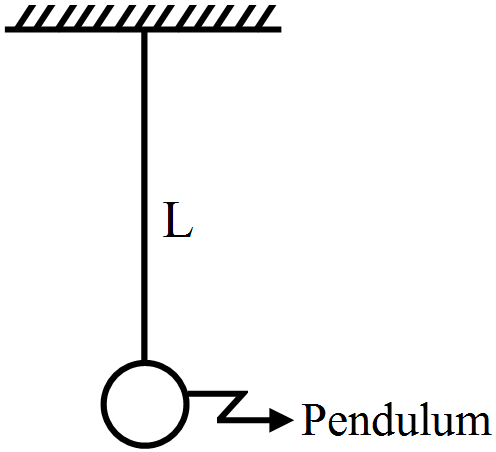
As the temperature is increased, the period of a pendulum:
  • A
    Increases as its effective length increases even though its centre of mass still remains at the centre of the bob.
  • B
    Decreases as its effective length increases even though its centre of mass still remains at the centre of the bob.
  • C
    Increases as its effective length increases due to shifting to centre of mass below the centre of the bob.
  • D
    Decreases as its effective length remains same but the centre of mass shifts above the centre of the bob.
Answer

  1. Increases as its effective length increases even though its centre of mass still remains at the centre of the bob.

Explanation:

As the temperature is increased length of the pendulum increases.

We know that, time period of pendulum $\text{T}=2\pi\sqrt{\frac{\text{L}}{\text{g}}}$

​​​​​​​$\Rightarrow\text{T}\propto\sqrt{\text{L}}$

As L, increases so, time period (T) also increases.

Need a full question paper?

Generate a complete, print-ready paper with questions like this in minutes — across 16+ boards, with answer keys.

Start Generating Free

Similar questions

Consider $1 \,kg$ of liquid water undergoing change in phase to water vapour at $100^{\circ} C$. At $100^{\circ} C$, the vapour pressure is $1.01 \times 10^5 \,N - m ^2$ and the latent heat of vaporization is $22.6 \times 10^5 \,Jkg ^{-1}$. The density of liquid water is $10^3 \,kg m ^{-3}$ and that of vapour is $\frac{1}{1.8} \,kg m ^{-3}$. The change in internal energy in this phase change is nearly ............ $\,J kg ^{-1}$
Two closed organ pipes of length $100\,cm$ and $101\,cm$ long give $16$ beats in $20\,sec$ when each pipe is sounded in fundamental mode. Calculate velocity of sound .... $ms^{-1}$
Three different objects of masses ${m_1},{m_2}$ and ${m_3}$ are allowed to fall from rest and from the same point $‘O’$ along three different frictionless paths. The speeds of the three objects, on reaching the ground, will be in the ratio of
The moment of inertia of a body about a given axis is $1.2 \;kg m^{2}$. Initially, the body is at rest. In order to produce a rotational kinetic energy of $1500\; joule$, an angular acceleration of $25 \;rad s^{-2}$ must be applied about that axis for a duration of
$Assertion$: A rigid disc rolls without slipping on a fixed rough horizontal surface with uniform angular velocity. Then the acceleration of lowest point on the disc is zero.
$Reason$ : For a rigid disc rolling without slipping on a fixed rough horizontal surface, the velocity of the lowest point on the disc is always zero
The heat capacity of a body depends on:
  1. The heat given.
  2. The temperature raised.
  3. The mass of the body.
  4. The material of the body.
Which of the following is the $\nu_m = T$  graph for a perfectly black body ($\nu_m$ =maximum frequency of radiation)
An open vessel is filled completely with oil which has same coefficient of volume expansion as that of the vessel. On heating both oil and vessel,
The molecular weight of a gas is $44$. The volume occupied by $2.2\, g$ of this gas at $0^\circ C$ and $2\, atm.$ pressure will be ....... $lit$
If it takes $5\,minutes$ to fill a $15\,litre$ bucket from a water tap of diameter $\frac{2}{{\sqrt \pi  }}cm$ then the Reynolds number for the flow is (density of water $= 10^3\,kg/m^3$ ) and viscosity of water $= 10^{-3}\,Pa.s$ ) close to