MCQ
Assertion $(A) :$ A window has the shape of a rectangle surmounted by an equilateral triangle. If the perimeter of the window is $12 m$, then length $1.782 m$ and breadth $2.812 m$ of the rectangle will produce the largest area of the window.
Reason $( R )$ : For maximum or minimum, $f^{\prime}(x)=0$.
  • Both $(A)$ and $(R)$ are true and $(R)$ is the correct explanation of $(A).$
  • B
    Both $(A)$ and $(R)$ are true but $(R)$ is not the correct explanation of $(A).$
  • C
    $(A)$ is true but $(R)$ is false.
  • D
    $(A)$ is false but $(R)$ is true.

Answer

Correct option: A.
Both $(A)$ and $(R)$ are true and $(R)$ is the correct explanation of $(A).$
Let each side of the equilateral triangle be $x m$ and $l m$ be the height (length) of the rectangular part of the window, then
$x+x+x+l+l=12$
$\Rightarrow 3 x+2 l=12$
$\Rightarrow l=6-\frac{3}{2} x ...(i)$
Let $A m ^2$ be the area of the window corresponding to the above dimensions, then
$A =l x+\frac{\sqrt{3}}{4} x^2 ; x>0, l>0$
$ =\left(6-\frac{3}{2} x\right) x+\frac{\sqrt{3}}{4} x^2 ($ Using $(i))$
Now, $\frac{d A}{d x}=6-3 x+\frac{\sqrt{3}}{2} x$
$\frac{d A}{d x}=0$
$\Rightarrow 6-3 x+\frac{\sqrt{3}}{2} x=0$
$\Rightarrow 12-6 x+\sqrt{3} x=0$
$\Rightarrow x=\frac{12}{6-\sqrt{3}} \approx 2.812$
Now, $\frac{d^2 A}{d x^2}=-3+\frac{\sqrt{3}}{2}<0$
$\therefore A$ has local maxima at $x=2.812$
For $x=2.812, l=6-\frac{3}{2}(2.812)=1.782$
$\therefore$ Height of rectangular part $=1.782 m$ and breadth $=2.812 m$

Need a full question paper?

Generate a complete, print-ready paper with questions like this in minutes — across 16+ boards, with answer keys.

Start Generating Free

Similar questions

Assertion (A) : Bag I contains 3 red and 4 black balls while another bag II contains 5 red and 6 black balls. One ball is drawn at random from one of the bags and it is found to be red. Then, the probability that it was drawn from bag II is $\frac{35}{68}$.
Reason (R) : By Bayes' theorem,
$
\begin{array}{r}
P\left(\frac{E_1}{A}\right)=\frac{P\left(E_1\right) \cdot P\left(A / E_1\right)}{P\left(E_1\right)\left(A \mid E_1\right)+P\left(E_1\right) \cdot P\left(A \mid E_2\right)+P\left(E_1\right) P\left(A \mid E_3\right)}
\end{array}
$
Directions: In the following questions, the Assertions $(A)$ and Reason$(s)\ (R)$ have been put forward. Read both the statements carefully and choose the correct alternative from the following:
Assertion $(A):$ Acontinuous funection is always differentiable.
Reason $(R):$ Adifferentiable function is always continuous.
Directions: In the following questions, the Assertions $(A)$ and Reason$(s) (R)$ have been put forward. Read both the statements carefully and choose the correct alternative from the following:
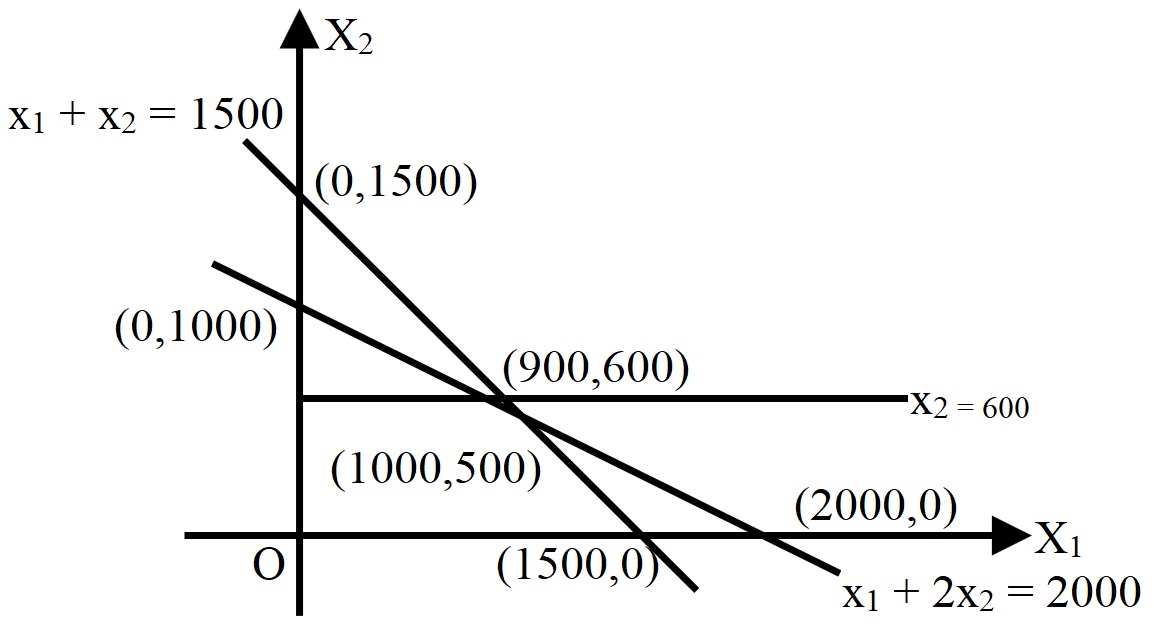
Assertion $(A):$ For the constraints of a $\text{LPP}$ problem given by $\text{x}_1+2\text{x}_2\leq2000,\text{x}_1+\text{x}_2\leq1500,\text{x}_2\leq600$ and $\text{x}_1,\text{x}_2\geq0$ the points $(1000, 0), (0, 500), (2, 0)$ lie in the positive bounded region, but point $(2000, 0)$ does not lie in the positive boundedregion.
Reason $(R):$
Assertion $(A) :\int \sin 3 x \cos 5 x d x=\frac{-\cos 8 x}{16}+\frac{\cos 2 x}{4}+C$
Reason $(R) :2 \cos A \sin B=\sin (A+B)-\sin (A-B)$
If $R$ is the relation in the set $A=\{1,2,3,4,5\}$ given by $R=\{\{a, b):|a-b|$ is even $\}$,
Assertion (A): R is an equivalence relation.
Reason (R): All elements of $\{1,3,5\}$ are related to all elements of $\{2,4\}$.
Directions : In the following questions, a statement of assertion $(A)$ is followed by a statement of reason $(R).$ Mark the correct choice as :
Assertion : The range of the function $\frac{\text{x}^{2}}{1+\text{x}^{2}}$ is $(0, 1).$
Reason : If $\text{f}(\text{x})\leq\text{g}(\text{x})$ then the range of $\frac{\text{f}(\text{x})}{\text{g}(\text{x})},\text{g}(\text{x})\neq0$ is $(0, 1).$
Directions: In the following questions, the Assertions $(A)$ and Reason$(s)\ (R)$ have been put forward. Read both the statements carefully and choose the correct alternative from the following:
Assertion $(A)$ The function $\text{f(x)}=\begin{cases}12\text{x} -13 , \text{if x}\leq3\\2\text{x}^2+5,\text{if x}>3\end{cases}$ is differentiable at $x = 3.$
Reason $(R)$ The function $f(x)$ is differentiable at $x = c$ of its domain if Left hand derivative of $f$ at $c =$ Right hand derivative of $f$ at $c.$
Directions : In the following questions, a statement of assertion $(A)$ is followed by a statement of reason $(R).$ Mark the correct choice as:
Assertion : A relation $R = \{(1,1), (1, 3), (3, 1), (3, 3), (3, 5)\}$ defined on the set $A = \{1, 3, 5\}$ is reflexive.
Reason : A relation $R$ on the set $A$ is transitive if $(\text{a},\text{b})\in\text{R}$ and $(\text{b},\text{c})\in\text{R}$
$\Rightarrow(\text{a},\text{c})\in\text{R}).$
Assertion $(A)$ : The adjacent sides of a parallelogram are along $\vec{a}=\hat{i}+2 \hat{j}$ and $\vec{b}=2 \hat{i}+\hat{j}$. The angle between the diagonals is $150^{\circ}$.
Reason $(R)$ : Two vectors are perpendicular to each other if their dot product is zero.
Directions : In the following questions, a statement of assertion $(A)$ is followed by a statement of reason $(R).$ Mark the correct choice as :
Assertion : A relation $R = \{(1, 1), (1, 2), (2, 2), (2, 3) (3, 3)\}$ defined on the set $A = \{1, 2, 3\}$ is reflexive.
Reason : A relation $R$ on the set $A$ is reflexive if $(\text{a},\text{a})\in\text{R},\forall\ \text{a}\in\text{A}.$