MCQ 11 Mark
Directions: In the following questions, the Assertions $(A)$ and Reason$(s) (R)$ have been put forward. Read both the statements carefully and choose the correct alternative from the following:
Assertion $(A):$ Let $\text{f(x)}=\text{e}^\frac{1}{\text{x}}$ is defined for all real values of $x.$
Reason$(R): \text{f(x)}=\text{e}^\frac{1}{\text{x}}$ is always decreasing as $\text{f'(x)}<0$ is $\text{x }\in\text{ R}$
- ✓
Both $A$ and $R$ are true and $R$ is the correct explanation of $A$
- B
Both $A$ and $R$ are true but $R$ is $\text{NOT}$ the correct explanation of $A$
- C
$A$ is true but $R$ is false.
- D
$A$ is false but $R$ is true.
AnswerCorrect option: A. Both $A$ and $R$ are true and $R$ is the correct explanation of $A$
View full question & answer→MCQ 21 Mark
Directions: In the following questions, the Assertions $(A)$ and Reason$(s) (R)$ have been put forward. Read both the statements carefully and choose the correct alternative from the following:
Assertion $(A):$ if $\text{f(x)}=\text{a}(\text{x}+\sin\text{x})$ is increasing function if $a\in(0,\infty)$
Reason $(R):$ The given function $\text{f(x) }$is increasing only if $a\in(0,\infty)$
- A
Both $A$ and $R$ are true and $R$ is the correct explanation of $A$
- B
Both $A$ and $R$ are true but $R$ is $\text{NOT}$ the correct explanation of $A$
- C
$A$ is true but $R$ is false.
- ✓
$A$ is false but $R$ is true.
AnswerCorrect option: D. $A$ is false but $R$ is true.
View full question & answer→MCQ 31 Mark
Directions: In the following questions, the Assertions $(A)$ and Reason$(s) (R)$ have been put forward. Read both the statements carefully and choose the correct alternative from the following:
Assertion $(A):$ The curve $y = x^2$ represents a parabola with vertex at origin.
Reason $(R):$ For a curve Tangent and Normal lines are always perpendicular at thepoint of contact.
- A
Both $A$ and $R$ are true and $R$ is the correct explanation of $A$
- ✓
Both $A$ and $R$ are true but $R$ is $\text{NOT}$ the correct explanation of $A$
- C
$A$ is true but $R$ is false.
- D
$A$ is false but $R$ is true.
AnswerCorrect option: B. Both $A$ and $R$ are true but $R$ is $\text{NOT}$ the correct explanation of $A$
View full question & answer→MCQ 41 Mark
Directions: In the following questions, the Assertions $(A)$ and Reason$(s) (R)$ have been put forward. Read both the statements carefully and choose the correct alternative from the following:
Assertion $(A):$ The function $\text{y}=\log(1+\text{x)}\ \frac{2\text{x}}{2+\text{x}}$ is decreasing throughout its domain
Reason $(R):$ The domain of the function $\text{y}=\log(1+\text{x)} \ \frac{2\text{x}}{2+\text{x}}$ is $(-1,\infty).$
- A
Both $A$ and $R$ are true and $R$ is the correct explanation of $A$
- B
Both $A$ and $R$ are true but $R$ is $\text{NOT}$ the correct explanation of $A$
- C
$A$ is true but $R$ is false.
- ✓
$A$ is false but $R$ is true.
AnswerCorrect option: D. $A$ is false but $R$ is true.
View full question & answer→MCQ 51 Mark
Directions: In the following questions, the Assertions $(A)$ and Reason$(s) (R)$ have been put forward. Read both the statements carefully and choose the correct alternative from the following:
Assertion $(A):$ The equation of tangent to the curve $ \text{y} = \sin\text{x}$ at the point $(0, 0)$ is $y = x.$
Reason $(R):$ if $\text{y}=\sin$ then $\frac{\text{dy}}{\text{dx}}$ at $x = 0$ is $1.$
- ✓
Both $A$ and $R$ are true and $R$ is the correct explanation of $A$
- B
Both $A$ and $R$ are true but $R$ is $\text{NOT}$ the correct explanation of $A$
- C
$A$ is true but $R$ is false.
- D
$A$ is false but $R$ is true.
AnswerCorrect option: A. Both $A$ and $R$ are true and $R$ is the correct explanation of $A$
View full question & answer→MCQ 61 Mark
Directions: In the following questions, the Assertions $(A)$ and Reason$(s) (R)$ have been put forward. Read both the statements carefully and choose the correct alternative from the following:
Assertion $(A):$ He curves $x^3 - 3xy^2 = a$ and $3x^2 y - y^3 = b$ cut each other, where $'a\ ’$ and $' b\ ’$ are some constants.
Reason $(R):$ The given curves cut orthogonally.
- ✓
Both $A$ and $R$ are true and $R$ is the correct explanation of $A$
- B
Both $A$ and $R$ are true but $R$ is $\text{NOT}$ the correct explanation of $A$
- C
$A$ is true but $R$ is false.
- D
$A$ is false but $R$ is true.
AnswerCorrect option: A. Both $A$ and $R$ are true and $R$ is the correct explanation of $A$
View full question & answer→MCQ 71 Mark
Directions : In the following questions, the Assertions $(A)$ and Reason $(s) \ (R)$ have been put forward. Read both the statements carefully and choose the correct alternative from the following:
Assertion $(A)$ : There exists a unique tangent to the curve $y^2 + 3x - 7 = 0$ at the point $(h, k)$ and is parallel to the line $x - y = 4$.
Reason $(R)$ : The value of $\text{k}=\frac{3}{2}.$
- ✓
Both $A$ and $R$ are true and $R$ is the correct explanation of $A$
- B
Both $A$ and $R$ are true but $R$ is $\text{NOT}$ the correct explanation of $A$
- C
$A$ is true but $R$ is false.
- D
$A$ is false but $R$ is true.
AnswerCorrect option: A. Both $A$ and $R$ are true and $R$ is the correct explanation of $A$
Both $A$ and $R$ are true and $R$ is the correct explanation of $A$
View full question & answer→MCQ 81 Mark
Directions: In the following questions, the Assertions $(A)$ and Reason$(s) (R)$ have been put forward. Read both the statements carefully and choose the correct alternative from the following:
Assertion $(A):$ For $\text{f(x)}=\text{x}+\frac{1}{2},\text{x}\neq0,$ maximum and minimum values both exists.
Reason $(R):$ Maximum value of $\text{f(x)}$ is less than its minimum value.
- ✓
Both $A$ and $R$ are true and $R$ is the correct explanation of $A$
- B
Both $A$ and $R$ are true but $R$ is $\text{NOT}$ the correct explanation of $A$
- C
$A$ is true but $R$ is false.
- D
$A$ is false but $R$ is true.
AnswerCorrect option: A. Both $A$ and $R$ are true and $R$ is the correct explanation of $A$
View full question & answer→MCQ 91 Mark
Directions: In the following questions, the Assertions $(A)$ and Reason$(s) (R)$ have been put forward. Read both the statements carefully and choose the correct alternative from the following:
Assertion $(A) :$ The function $f(x) = x^3 - 3x^2 + 6x - 100$ is strictly increasing on $R$
Reason $(R) :$ A strictly increasing functions is an injective function.
- ✓
Both $A$ and $R$ are true and $R$ is the correct explanation of $A$
- B
Both $A$ and $R$ are true but $R$ is $\text{NOT}$ the correct explanation of $A$
- C
$A$ is true but $R$ is false.
- D
$A$ is false but $R$ is true.
AnswerCorrect option: A. Both $A$ and $R$ are true and $R$ is the correct explanation of $A$
View full question & answer→MCQ 101 Mark
Directions: In the following questions, the Assertions $(A)$ and Reason$(s) (R)$ have been put forward. Read both the statements carefully and choose the correct alternative from the following:
Assertion $(A):$ There exists no tangent to the curve $=\sqrt{3\text{x}-2},$ which is parallel to the line $4x - 2y + 5 = 0$
Reason $(R):$ Tangent to the curve $\text{x}=\sqrt{3\text{x}-2},$ exists at $\Big(\frac{41}{48},\frac{3}{4}\Big).$
- ✓
Both $A$ and $R$ are true and $R$ is the correct explanation of $A$
- B
Both $A$ and $R$ are true but $R$ is $\text{NOT}$ the correct explanation of $A$
- C
$A$ is true but $R$ is false.
- D
$A$ is false but $R$ is true.
AnswerCorrect option: A. Both $A$ and $R$ are true and $R$ is the correct explanation of $A$
View full question & answer→MCQ 111 Mark
Directions: In the following questions, the Assertions $(A)$ and Reason$(s) (R)$ have been put forward. Read both the statements carefully and choose the correct alternative from the following:
Assertion $(A):$ At $\text{x}=\frac{\pi}{6},$ the curve $\text{y}=2\cos^2(3\text{x})$ has a vertical tangent.
Reason $(R):$ The slope of tangent to the curve $\text{y}=2\cos^2(3\text{x})$ at $\text{x}=\frac{\pi}{6}$ is zero.
- A
Both $A$ and $R$ are true and $R$ is the correct explanation of $A$
- B
Both $A$ and $R$ are true but $R$ is $\text{NOT}$ the correct explanation of $A$
- C
$A$ is true but $R$ is false.
- ✓
$A$ is false but $R$ is true.
AnswerCorrect option: D. $A$ is false but $R$ is true.
View full question & answer→MCQ 121 Mark
Directions: In the following questions, the Assertions $(A)$ and Reason$(s) (R)$ have been put forward. Read both the statements carefully and choose the correct alternative from the following: $AB$ is the diameter of a circle and $C$ is any point on the circle.
Assertion $(A):$ The area of $\triangle\text{ABC}$ is maximum when it is isosceles.
Reason $(R): \triangle\text{ABC}$ is a right $-$ angled triangle.
- ✓
Both $A$ and $R$ are true and $R$ is the correct explanation of $A$
- B
Both $A$ and $R$ are true but $R$ is $\text{NOT}$ the correct explanation of $A$
- C
$A$ is true but $R$ is false.
- D
$A$ is false but $R$ is true.
AnswerCorrect option: A. Both $A$ and $R$ are true and $R$ is the correct explanation of $A$
View full question & answer→MCQ 131 Mark
Directions: In the following questions, the Assertions $(A)$ and Reason$(s) (R)$ have been put forward. Read both the statements carefully and choose the correct alternative from the following: Consider the function $\text{f(x)}=\sin^4\text{x}+\cos^4\text{x}.$
Assertion $(A): \text{f(x)}$ is increasing in $\big[0,\frac{\pi}{4}\big].$
Reason $(R): \text{f(x)}$ is decreasing in $\big[\frac{\pi}{4},\frac{\pi}{4}\big].$
- A
Both $A$ and $R$ are true and $R$ is the correct explanation of $A$
- ✓
Both $A$ and $R$ are true but $R$ is $\text{NOT}$ the correct explanation of $A$
- C
$A$ is true but $R$ is false.
- D
$A$ is false but $R$ is true.
AnswerCorrect option: B. Both $A$ and $R$ are true but $R$ is $\text{NOT}$ the correct explanation of $A$
View full question & answer→MCQ 141 Mark
Directions: In the following questions, the Assertions $(A)$ and Reason$(s) (R)$ have been put forward. Read both the statements carefully and choose the correct alternative from the following:
Assertion $(A):$ For the curve $x^3 + y^3 = 6xy$, the slope of the tangent at $(3, 3)$ is $2$.
Reason $(R):$ The $\Big(\frac{\text{dy}}{\text{dx}}\Big)_{(\text{at }\text{x}_1,\text{y}_1)}$ gives slope of tangent of $\text{y}=\text{f(x)} $ at $(\text{x}_1,\text{y}_1)$
- ✓
Both $A$ and $R$ are true and $R$ is the correct explanation of $A$
- B
Both $A$ and $R$ are true but $R$ is $\text{NOT}$ the correct explanation of $A$
- C
$A$ is true but $R$ is false.
- D
$A$ is false but $R$ is true.
AnswerCorrect option: A. Both $A$ and $R$ are true and $R$ is the correct explanation of $A$
View full question & answer→MCQ 151 Mark
Directions: In the following questions, the Assertions $(A)$ and Reason$(s) (R)$ have been put forward. Read both the statements carefully and choose the correct alternative from the following:
Assertion $(A):$ If $\text{f(x)}=\log(\cos\text{x)},\text{x}>0$ is strictly decreasing in $\Big(0,\frac{\pi}{2}\Big).$
Reason $(R):$ if $\text{f'(x)}\geq0,$ then $\text{f(x)}$ is strictlyincreasing function.
- A
Both $A$ and $R$ are true and $R$ is the correct explanation of $A$
- ✓
Both $A$ and $R$ are true but $R$ is $\text{NOT}$ the correct explanation of $A$
- C
$A$ is true but $R$ is false.
- D
$A$ is false but $R$ is true.
AnswerCorrect option: B. Both $A$ and $R$ are true but $R$ is $\text{NOT}$ the correct explanation of $A$
View full question & answer→MCQ 161 Mark
Directions: In the following questions, the Assertions $(A)$ and Reason$(s) (R)$ have been put forward. Read both the statements carefully and choose the correct alternative from the following:
Assertion $(A):$ For all values of $'a\ ’ \ \text{f(x)}=\sin\text{x} \text{ ax}+\text{b}$ is decreasing on $\text{x }\in\text{ R}.$
Reason $(R):$ Given function $\text{f(x)} $ decreasing only if $a\in[1,\infty]$
- A
Both $A$ and $R$ are true and $R$ is the correct explanation of $A$
- B
Both $A$ and $R$ are true but $R$ is $\text{NOT}$ the correct explanation of $A$
- C
$A$ is true but $R$ is false.
- ✓
$A$ is false but $R$ is true.
AnswerCorrect option: D. $A$ is false but $R$ is true.
View full question & answer→MCQ 171 Mark
Directions: In the following questions, the Assertions $(A)$ and Reason$(s) (R)$ have been put forward. Read both the statements carefully and choose the correct alternative from the following:
Assertion $(A):$ The points of contact of the vertical tangents to $\text{x}=5-3\cos\theta,$ $\text{y}=3+5\sin\theta$ are $(2, 3)$
Reason $(R):$ For vertical tangent $\frac{\text{dx}}{\text{d}\theta}=0.$
- ✓
Both $A$ and $R$ are true and $R$ is the correct explanation of $A$
- B
Both $A$ and $R$ are true but $R$ is $\text{NOT}$ the correct explanation of $A$
- C
$A$ is true but $R$ is false.
- D
$A$ is false but $R$ is true.
AnswerCorrect option: A. Both $A$ and $R$ are true and $R$ is the correct explanation of $A$
View full question & answer→MCQ 181 Mark
Directions: In the following questions, the Assertions $(A)$ and Reason$(s) (R)$ have been put forward. Read both the statements carefully and choose the correct alternative from the following:
Assertion $(A):$ Slope of the curve given as $4y^2 = x$ at $x = 1$ not defined.
Reason $(R):$ Slope of the curve given as $y^2 = x$ at $x =$ is $\pm\frac{1}{2}.$
- A
Both $A$ and $R$ are true and $R$ is the correct explanation of $A$
- B
Both $A$ and $R$ are true but $R$ is $\text{NOT}$ the correct explanation of $A$
- C
$A$ is true but $R$ is false.
- ✓
$A$ is false but $R$ is true.
AnswerCorrect option: D. $A$ is false but $R$ is true.
View full question & answer→MCQ 191 Mark
Directions: In the following questions, the Assertions $(A)$ and Reason$(s) (R)$ have been put forward. Read both the statements carefully and choose the correct alternative from the following:
Assertion $(A):$ The slope of normal to the curve $x^2 + 2y + y^2 = 0$ at $(- 1, 2)$ is $- 3$.
Reason $(R):$ The slope of tangent to the curve $x^2 + 2y + y^2 = 0$ at $(-1, 2)$ is $\frac{1}{3}.$
- ✓
Both $A$ and $R$ are true and $R$ is the correct explanation of $A$
- B
Both $A$ and $R$ are true but $R$ is $\text{NOT}$ the correct explanation of $A$
- C
$A$ is true but $R$ is false.
- D
$A$ is false but $R$ is true.
AnswerCorrect option: A. Both $A$ and $R$ are true and $R$ is the correct explanation of $A$
View full question & answer→MCQ 201 Mark
Directions: In the following questions, the Assertions $(A)$ and Reason$(s) (R)$ have been put forward. Read both the statements carefully and choose the correct alternative from the following:
Assertion $(A): \text{f(x)}=\frac{1}{\text{x}-7}$ is decreasing ${7}.$
Reason $(R): \text{f '(x)}<0,\forall\text{ x}\neq7.$
- ✓
Both $A$ and $R$ are true and $R$ is the correct explanation of $A$
- B
Both $A$ and $R$ are true but $R$ is $\text{NOT}$ the correct explanation of $A$
- C
$A$ is true but $R$ is false.
- D
$A$ is false but $R$ is true.
AnswerCorrect option: A. Both $A$ and $R$ are true and $R$ is the correct explanation of $A$
View full question & answer→MCQ 211 Mark
Directions: In the following questions, the Assertions$(A)$ and Reason$(s) (R)$ have been put forward. Read both the statements carefully and choose the correct alternative from the following:
Assertion $(A):$ The function $y = [ x(y^2)]^2$ is increasing in $(0,1)\cup(2,\infty)$
Reason $(R): \frac{\text{dy}}{\text{dx}}=0,$ when $\text{x}=0,1,2.$
- A
Both $A$ and $R$ are true and $R$ is the correct explanation of $A$
- ✓
Both $A$ and $R$ are true but $R$ is $\text{NOT}$ the correct explanation of $A$
- C
$A$ is true but $R$ is false.
- D
$A$ is false but $R$ is true.
AnswerCorrect option: B. Both $A$ and $R$ are true but $R$ is $\text{NOT}$ the correct explanation of $A$
View full question & answer→MCQ 221 Mark
Directions: In the following questions, the Assertions $(A)$ and Reason$(s) (R)$ have been put forward. Read both the statements carefully and choose the correct alternative from the following:
Assertion $(A):$ if $\text{f(x)}=\cos\big(2\text{x}+\frac{\pi}{4}\big)$ is strictly increasing in $\text{x }\in\big(\frac{3\pi}{8},\frac{7\pi}{8}\big)$
Reason $(R):$ The function given above is strictly increasing in $\big(\frac{3\pi}{8},\frac{7\pi}{8}\big)$
- ✓
Both $A$ and $R$ are true and $R$ is the correct explanation of $A$
- B
Both $A$ and $R$ are true but $R$ is $\text{NOT}$ the correct explanation of $A$
- C
$A$ is true but $R$ is false.
- D
$A$ is false but $R$ is true.
AnswerCorrect option: A. Both $A$ and $R$ are true and $R$ is the correct explanation of $A$
View full question & answer→MCQ 231 Mark
Directions: In the following questions, the Assertions $(A)$ and Reason$(s) (R)$ have been put forward. Read both the statements carefully and choose the correct alternative from the following:
Assertion $(A):$ For all values of $' t\ ’$ the tangent to the curve $x = t^2 - 1, y = t^2 - t$ is perpendicular tothe $x -$ axis.
Reason $(R):$ For lines perpendicular to $x -$ axis, their slopes will not defined always.
- A
Both $A$ and $R$ are true and $R$ is the correct explanation of $A$
- B
Both $A$ and $R$ are true but $R$ is $\text{NOT}$ the correct explanation of $A$
- C
$A$ is true but $R$ is false.
- ✓
$A$ is false but $R$ is true.
AnswerCorrect option: D. $A$ is false but $R$ is true.
View full question & answer→MCQ 241 Mark
Directions: In the following questions, the Assertions $(A)$ and Reason$(s) (R)$ have been put forward. Read both the statements carefully and choose the correct alternative from the following:
The equation of the tangent at $(2, 3)$ on the curve $y^2 = ax^3 + b$ is $y = 4x - 5$
Assertion $(A):$ The value of $a$ is $\pm2$
Reason $(R):$ The value of $b$ is $\pm7.$
- A
Both $A$ and $R$ are true and $R$ is the correct explanation of $A$
- B
Both $A$ and $R$ are true but $R$ is $\text{NOT}$ the correct explanation of $A$
- ✓
$A$ is true but $R$ is false.
- D
$A$ is false but $R$ is true.
AnswerCorrect option: C. $A$ is true but $R$ is false.
View full question & answer→MCQ 251 Mark
Directions: In the following questions, the Assertions $(A)$ and Reason$(s) (R)$ have been put forward. Read both the statements carefully and choose the correct alternative from the following:
Assertion $(A):$ if $\text{f(x)}=\log(\sin\text{x)},\text{x}>0$ is strictly decreasing in $\Big(\frac{\pi}{2},\pi\Big).$
Reason $(R):$ if $\text{f '(x)}\geq0,$ then $\text{f(x)}$ is strictly increasing function
- A
Both $A$ and $R$ are true and $R$ is the correct explanation of $A$
- B
Both $A$ and $R$ are true but $R$ is $\text{NOT}$ the correct explanation of $A$
- C
$A$ is true but $R$ is false.
- ✓
$A$ is false but $R$ is true.
AnswerCorrect option: D. $A$ is false but $R$ is true.
View full question & answer→MCQ 261 Mark
Directions: In the following questions, the Assertions $(A)$ and Reason$(s) (R)$ have been put forward. Read both the statements carefully and choose the correct alternative from the following:
Assertion $(A): \text{f(x)}=\sin2\text{x}+3$ is defined for all real values of $x.$
Reason $(R):$ Minimum value of $\text{f(x)}$ is $2$ and Maximum value is $4.$
- ✓
Both $A$ and $R$ are true and $R$ is the correct explanation of $A$
- B
Both $A$ and $R$ are true but $R$ is $\text{NOT}$ the correct explanation of $A$
- C
$A$ is true but $R$ is false.
- D
$A$ is false but $R$ is true.
AnswerCorrect option: A. Both $A$ and $R$ are true and $R$ is the correct explanation of $A$
View full question & answer→MCQ 271 Mark
Directions: In the following questions, the Assertions $(A)$ and Reason$(s) (R)$ have been put forward. Read both the statements carefully and choose the correct alternative from the following:
Assertion $(A):$ Equation of tangent at the point $(2, 3)$ on the curve $y^2 = ax^3 + b$ is $y = 4x - 5$.
Reason $(R):$ Value of $a = 2$ and $b = - 7$.
- ✓
Both $A$ and $R$ are true and $R$ is the correct explanation of $A$
- B
Both $A$ and $R$ are true but $R$ is $\text{NOT}$ the correct explanation of $A$
- C
$A$ is true but $R$ is false.
- D
$A$ is false but $R$ is true.
AnswerCorrect option: A. Both $A$ and $R$ are true and $R$ is the correct explanation of $A$
View full question & answer→MCQ 281 Mark
Directions: In the following questions, the Assertions$(A)$ and Reason$(s) (R)$ have been put forward. Read both the statements carefully and choose the correct alternative from the following:
Assertion $(A): \text{f(x)}=\text{e}^\text{x}$ is an increasing function, $\forall\text{ x } \in\text{ R}$
Reason $(R):$ If $\text{f '(x)}\le0,$ then $\text{f(x)}$ is an increasing function.
- A
Both $A$ and $R$ are true and $R$ is the correct explanation of $A$
- B
Both $A$ and $R$ are true but $R$ is $\text{NOT}$ the correct explanation of $A$
- ✓
$A$ is true but $R$ is false.
- D
$A$ is false but $R$ is true.
AnswerCorrect option: C. $A$ is true but $R$ is false.
View full question & answer→MCQ 291 Mark
Directions: In the following questions, the Assertions $(A)$ and Reason$(s) (R)$ have been put forward. Read both the statements carefully and choose the correct alternative from the following:
Assertion $(A):$ if $\text{f(x)}=\tan^{-1}(\sin\text{x}+\cos\text{x}),\text{x}>0$ is always strictly increasing function in theinterval $\text{x }\in\big(0,\frac{\pi}{4}\big)$
Reason $(R):$ For the given function $\text{f(x)},\text{f '(x)}>0$ if $\text{x }\in \big(0,\frac{\pi}{4}\big).$
- ✓
Both $A$ and $R$ are true and $R$ is the correct explanation of $A$
- B
Both $A$ and $R$ are true but $R$ is $\text{NOT}$ the correct explanation of $A$
- C
$A$ is true but $R$ is false.
- D
$A$ is false but $R$ is true.
AnswerCorrect option: A. Both $A$ and $R$ are true and $R$ is the correct explanation of $A$
View full question & answer→MCQ 301 Mark
Directions: In the following questions, the Assertions $(A)$ and Reason$(s) (R)$ have been put forward. Read both the statements carefully and choose the correct alternative from the following:
Assertion $(A): f(x) = - x + 1 +3$ is defined for all real values of $x$ except $x = - 1$
Reason $(R):$ Maximum value of $f(x)$ is $3$ and Minimum value does not exist.
- A
Both $A$ and $R$ are true and $R$ is the correct explanation of $A$
- B
Both $A$ and $R$ are true but $R$ is $\text{NOT}$ the correct explanation of $A$
- C
$A$ is true but $R$ is false.
- ✓
$A$ is false but $R$ is true.
AnswerCorrect option: D. $A$ is false but $R$ is true.
View full question & answer→MCQ 311 Mark
Directions: In the following questions, the Assertions $(A)$ and Reason$(s) (R)$ have been put forward. Read both the statements carefully and choose the correct alternative from the following:
Assertion $(A):$ For the curve $y = \tan x ,$ the tangent and normal exists at a point $(0, 0).$
Reason $(R):$ Tangent and Normal lines are $x - y = 0$ and $x + y = 0.$
- ✓
Both $A$ and $R$ are true and $R$ is the correct explanation of $A$
- B
Both $A$ and $R$ are true but $R$ is $\text{NOT}$ the correct explanation of $A$
- C
$A$ is true but $R$ is false.
- D
$A$ is false but $R$ is true.
AnswerCorrect option: A. Both $A$ and $R$ are true and $R$ is the correct explanation of $A$
View full question & answer→MCQ 321 Mark
Directions : In the following questions, the Assertions $(A)$ and Reason $(s)\ (R)$ have been put forward. Read both the statements carefully and choose the correct alternative from the following :
Assertion $(A) : \text{f(x)}=\sin\text{x})$ is defined for all real values of $x.$
Reason $(R)$ : Minimum and minimum values does not exis.
- A
Both $A$ and $R$ are true and $R$ is the correct explanation of $A.$
- B
Both $A$ and $R$ are true but $R$ is not the correct explanation of $A.$
- ✓
$A$ is true but $R$ is false.
- D
$A$ is false but $R$ is true.
AnswerCorrect option: C. $A$ is true but $R$ is false.
View full question & answer→MCQ 331 Mark
Assertion $( A )$ : The maximum value of the function $f(x)$ $=x^5, x \in[-1,1]$, is attained at its critical point, $x=0$. Reason (R): The maximum of a function can only occur at points where derivative is zero.
- A
Both $(A)$ and $(R)$ are true and $(R)$ is the correct explanation for (A).
- B
Both $(A)$ and $(R)$ are true but $(R)$ is not the correct explanation for (A).
- C
(A) is false but $(R)$ is true.
- ✓
Both $(A)$ and $(R)$ are false.
AnswerCorrect option: D. Both $(A)$ and $(R)$ are false.
Both $(A)$ and $(R)$ are false.
View full question & answer→MCQ 341 Mark
Assertion $(A):$ Let $f(x)=x^3+a x^2+b x+5 \sin ^2 x,$ then the condition that $f(x)$ is always one $-$ one function is $a^2-3 b+15 < 0$.
Reason $(R) : f(x)$ to be one one either $f$ is strictly increasing or strictly decreasing.
- ✓
Both $(A)$ and $(R)$ are true and $(R)$ is the correct explanation of $(A).$
- B
Both $(A)$ and $(R)$ are true but $(R)$ is not the correct explanation of $(A).$
- C
$(A)$ is true but $(R)$ is false.
- D
$(A)$ is false but $(R)$ is true.
AnswerCorrect option: A. Both $(A)$ and $(R)$ are true and $(R)$ is the correct explanation of $(A).$
$ f(x)=x^3+a x^2+b x+5 \sin ^2 x$
$\therefore f^{\prime}(x)=3 x^2+2 a x+b+5 \sin 2 x$
For one $-$ one function, $f^{\prime}(x)>0$ for $x \in R$
$\Rightarrow 3 x^2+2 a x+b+5 \sin 2 x>0$
$\Rightarrow 3 x^2+2 a x+(b-5)>0$
$ \Rightarrow(2 a)^2-4 \cdot 3(b-5)<0$
$\Rightarrow a^2-3 b+15<0$
View full question & answer→MCQ 351 Mark
Assertion (A) : $f(x)=\frac{1}{x-7}$ is decreasing $\forall x \in R-\{7\}$.
Reason (R) : $f^{\prime}(x)<0 \forall x \neq 7$.
- ✓
Both (A) and (R) are true and (R) is the correct explanation of (A).
- B
Both (A) and (R) are true but (R) is not the correct explanation of (A).
- C
(A) is true but (R) is false.
- D
(A) is false but (R) is true.
AnswerCorrect option: A. Both (A) and (R) are true and (R) is the correct explanation of (A).
(a) : $f(x)=\frac{1}{x-7}$
$
\Rightarrow \quad f^{\prime}(x)=\frac{-1}{(x-7)^2}<0 \forall x \in R-\{7\}
$
View full question & answer→MCQ 361 Mark
Assertion $(A) :$ A window has the shape of a rectangle surmounted by an equilateral triangle. If the perimeter of the window is $12 m$, then length $1.782 m$ and breadth $2.812 m$ of the rectangle will produce the largest area of the window.
Reason $( R )$ : For maximum or minimum, $f^{\prime}(x)=0$.
- ✓
Both $(A)$ and $(R)$ are true and $(R)$ is the correct explanation of $(A).$
- B
Both $(A)$ and $(R)$ are true but $(R)$ is not the correct explanation of $(A).$
- C
$(A)$ is true but $(R)$ is false.
- D
$(A)$ is false but $(R)$ is true.
AnswerCorrect option: A. Both $(A)$ and $(R)$ are true and $(R)$ is the correct explanation of $(A).$
Let each side of the equilateral triangle be $x m$ and $l m$ be the height (length) of the rectangular part of the window, then
$x+x+x+l+l=12$
$\Rightarrow 3 x+2 l=12$
$\Rightarrow l=6-\frac{3}{2} x ...(i)$
Let $A m ^2$ be the area of the window corresponding to the above dimensions, then
$A =l x+\frac{\sqrt{3}}{4} x^2 ; x>0, l>0$
$ =\left(6-\frac{3}{2} x\right) x+\frac{\sqrt{3}}{4} x^2 ($ Using $(i))$
Now, $\frac{d A}{d x}=6-3 x+\frac{\sqrt{3}}{2} x$
$\frac{d A}{d x}=0$
$\Rightarrow 6-3 x+\frac{\sqrt{3}}{2} x=0$
$\Rightarrow 12-6 x+\sqrt{3} x=0$
$\Rightarrow x=\frac{12}{6-\sqrt{3}} \approx 2.812$
Now, $\frac{d^2 A}{d x^2}=-3+\frac{\sqrt{3}}{2}<0$
$\therefore A$ has local maxima at $x=2.812$
For $x=2.812, l=6-\frac{3}{2}(2.812)=1.782$
$\therefore$ Height of rectangular part $=1.782 m$ and breadth $=2.812 m$
View full question & answer→MCQ 371 Mark
Consider the function $f(x)=x^{1 / 3}, x \in R$.
Assertion (A) : $f$ has a point of inflexion at $x=0$.
Reason $( R ): f^{\prime \prime}(0)=0$.
- A
Both (A) and (R) are true and (R) is the correct explanation of (A).
- B
Both (A) and (R) are true but (R) is not the correct explanation of (A).
- ✓
(A) is true but (R) is false.
- D
(A) is false but (R) is true.
AnswerCorrect option: C. (A) is true but (R) is false.
(c) : Given $f(x)=x^{1 / 3}, x \in R$
$\Rightarrow f^{\prime}(x)=\frac{1}{3} x^{-2 / 3}$
and $f^{\prime \prime}(x)=\frac{1}{3}\left(-\frac{2}{3}\right) x^{-5 / 3}$
$
=\frac{-2}{9 x^{5 / 3}}
$
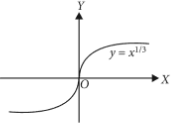
Both $f^{\prime}(x)$ and $f^{\prime \prime}(x)$ exist at all points except at $x=0$
So, $f^{\prime \prime}(0)$ does not exist.
Thus, reason is wrong.
However, we note that $f^{\prime \prime}(x)>0$ for $x<0$ and $f^{\prime \prime}(x)<0$ for $x>0$
$\Rightarrow f^{\prime \prime}(x)$ changes sign from positive to negative as we move from left to right through 0 .
So, $f$ has a point of inflexion at $x=0$. View full question & answer→MCQ 381 Mark
Assertion (A) : If $f^{\prime}(x)=(x-1)^3(x-2)^8$, then $f(x)$ has neither maximum nor minimum at $x=2$.
Reason $( R ): f^{\prime}(x)$ changes sign from negative to positive at $x=2$.
- A
Both (A) and (R) are true and (R) is the correct explanation of (A).
- B
Both (A) and (R) are true but (R) is not the correct explanation of (A).
- ✓
(A) is true but (R) is false.
- D
(A) is false but (R) is true.
AnswerCorrect option: C. (A) is true but (R) is false.
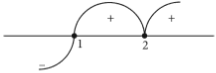
(c) : It is clear from figure that $f^{\prime}(x)$ has no sign change at $x=2$. Hence, $f(x)$ is neither maximum nor minimum at $x=2$.
View full question & answer→MCQ 391 Mark
Assertion (A): The graph $y=x^3+a x^2+b x+c$ has extremum, if $a^2<3 b$.
Reason (R): A function, $y=f(x)$ has an extremum, if $\frac{d y}{d x}>0$ or $\frac{d y}{d x}<0$ for all $x \in R$.
- ✓
Both (A) and (R) are true and (R) is the correct explanation of (A).
- B
Both (A) and (R) are true but (R) is not the correct explanation of (A).
- C
(A) is true but (R) is false.
- D
(A) is false but (R) is true.
AnswerCorrect option: A. Both (A) and (R) are true and (R) is the correct explanation of (A).
(a) : For an extremum
$
\begin{aligned}
& \frac{d y}{d x}>0 \text { or } \frac{d y}{d x}<0 \text { for all } x \in R \\
\therefore & \frac{d y}{d x}=3 x^2+2 a x+b>0 \\
\Rightarrow & 3 x^2+2 a x+b>0 \Rightarrow D<0 \\
\Rightarrow & 4 a^2-4 \cdot 3 \cdot b<0 \Rightarrow a^2<3 b
\end{aligned}
$
View full question & answer→MCQ 401 Mark
Assertion $(A) :$ Let $f: R \rightarrow R$ be a function such that $f(x)=x^3+x^2+3 x+\sin x$. Then, $f$ is an increasing function.
Reason $(R) :$ If $f^{\prime}(x) < 0$, then $f(x)$ is a decreasing function.
- A
Both $(A)$ and $(R)$ are true and $(R)$ is the correct explanation of $(A).$
- B
Both $(A)$ and $(R)$ are true but $(R)$ is not the correct explanation of $(A).$
- ✓
$(A)$ is true but $(R)$ is false.
- D
$(A)$ is false but $(R)$ is true.
AnswerCorrect option: C. $(A)$ is true but $(R)$ is false.
$ f^{\prime}(x)=3 x^2+2 x+3+\cos x$
$=3\left\{x^2+\frac{2 x}{3}+1\right\}+\cos x=3\left\{\left(x+\frac{1}{3}\right)^2-\frac{1}{9}+1\right\}+\cos x$
$=3\left(x+\frac{1}{3}\right)^2+\frac{8}{3}+\cos x > 0 \quad\left[\because 3\left(x+\frac{1}{3}\right)^2 \geq 0,-1 \leq \cos x \leq 1\right]$
$\therefore f(x)$ is an increasing function.
If $f^{\prime}(x)<0$, then $f(x)$ is a decreasing function.
View full question & answer→MCQ 411 Mark
Assertion $(A):$ If the function $f(x)=\frac{a e^x+b e^{-x}}{c e^x+d e^{-x}}$ is increasing function of $x$, then $b c > a d$.
Reason $(R):$ A function $f(x)$ is increasing if $f^{\prime}(x) > 0$ for all $x$.
- A
Both $(A)$ and $(R)$ are true and $(R)$ is the correct explanation of $(A).$
- ✓
Both $(A)$ and $(R)$ are true but $(R)$ is not the correct explanation of $(A).$
- C
$(A)$ is true but $(R)$ is false.
- D
$(A)$ is false but $(R)$ is true.
AnswerCorrect option: B. Both $(A)$ and $(R)$ are true but $(R)$ is not the correct explanation of $(A).$
$f^{\prime}(x)=\frac{2(a d-b c)}{\left(c e^x+d e^{-x}\right)^2}$and $f(x)$ is an increasing function.
$\therefore f^{\prime}(x) > 0$
$\Rightarrow \frac{2(a d-b c)}{\left(c e^x+d e^{-x}\right)^2} > 0$
$\Rightarrow 2(a d-b c) > 0$
$\Rightarrow a d > b c$
$ \Rightarrow b c < ad$
View full question & answer→MCQ 421 Mark
Assertion (A) : Both $\sin x$ and $\cos x$ are decreasing functions in $\left(\frac{\pi}{2}, \pi\right)$.
Reason (R): If a differentiable function decreases in $(a, b)$, then its derivative also decreases in $(a, b)$.
- A
Both (A) and (R) are true and (R) is the correct explanation of (A).
- B
Both (A) and (R) are true but (R) is not the correct explanation of (A).
- C
(A) is true but (R) is false.
- D
(A) is false but (R) is true.
View full question & answer→MCQ 431 Mark
Assertion $(A) :$ The absolute maximum and minimum values of $f(x)=x^2 \sqrt{1+x}$ in $\left[-1, \frac{1}{2}\right]$ are $\frac{\sqrt{6}}{8}$ and 0 respectively.
Reason$ (R) :$ Let $f$ be a differentiable function on $I$ and $x_0$ be any interior point of $I$. If $f$ attains its absolute maximum or minimum value at $x_0$, then $f^{\prime}\left(x_0\right)=0$.
- A
Both $(A)$ and $(R)$ are true and $(R)$ is the correct explanation of $(A).$
- B
Both $(A)$ and $(R)$ are true but $(R)$ is not the correct explanation of $(A).$
- ✓
$(A)$ is true but $(R)$ is false.
- D
$(A)$ is false but $(R)$ is true.
AnswerCorrect option: C. $(A)$ is true but $(R)$ is false.
Given, $f(x)=x^2 \sqrt{1+x} ....(i)$
The given function is differentiable for all $x$ in $\left[-1, \frac{1}{2}\right]$.
Differentiating $(i)$ w.r.t. $x$, we get
$f^{\prime}(x)=x^2 \cdot \frac{1}{2}(1+x)^{-1 / 2}+\sqrt{1+x} \cdot 2 x$
$=\frac{x^2}{2 \sqrt{1+x}}+2 x \sqrt{1+x}=\frac{5 x^2+4 x}{2 \sqrt{1+x}}$
Now $f^{\prime}(x)=0$
$\Rightarrow \frac{5 x^2+4 x}{2 \sqrt{1+x}}=0$
$\Rightarrow 5 x^2+4 x=0$
$\Rightarrow x(5 x+4)=0$
$\Rightarrow x=0,-\frac{4}{5}$
Also $0,-\frac{4}{5}$ both lie in $\left[-1, \frac{1}{2}\right]$,
therefore, $0$ and $-\frac{4}{5}$ both are stationary points.
Further, $f(0)=0, f\left(-\frac{4}{5}\right)=\frac{16}{25} \cdot \frac{1}{\sqrt{5}}=\frac{16}{25 \sqrt{5}}$
$f(-1)=0, f\left(\frac{1}{2}\right)=\frac{1}{4} \cdot \sqrt{\frac{3}{2}}=\frac{\sqrt{6}}{8}$
Therefore, the absolute maximum value is $\frac{\sqrt{6}}{8}$ and the absolute minimum value is $0$ .
The point of maxima is $\frac{1}{2}$ and points of minima are $\{-1,0\}$.
View full question & answer→