MCQ
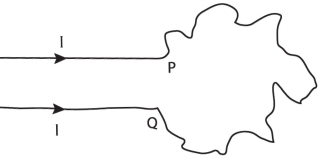
Assertion $(A):$ A wire bent into an irregular shape with the points $P$ and $Q$ fixed. If a current $I$ passed through the wire, then the area enclosed by the irregular portion of the wire increases.

Reason $(R):$ Opposite currents carrying wires repel each other.
  • If both Assertion and Reason are true and Reason is correct explanation of Assertion.
  • B
    If both Assertion and Reason are true but Reason is not the correct explanation of Assertion.
  • C
    If Assertion is true but Reason is false.
  • D
    If both Assertion and Reason are false.
Answer

Correct option: A.
If both Assertion and Reason are true and Reason is correct explanation of Assertion.
a
(a)

Need a full question paper?

Generate a complete, print-ready paper with questions like this in minutes — across 16+ boards, with answer keys.

Start Generating Free

Similar questions

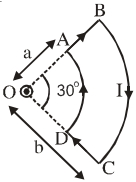
A current loop $ABCD$ is held fixed on the plane of the paper as shown in the figure. The arcs $ BC$ (radius $= b$) and $DA $ (radius $= a$) of the loop are joined by two straight wires $AB $  and $CD$. A steady current $I$ is flowing in the loop. Angle made by $AB$ and $CD$ at the origin $O$ is $30^o $. Another straight thin wire with steady current $I_1$ flowing out of the plane of the paper is kept at the origin.

Due to the presence of the current $I_1$ at the origin

A uniform metal rod of $2\, mm^2$ cross section fixed between two walls is heated from $0\,^oC$ to $20\,^oC$. The coefficient of linear expansion of rod is $12\times10^{-6}/^oC$. Its Young's modulus of elasticity is $10^{11} \,N/m^2$. The energy stored per unit volume of rod will be ....... $J/m^3$
What is/are the same for $O_2$ and $NH_3$ in gaseous state
Least doped region in a transistor
A $100\,m$ long wire having cross-sectional area $6.25 \times 10^{-4}\,m ^2$ and Young's modulus is $10^{10}\,Nm ^{-2}$ is subjected to a load of $250\,N$, then the elongation in the wire will be :
A container with $1 kg$ of water in it is kept in sunlight, which causes the water to get warmer than the surroundings. The average energy per unit time per unit area received due to the sunlight is $700 Wm ^{-2}$ and it is absorbed by the water over an effective area of $0.05 m ^2$. Assuming that the heat loss from the water to the surroundings is governed by Newton's law of cooling, the difference (in ${ }^{\circ} C$ ) in the temperature of water and the surroundings after a long time will be. . . . . . . . (Ignore effect of the container, and take constant for Newton's law of cooling $=0.001 s ^{-1}$, Heat capacity of water $\left.=4200 J kg ^{-1} K ^{-1}\right)$
Inside a uniform spherical shell

$(a)$ the gravitational field is zero

$(b)$ the gravitational potential is zero

$(c)$ the gravitational field is same everywhere

$(d)$ the gravitation potential is same everywhere

$(e)$ all of the above

Choose the most appropriate answer from the options given below

An astronomical refracting telescope has an objective of focal length $20\,m$ and an eye piece of focal length $2\,cm$, then
$25$ tunning forks are arranged in series in the order of decreasing frequency. Any two successive forks produce $3\, beats/sec.$ If the frequency of the first turning fork is the octave of the last fork, then the frequency of the $21^{st}$ fork is .... $Hz$
Assertion : A charge, whether stationary or in motion produces a magnetic field around it.

Reason : Moving charges produce only electric field in the surrounding space.