MCQ
Assertion (A): Natural numbers are closed under addition
Reason (R): A rational number is a number that is in the form of $\frac{\text{p}}{\text{q}}$ where p and q are integers, and q is not equal to 0.
  • A
    Both A and R are true and R is the correct explanation of A
  • Both A and R are true but R is not the correct explanation of A
  • C
    A is true but R is false
  • D
    A is false but R is true

Answer

Correct option: B.
Both A and R are true but R is not the correct explanation of A
B

Need a full question paper?

Generate a complete, print-ready paper with questions like this in minutes — across 16+ boards, with answer keys.

Start Generating Free

Similar questions

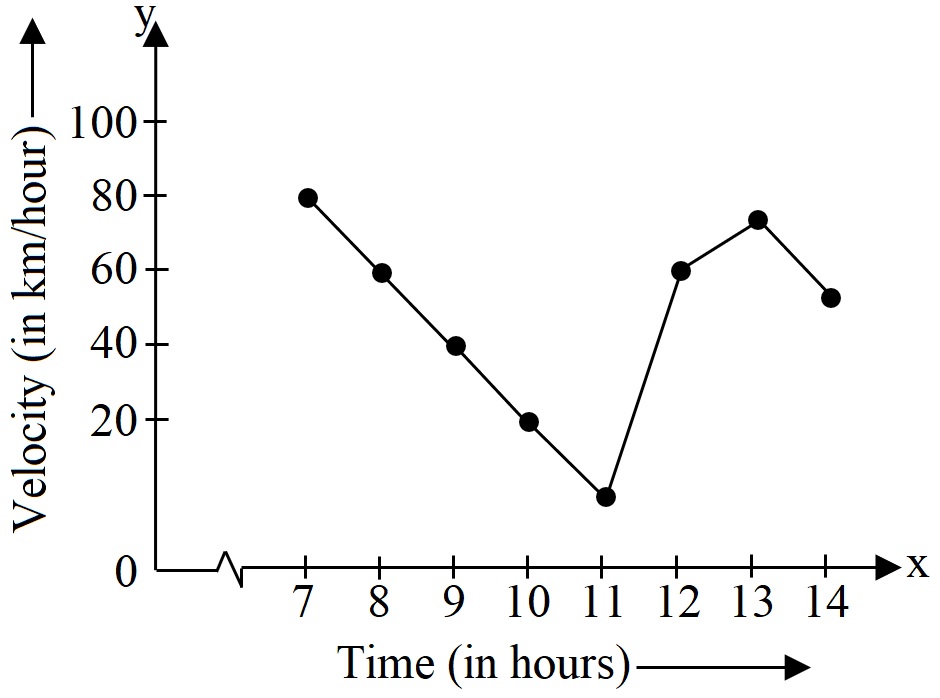
Observe the following velocity-time graph and consider it as reasons for the following assertions:

Assertion (A): 9 and 11is the velocity minimum.
Directions: In the following questions, the Assertions $(A)$ and Reason(s) $(R)$ have been put forward. Read both the statements carefully and choose the correct alternative from the following:
Assertion (A): The factorisation of $x^2+ x + xy + y + zx + z$ is $(x + y + z) (x + y)$
Reasons (R): The factorisation is defined as expressing or decomposing a number or an algebraic expression as a product of its prime factors or irreducible factors.
Directions: In the following questions, the Assertions $(A)$ and Reason$(s)$ $(R)$ have been put forward. Read both the statements carefully and choose the correct alternative from the following:
Assertion (A): The like terms are $ab, -5b$
Reasons (R): like terms are terms that have the same variables and powers
Assertion (A): Rational numbers are not closed under multiplication
Reason (R): A rational number is a number that is in the form of $\frac{\text{p}}{\text{q}}$ where p and q are integers, and q is not equal to 0.
Assertion (A): Natural numbers are associative for division
Reason (R): The associative property states that the sum or the product of three or more numbers does not change if they are grouped in a different way.
Assertion (A): The number of zeros in the square of the number 50 is 3
Reasons (R): The number of zeros at the end of the number obtained, by multiplying the number from 1 to 100 will be.
Directions: In the following questions, the Assertions $(A)$ and Reason$(s) (R)$ have been put forward. Read both the statements carefully and choose the correct alternative from the following:
Assertion $(A)$: The unit digit number $132$ is in the square of the $4$.
Reasons $(R)$: Units digit of a number is the digit in the one’s place of the number. i.e. it is the rightmost digit of the number.
Assertion (A): Integers are associative for division
Reason (R): The associative property states that the sum or the product of three or more numbers does not change if they are grouped in a different way.
Assertion (A): For positive values of a rational number $n, n^2>n$ only if $n>1$.
Reason (R): For $0<n<1$, we have $n^2<n$.