MCQ
Assertion : A paramagnetic sample display greater magnetisation (for the same magnetic field) when cooled.

Reason : The magnetisation does not depend on temperature.

  • A
    If both Assertion and Reason are correct and the Reason is a correct explanation of the Assertion.
  • B
    If both Assertion and Reason are correct but Reason is not a correct explanation of the Assertion.
  • C
    If the Assertion is correct but Reason is incorrect.
  • If both the Assertion and Reason are incorrect.
Answer

Correct option: D.
If both the Assertion and Reason are incorrect.
d
A paramagnetic sample display greater magnetisation when cooled, this is because at lower temperature, the tendency to disrupt the alignment of dipoles (due to magnetising field) decreases on account of reduced random thermal motion.

Need a full question paper?

Generate a complete, print-ready paper with questions like this in minutes — across 16+ boards, with answer keys.

Start Generating Free

Similar questions

White light is split into a spectrum by a prism and it is seen on a screen. If we put another identical inverted prism behind it in contact, what will be seen on the screen?
If an electron oscillates at a frequency of $ 1 GHz$  it gives
A cylinder with fixed capacity of $67.2\, lit$ contains helium gas at $STP$. The amount of heat needed to raise the temperature of the gas by $20\,^oC$ is ..... $J$ [Given that $R = 8.31\, J\, mol^{-1}\, K^{-1}$]
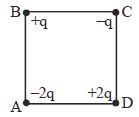
Four charges are arranged at the corners of a square $ABCD$, as shown. The force on a $+ve$ charge kept at the centre of the square is
With the decrease of current in the primary coil from $2\,amperes$ to zero value in $0.01\,s$ the $emf$ generated in the secondary coil is $1000\,volts$. The mutual inductance of the two coils is......$H$
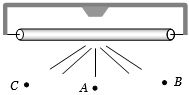
Figure shows a glowing mercury tube. The illuminances at point $A, B$ and $C$ are related as
Young's modulus is determined by the equation given by $\mathrm{Y}=49000 \frac{\mathrm{m}}{\ell} \frac{\text { dyne }}{\mathrm{cm}^2}$ where $\mathrm{M}$ is the mass and $\ell$ is the extension of wre used in the experiment. Now error in Young modules $(\mathrm{Y})$ is estimated by taking data from $M-\ell$ plot in graph paper. The smallest scale divisions are $5 \mathrm{~g}$ and $0.02$ $\mathrm{cm}$ along load axis and extension axis respectively. If the value of $M$ and $\ell$ are $500 \mathrm{~g}$ and $2 \mathrm{~cm}$ respectively then percentage error of $\mathrm{Y}$ is :
A particle in $S.H.M.$ is described by the displacement function $x(t) = a\cos (\omega t + \theta )$. If the initial $(t = 0)$ position of the particle is $1\, cm  $ and its initial velocity is $\pi \,cm/s$. The angular frequency of the particle is $\pi \,rad/s$, then it’s amplitude is
The Davisson-Germer experiment that first demonstrated the wave nature of matter used electron accelerated to $54\  V$. Determine the wavelength of the electrons in the Davisson- Germer experiment .................. $\mathop {\rm{A}}\limits^o $
At time $t=0$ is particle starts moving along the $x-$axis. If its kinetic energy increases uniformly with time $t$, the net force acting on it must be proportional to