MCQ
Assertion : A red object appears dark in the yellow light.

Reason : The red colour is scattered less.

  • A
    If both Assertion and Reason are correct and the Reason is a correct explanation of the Assertion.
  • If both Assertion and Reason are correct but Reason is not a correct explanation of the Assertion.
  • C
    If the Assertion is correct but Reason is incorrect.
  • D
    If both the Assertion and Reason are incorrect.

Answer

Correct option: B.
If both Assertion and Reason are correct but Reason is not a correct explanation of the Assertion.
b
A red object appears dark in the yellow light because red object absorbs all the light falling on it except red. The Reason which is a fact can not be assigned to the Assertion.

Need a full question paper?

Generate a complete, print-ready paper with questions like this in minutes — across 16+ boards, with answer keys.

Start Generating Free

Similar questions

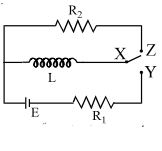
In the circuit shown, $X$ is joined to $Y$ for a long time, and then $X$ is joined to $Z$. The total heat produced in $R_2$ is :=
In case of a Van de Graaff generator, the breakdown field of air is:
The electric potential at the centre of a charged solid sphere of metal is:
A light wave has a frequency of $4 \times 10^{14}$ Hz and a wavelength of $5 \times 10^{-7}$ meters in a medium. The refractive index of the medium is
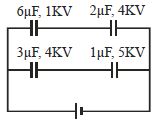
Find breakdown voltage of combination....$KV$
A transformer connected to $220 \,volt$ line shows an output of $2 \,A$ at $11000 \,volt$. The efficiency is $100/%$. The current drawn from the line is......$A$
A steady eletric current is flowing through a cylindrical wire

$(a)$ the electric field at the axis of wire is zero
$(b)$ the magnetic field at the axis of wire is zero
$(c)$ the electric field in the vicinity of wire is Zero.
$(d)$ the magnetic field in the vicinity of wire is Zero

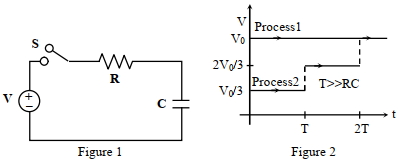
Consider a simple $RC$ circuit as shown in Figure $1$.

Process $1$: In the circuit the switch $S$ is closed at $t=0$ and the capacitor is fully charged to voltage $V_0$ (i.e. charging continues for time $T \gg R C$ ). In the process some dissipation ( $E_D$ ) occurs across the resistance $R$. The amount of energy finally stored in the fully charged capacitor is $EC$.

Process $2$: In a different process the voltage is first set to $\frac{V_0}{3}$ and maintained for a charging time $T \gg R C$. Then the voltage is raised to $\frac{2 \mathrm{~V}_0}{3}$ without discharging the capacitor and again maintained for time $\mathrm{T} \gg \mathrm{RC}$. The process is repeated one more time by raising the voltage to $V_0$ and the capacitor is charged to the same final

take $\mathrm{V}_0$ as voltage

These two processes are depicted in Figure $2$.

 ($1$) In Process $1$, the energy stored in the capacitor $E_C$ and heat dissipated across resistance $E_D$ are released by:

$[A]$ $E_C=E_D$ $[B]$ $E_C=E_D \ln 2$ $[C]$ $\mathrm{E}_{\mathrm{C}}=\frac{1}{2} \mathrm{E}_{\mathrm{D}}$ $[D]$ $E_C=2 E_D$

 ($2$) In Process $2$, total energy dissipated across the resistance $E_D$ is:

$[A]$ $\mathrm{E}_{\mathrm{D}}=\frac{1}{2} \mathrm{CV}_0^2$     $[B]$ $\mathrm{E}_{\mathrm{D}}=3\left(\frac{1}{2} \mathrm{CV}_0^2\right)$    $[C]$ $\mathrm{E}_{\mathrm{D}}=\frac{1}{3}\left(\frac{1}{2} \mathrm{CV}_0^2\right)$   $[D]$ $\mathrm{E}_{\mathrm{D}}=3 \mathrm{CV}_0^2$

Given the answer quetion  ($1$) and  ($2$)
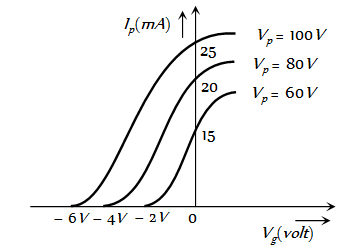
The variation of anode current in a triode corresponding to a change in grid potential at three different values of the plate potential is shown in the diagram. The mutual conductance of the triode is
Experimentally it is found that $12.8\,eV$ energy is required to separate a hydrogen atom into a proton and an electron. So the orbital radius of the electron in a hydrogen atom is $\frac{9}{ x } \times 10^{-10}\,m$. The value of the $x$ is $\left(1\,eV =1.6 \times 10^{-19}\,J , \frac{1}{4 \pi \in_0}=9 \times 10^9\,Nm ^2 / C ^2\right.$ and electronic charge $=1.6 \times 10^{-19}\,J\,C$ )