MCQ
A steady eletric current is flowing through a cylindrical wire

$(a)$ the electric field at the axis of wire is zero
$(b)$ the magnetic field at the axis of wire is zero
$(c)$ the electric field in the vicinity of wire is Zero.
$(d)$ the magnetic field in the vicinity of wire is Zero

  • A
    $a,b,c$
  • $b,c$
  • C
    only $c$
  • D
    only $b$

Answer

Correct option: B.
$b,c$
b
If a wire carry steady current then electric field will exist inside the wire but electric field outside the wire as zero.

Need a full question paper?

Generate a complete, print-ready paper with questions like this in minutes — across 16+ boards, with answer keys.

Start Generating Free

Similar questions

If a dielectric substance is introduced between the plates of a charged air-gap capacitor. The energy of the capacitor will
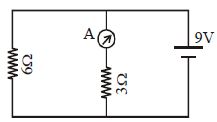
In the figure shown, if the internal resistance of the battery is $1\, ohm$ , the reading of the ammeter will be ................. $\mathrm{A}$
Which of the following planets have rings around it
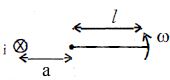
A rod of length $l$ is rotating in the plane of paper with an angular speed $\omega$ about one of its ends which is at a disatnace a from an infinetly long conducting wire carrying current $i$ inwards the plane of paper find induced $emf$ in the rod at the instant as shown in figure 
A $160 \,W$ light source is radiating light of wavelength $6200 \,\mathring A$ uniformly in all directions. The photon flux at a distance of $1.8 \,m$ is of the order of .......... $m ^{-2} s ^{-1}$ (Planck's constant $\left.=6.63 \times 10^{-34} \,J - s \right)$
The wavefront of a distant source of unknown shape is approximately
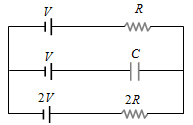
In the given circuit, with steady current, the potential drop across the capacitor must be
A particle of mass M and charge Q moving with velocity $\vec{v}$ describes a circular path of radius R when subjected to a uniform transverse magnetic field of induction B. The work done by the field when the particle completes one full circle is
If the magnetic field of a plane electromagnetic wave is given by (The speed of light $ = 3 \times {10^8}\,m/s$ )

$B = 100 \times {10^{ - 6}}\,\sin \,\left[ {2\pi  \times 2 \times {{10}^{15}}\,\left( {t - \frac{x}{c}} \right)} \right]$ 

then the maximum electric field associated with it is

The resultant of $\overrightarrow{\text{A}}$ and $\overrightarrow{\text{B}}$ makes an angle a with $\overrightarrow{\text{A}}$ and $\beta$ with $\overrightarrow{\text{B}},$