MCQ
Assertion (A): Sulphur present in an organic compound can be estimated quantitatively by Carius method.
Reason (R): Sulphur can be separated easily from other atoms in the molecule, by lassiagn's test, but the yellow precipitate cannot be obtained.
  • A
    A is correct and R is not correct.
  • B
    Both A and R are correct and R is the correct explanation of A.
  • C
    Both A and R are correct but R is not the correct explanation of A.
  • A is not correct but R is correct.

Answer

Correct option: D.
A is not correct but R is correct.
(d) A is not correct but R is correct.
Explanation: We know that the Carius method is used to estimate the halogen quantity, hence assertion is found to be wrong. Now reason, Sulphur can be separated easily from other atoms in the molecule, by lassiagn's test, but the yellow precipitate cannot be obtained.

Need a full question paper?

Generate a complete, print-ready paper with questions like this in minutes — across 16+ boards, with answer keys.

Start Generating Free

Similar questions

Assertion (A): The nuclear isomers are the atoms with the same atomic number and same mass number, but with different radioactive properties.
Reason (R): The nucleus in the excited state will evidently have a different half-life as compared to that in the ground state.
Assertion (A): Overlapping in benzene is $sp ^2- sp ^2$ type.
Reason (R): C-C bond length in benzene is $1.3 \stackrel{\circ}{A}$.
Assertion $(A)$ : Some metals like platinum and palladium, can be used as storage media for hydrogen.
Reason $(R)$ : Platinum and palladium can absorb large volumes of hydrogen.
Assertion (A): Energy of radiation is large if its wavelength is large.
Reason (R): Energy $= h \nu\left(\nu=\right.$ frequency, $\left.\nu=\frac{c}{\lambda}\right)$
Note : In the following questions a statement of Assertion $(A)$ followed by a statement of Reason $(R)$ is given. Choose the correct option out of the choices given below each question.
Assertion $(A)$ : Black body is an ideal body that emits and absorbs radiations of all frequencies.
Reason $(R)$ : The frequency of radiation emitted by a body goes from a lower frequency to higher frequency with an increase in temperature.
In the following questions a statement of assertion $(A)$ followed by a statement of reason $(R)$ is given. Choose the correct option out of the choices given below each question.
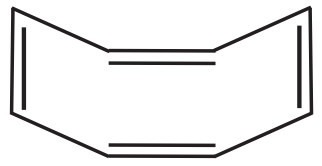
Assertion $(A)$ : The compound cyclooctane has the following structural formula:

It is cyclic and has conjugated $8\pi-$ electron system but it is not an aromatic compound.
Reason $(R) : (4n + 2) \pi-$ electrons rule does not hold good and ring is not planar.
Assertion $(A)$ : At critical temperature liquid passes into gaseous state imperceptibly and continuously.
Reason $(R)$ : The density of liquid and gaseous phase is equal to critical temperature.
Assertion (A): Hydrogen atom has only one electron in its orbit. But it produces several spectral lines.
Reason (R): There are many excited energy levels available.
Select the members of group 14 that:
  1. Forms the most acidic dioxide.
  2. Is commonly found in +2 oxidation state.
  3. Used as semiconductor,.
  4. Exhibit highest catenation tendency.
Assertion (A): Splitting of the spectral lines in the presence of a magnetic field is known as the Stark effect.
Reason (R): The line spectrum is simplest for the hydrogen atoms.