MCQ
Assertion : A transistor is a voltage-operating device.
Reason : Base current is greater than the collector current.
  • A
    If both assertion and reason are true and the reason is the correct explanation of the assertion.
  • B
    If both assertion and reason are true but reason is not the correct explanation of the assertion.
  • C
     If assertion is true but reason is false.
  •  If the assertion and reason both are false.

Answer

Correct option: D.
 If the assertion and reason both are false.
If the assertion and reason both are false.

Need a full question paper?

Generate a complete, print-ready paper with questions like this in minutes — across 16+ boards, with answer keys.

Start Generating Free

Similar questions

Which of the energy band diagrams shown in the figure corresponds to that of a semiconductor
The light when enters the human eye experiences most of the refraction while passing through
In a mixture of $\mathrm{H}-\mathrm{He}^{+}$gas ( $\mathrm{He}^{+}$is singly ionized $\mathrm{He}$ atom), $\mathrm{H}$ atoms and $\mathrm{He}^{+}$ions are excited to their respective first excited states. Subsequently, $\mathrm{H}$ atoms transfer their total excitation energy to $\mathrm{He}^{+}$ions (by collisions). Assume that the Bohr model of atom is exactly valid.

$1.$ The quantum number $\mathrm{n}$ of the state finally populated in $\mathrm{He}^{+}$ions is

$(A)$ $2$ $(B)$ $3$ $(C)$ $4$ $(D)$ $5$

$2.$ The wavelength of light emitted in the visible region by $\mathrm{He}^{+}$ions after collisions with $\mathrm{H}$ atoms is

$(A)$ $6.5 \times 10^{-7} \mathrm{~m}$ $(B)$ $5.6 \times 10^{-7} \mathrm{~m}$

$(C)$ $4.8 \times 10^{-7} \mathrm{~m}$ $(D)$ $4.0 \times 10^{-7} \mathrm{~m}$

$3.$ The ratio of the kinetic energy of the $\mathrm{n}=2$ electron for the $\mathrm{H}$ atom to that of $\mathrm{He}^{+}$ion is

$(A)$ $\frac{1}{4}$ $(B)$ $\frac{1}{2}$ $(C)$ $1$ $(D)$ $2$

Give the answer question $1,2$ and $3.$
Which reaction is not part of proton-proton cycle
A proton and a deutron both having the same kinetic energy, enter perpendicularly into a uniform magnetic field $B$. For motion of proton and deutron on circular path of radius ${R_p}$ and ${R_d}$ respectively, the correct statement is
If a charged particle moves unaccelerated in a region containing electric and magnetic fields,
A parallel plate capacitor is charged to a potential difference of $50\, V$. It is discharged through a resistance. After $1$ second, the potential difference between plates becomes $40 \,V$. Then
Sun radiates continuously and maintains its brightness because
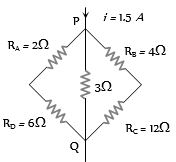
Potential difference between the points $P$ and $Q$ in the electric circuit shown is ................. $V$
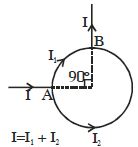
A current $I$ enters a circular coil of radius $R$, branches into two parts and then recombines as shown in the circuit diagram. The resultant magnetic field at the centre of the coil is