MCQ
Assertion: $AgCl$ dissolves in $NH_4OH$ solution.

Reason: Due to formation of a complex

  • If both Assertion and Reason are correct and the Reason is a correct explanation of the Assertion.
  • B
    If both Assertion and Reason are correct but Reason is not a correct explanation of the Assertion.
  • C
    If the Assertion is correct but Reason is incorrect.
  • D
    If both the Assertion and Reason are incorrect.
Answer

Correct option: A.
If both Assertion and Reason are correct and the Reason is a correct explanation of the Assertion.
a
$AgCl$ dissolves in $NH_4OH$ due to formation of complex.

$AgCl + 2NH_4OH \to [Ag(NH_3 )_2 ]Cl + 2H_2O$

Need a full question paper?

Generate a complete, print-ready paper with questions like this in minutes — across 16+ boards, with answer keys.

Start Generating Free

Similar questions

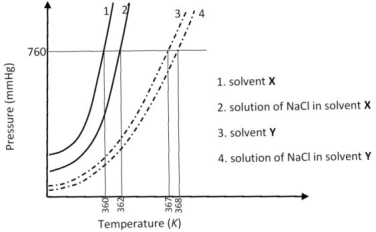
The plot given below shows $P - T$ curves (where $P$ is the pressure and $T$ is the temperature) for two solvents $X$ and $Y$ and isomolal solutions of $NaCl$ in these solvents. $NaCl$ completely dissociates in both the solvents.

On addition of equal number of moles of a non-volatile solute $S$ in equal amount (in $kg$ ) of these solvents, the elevation of boiling point of solvent $X$ is three times that of solvent $Y$. Solute $S$ is known to undergo dimerization in these solvents. If the degree of dimerization is $0.7$ in solvent $Y$, the degree of dimerization in solvent $X$ is. . . . . . .

For the compounds:
(A) $H _3 C - CH _2- O - CH _2- CH _2- CH _3$
(B) $H _3 C - CH _2- CH _2- CH _2- CH _3$

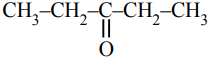
(C)Image
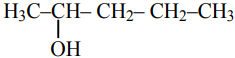
(D)Image

The increasing order of boiling point is :
When vapours of an alcohol are passed over hot reduced copper, alcohol is converted into alkene quickly, the alcohol is
Assertion : Carboxypeptidase is an exopeptidase.
Reason : It cleaves the $N-$ terminal bond
$5\,g$ of $NaOH$ was dissolved in deionized water to prepare a $450\,mL$ stock solution. What volume (in $mL$ ) of this solution would be required to prepare $500\,mL$ of $0.1\,M$ solution?

Given : Molar Mass of $Na$, $O$ and $H$ is $23,16$ and $1\,g\,mol ^{-1}$ respectively

Quantitative measurement of nitrogen in an organic compounds is done by the method
Which of the following has largest bond angle ?
Which compound is optically active
The energies of activation for forward and reverse reactions for ${A_2} + {B_2} \rightleftharpoons 2AB$ are $180\, kJ\, mol^{-1}$ and $200\, kJ\, mol^{-1}$ respectively. The presence of a catalyst lowers the activation energy of both (forward and reverse) reactions by $100\, kJ\, mol^{-1}$. The enthalpy change of the reaction $(A_2 + B_2 \to  2AB)$ in the presence of catalyst will be (in $kJ\, mol^{-1}$)
Electrolysis rules of Faraday’s states that mass deposited on electrode is proportional to