MCQ
Assertion and Reason Type $\text{MCQ}$
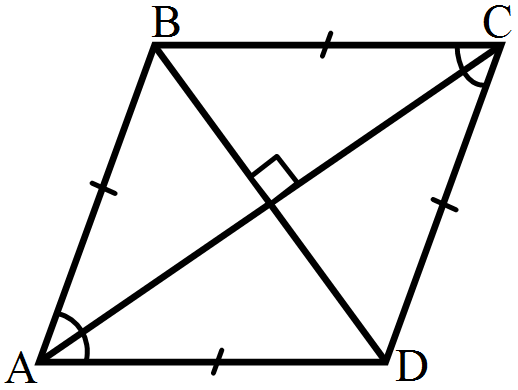
Assertion: In a rhombus $\text{ABCD,}$ the diagonal $\text{AC}$ bisects $\angle\text{A}$ as well as $\angle\text{C}.$
Reason: The diagonals of a rhombus bisect each other at right angles.
  • A
    Both Assertion $(A)$ and Reason $(R)$ are true and Reason is a correct explanation of Assertion $(A)$.
  • Both Assertion $(A)$ and Reason $(R)$ are true but Reason is not a correct explanation of Assertio $(A)$.
  • C
    Assertion $(A)$ is true and Reason $(R)$ is false.
  • D
    Assertion $(A)$ is false and Reason $(R)$ is true.
Answer

Correct option: B.
Both Assertion $(A)$ and Reason $(R)$ are true but Reason is not a correct explanation of Assertio $(A)$.

In a rhombus $\text{ABCD,}$ the diagonal $\text{AC}$ bisects $\angle\text{A}$ as well as $\angle\text{C}.$
So, the Assertion $(A)$ is true.
The diagonal of a rhombus bisect each other at right angles.
So, the Reason $(R)$ is true, and is not the correct explanation for the Assertion $(A).$

Need a full question paper?

Generate a complete, print-ready paper with questions like this in minutes — across 16+ boards, with answer keys.

Start Generating Free

Similar questions

Directions: In the following questions, the Assertions $(A)$ and Reason(s) $(R)$ have been put forward. Read both the statements carefully and choose the correct alternative from the following:
Assertion: The sides of a triangle are in the ratio of $25 : 14 : 12$ and its perimeter is $510\ cm.$ Then the area of the triangle is $4449.08\ cm^2.$
Reason: Perimeter of a triangle $= a + b + c,$ where $a, b, c $ are sides of $a$ triangle.
Directions: In the following questions, the Assertions $(A)$ and Reason(s) $(R)$ have been put forward. Read both the statements carefully and choose the correct alternative from the following:
Assertion: Mode of given data $110, 120, 130, 120, 110, 140, 130, 120, 140, 120$ is $120.$
Reason: The observation with maximum frequency is called mode.
Directions: In the following questions, the Assertions $(A)$ and Reason(s) $(R)$ have been put forward. Read both the statements carefully and choose the correct alternative from the following:
Assertion: In the given figure, if $\text{AB}\parallel\text{CD}$ and $\angle\text{F}=30^\circ,$ then $\angle\text{FCD}$ is $120^\circ$.
Reason: If two parallel lines are intersected by a transversal, then co - interior angles are equal.
Statement-1 (A): The angles subtended by a chord at any two points of a circle are equal.
Statement-2 (R): Angles in the same segment of a circle are equal.
Directions: In the following questions, the Assertions $(A)$ and Reason(s) $(R)$ have been put forward. Read both the statements carefully and choose the correct alternative from the following:
Assertion: The slant height of the frustum of a cone is $5\ cm$ and the difference between the radii of its two circular ends is $4\ cm$ than the height of the frustum is $3\ cm.$
Reason: Slant height of frustum of cone is given by $\text{I}=\sqrt{(\text{R}-\text{r})}^2+\text{h}^2$
Statement-1 (A): Everything equal to itself.
Statement-2 (R): Things which coincide with one another are equal to one another.
Directions: In the following questions, the Assertions $(A)$ and Reason(s) $(R)$ have been put forward. Read both the statements carefully and choose the correct alternative from the following:
Assertion: The area of a triangle is $6 \mathrm{~cm}^2$ whose sides are $3 \mathrm{~cm}, 4 \mathrm{~cm}$ and $5 \mathrm{~cm}$ respectively.
Reason: Area of triangle $= \sqrt{\text{s}(\text{s}-\text{a})(\text{s}-\text{b})(\text{s}-\text{c})}.$
Statement-1 (A): The graph of the linear equation $y=4$ is a line parallel to $x$-axis at a distance of 4 units above it.
Statement-2 (R): The line parallel to $x$-axis at a distance a units above the $x$-axis is given by the equation $y=-a$.
Directions: In the following questions, the Assertions $(A)$ and Reason(s) $(R)$ have been put forward. Read both the statements carefully and choose the correct alternative from the following:
Assertion: The consecutive sides of a quadrilateral have one common point..
Reason: The opposite sides of a quadrilateral have two common point.
Assertion and Reason Type $\text{MCQ}$
Assertion: $\text{BCD}$ is a quadrilateral in which $\text{P, Q, R}$ and $S$ are the mid$-$points of $\text{AB, BC, CD}$ and $\text{DA}$ respectively. Then, $\text{PQRS}$ is a parallelogram.
Reason: The line segment joining the mid$-$points of any two sides of a triangle is parallel to the third side and equal to half of it.