MCQ
Assertion : Binding energy (or mass defect) of hydrogen nucleus is zero.

Reason : Hydrogen nucleus contain only one nucleon.

  • If both Assertion and Reason are correct and the Reason is a correct explanation of the Assertion.
  • B
    If both Assertion and Reason are correct but Reason is not a correct explanation of the Assertion.
  • C
    If the Assertion is correct but Reason is incorrect.
  • D
    If both the Assertion and Reason are incorrect.
Answer

Correct option: A.
If both Assertion and Reason are correct and the Reason is a correct explanation of the Assertion.
a
The nucleus of hydrogen atom contains only one proton, and an orbital electron. There cannot be any nuclear binding energy in a hydrogen atom. Because nuclear binding can only arise when the nucleus contain at least two nucleons. Hydrogen atom contains only one nucleon.

Need a full question paper?

Generate a complete, print-ready paper with questions like this in minutes — across 16+ boards, with answer keys.

Start Generating Free

Similar questions

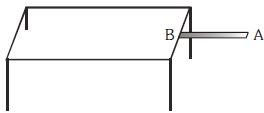
A thin uniform stick of length $l$ and mass $m$ is held horizontally with its end $B$ hinged on the edge of a table. Point $A$ is suddenly released. The acceleration of the centre of mass of the stick at the time of release, is
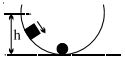
$A$ block of mass $m$ starts from rest and slides down $a$ frictionless semi-circular track from $a$ height $h$ as shown. When it reaches the lowest point of the track, it collides with a stationary piece of putty also having mass $m$. If the block and the putty stick together and continue to slide, the maximum height that the block-putty system could reach is:
When a slow neutron goes sufficiently close to a ${U^{235}}$ nucleus, then the process that takes place is
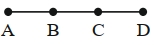
An object moves with speed $v_1, v_2$, and $v_3$ along a line segment $A B, B C$ and $C D$ respectively as shown in figure. Where $AB = BC$ and $AD =3 AB$, then average speed of the object will be :
Indicator diagram is a ...........
A curved in a level road has a radius $75\, m$. The maximum speed of a car turning this curved road can be $30 \,m / s$ without skidding. If radius of curved road is changed to $48\, m$ and the coefficient of friction between the tyres and the road remains same, then maximum allowed speed would be .........$m / s$.
Assertion : Faraday's laws are consequence of conservation of energy.

Reason : In a purely resistive ac circuit, the current legs behind the $emf$ in phase.

A small current element of length $d \ell$ and carrying current is placed at $(1,1,0)$ and is carrying current in ' $+ z$ ' direction. If magnetic field at origin be $\overrightarrow{ B }_1$ and at point $(2,2,0)$ be $\overrightarrow{ B }_2$ then
In a double slit experiment, at a certain point on the screen the path difference between the two interfering waves is $\frac{1}{8} ^{th}$ of a wavelength. The ratio of the intensity of light at that point to that at the centre of a bright fringe is
Two polarisers $P_1$ and $P_2$ are placed in such a way that the intensity of the transmitted light will be zero. A third polariser $P_3$ is inserted in between $P_1$ and $P_2$, at the particular angle between $P_2$ and $P_3$. The transmitted intensity of the light passing the through all three polarisers is maximum. The angle between the polarisers $P _2$ and $P _3$ is :