MCQ
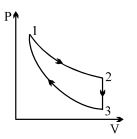
Indicator diagram is a ...........
  • A
    $P-T$ curve
  • $P-V$ curve
  • C
    $V-T$ curve
  • D
    $Q-T$ curve

Answer

Correct option: B.
$P-V$ curve
b
(b)

A graph that indicates changes in pressure with respect to volume within the cylinder of a reciprocating engine is known as an indicator diagram. Only one option shows a graph between pressure and volume.

Need a full question paper?

Generate a complete, print-ready paper with questions like this in minutes — across 16+ boards, with answer keys.
Start Generating Free

Similar questions

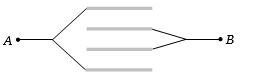
Four plates of equal area $A$ are separated by equal distances $d$ and are arranged as shown in the figure. The equivalent capacity is
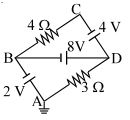
The figure shows a network of resistances in which the point $A$ is earthed. The current through the $3\,\Omega$ resistor is
Huygen's conception of secondary waves
Three processes form a thermodynamic cycle as shown on $P-V$ diagram for an ideal gas. Process $1 \rightarrow 2$ takes place at constant temperature $(300K$). Process $2 \rightarrow 3$ takes place at constant volume. During this process $40J$ of heat leaves the system. Process $3 \rightarrow 1$ is adiabatic and temperature $T_3$ is $275K$. Work done by the gas during the process $3 \rightarrow 1$ is ..... $J$
The effective resistance of two resistors in parallel is $\frac{{12}}{7}\,\Omega $. If one of the resistors is disconnected the resistance becomes $4$ $\Omega$. The resistance of the other resistor is.............. $\Omega$
Electron moves at right angles to a magnetic field of $1.5 \times 10^{-2}\,tesla$ with speed of $6 \times 10^7\,m/s$. If the specific charge of the electron is $1.7 \times 10^{11}\,C/kg$. The radius of circular path will be......$cm$
An ideal gas of Molar mass $M$ is contained in a vertical tube of height $H$, closed at both ends. The tube is accelerating vertically upwards with acceleration $g$ Then, the ratio of pressure at the bottom and the mid point of the tube will be
The physical quantity that has no dimensions
If a star is moving towards the earth, then the lines are shifted towards
A spherical shell has mass one fourth of mass of a solid sphere and both have same $M.I.$  about their respective diameters. The ratio of their radii will be :-