Question
Assertion  : Bohr had to postulate that the electrons in stationary orbits around the nucleus do not radiate.
Reason      : According to classical physics all moving electrons radiate. (a) If both assertion and reason are true and the reason is the correct explanation of the assertion.(b) If both assertion and reason are true but reason is not the correct explanation of the assertion.(c) If assertion is true but reason is false.(d) If the assertion and reason both are false.


Answer

(b) If both assertion and reason are true but reason is not the correct explanation of the assertion.

Need a full question paper?

Generate a complete, print-ready paper with questions like this in minutes — across 16+ boards, with answer keys.

Start Generating Free

Similar questions

The distance travelled by light in glass (refractive index =1.5)  in a nanosecond will be(a) 45 cm (b) 40 cm(c) 30 cm (d) 20 cm
       
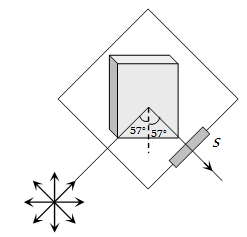
Figure represents a glass plate placed vertically on a horizontal table with a beam of unpolarised light falling on its surface at the polarising angle of $57^{\circ}$ with the normal. The electric vector in the reflected light on screen $S$ will vibrate with respect to the plane of incidence in $a$
The unit of the ratio of magnetic field B and electric field E i.e., $(B/E)$ is :
The kinetic energy of electron and proton is $10^{-32} \mathrm{~J}.$ Then the relation between their de$-$Broglie wavelengths is
An ammeter of 5 ohm resistance can read 5 mA. If it is to be used to read 100 volts, how much resistance is to be connected in series(a) 19.9995 Ω(b) 199.995 Ω(c) 1999.95 Ω(d) 19995 Ω
       
The refractive indices of water and glass with respect to air are 1.2 and 1.5 respectively. The refractive index of glass with respect to water is(a) 0.6     (b) 0.8(c) 1.25   (d) 1.75
       
A $700\ pF$ capacitor is charged by a $50 V$ battery. The electrostatic energy stored by it is
Which of the following is used to investigate the structure of solids?
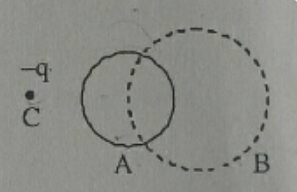
In the figure shown here, A is a conducting sphere and B is a closed spherical surface. If a-q change is placed at C near A, then the electric flux through the closed surface is -
When a proton is accelerated through 1V, then its kinetic energy will be (a) 1840 eV(b) 13.6 eV(c) 1 eV   (d) 0.54 eV