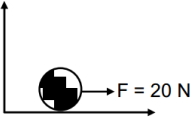
MCQ
$Assertion$ : Centripetal and centrifugal forces cancel each other.
$Reason$ : Centrifugal force is a reaction of centripetal force
  • A
    If both Assertion and Reason are correct and the Reason is a correct explanation of the Assertion.
  • B
    If both Assertion and Reason are correct but Reason is not a correct explanation of the Assertion.
  • C
    If the Assertion is correct but Reason is incorrect.
  • If both the Assertion and Reason are incorrect.
Answer

Correct option: D.
If both the Assertion and Reason are incorrect.
d

Need a full question paper?

Generate a complete, print-ready paper with questions like this in minutes — across 16+ boards, with answer keys.

Start Generating Free

Similar questions

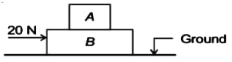
Blocks shown in figure moves with constant velocity $10 \,m / s$ towards right. All surfaces in contact are rough. The friction force applied by $B$ on $A$ is ...........$N$
Due to addition of impurities, the modulus of elasticity
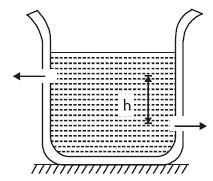
There are two identical small holes of area of cross-section a on the opposite sides of a  tank containing a liquid of density $\rho$. The difference in height between the holes is $h$. Tank  is resting on a smooth horizontal surface. Horizontal force which will have to be  applied on the tank to keep it in equilibrium is
Starting from rest a body slides down a $45^o$ inclined plane in twice the time it takes to slide down the same distance in the absence of friction. The co-efficient of friction between the body and the inclined plane is 
Consider the following statements for air molecules in an air tight container :

$(I)$ The average speed of molecules is larger than root mean square speed.

$(II)$ Mean free path of molecules is larger than the mean distance between molecules.

$(III)$ Mean free path of molecules increases with temperature.

$(IV)$ The rms speed of nitrogen is smaller than oxygen molecule.

Which of the above statements are correct?

Which of the following quantities is zero on an average for the molecules of an ideal gas in equilibrium?
A metal ball falls from a height of $32$ metre on a steel plate. If the coefficient of restitution is $0.5$, to what height will the ball rise after second bounce ............ $m$
The total energy of water molecule is given by:
Two engines pass each other moving in opposite directions with uniform speed of $30\,m/s$ . One of them is blowing a whistle of frequency $540\,Hz.$ Calculate the frequency heard by driver of second engine before they pass each other  ... $Hz$. Speed of sound is $330\,m/sec$
Find ratio of acceleration and angular acceleration of com ? If for the below diagram $m =2 \,kg$ and $r =10\, cm$