MCQ
Assertion : De-morgan's theorem $\overline{A+B}=\bar{A} \cdot \bar{B}$ may be explained by the following circuit
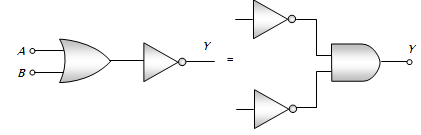
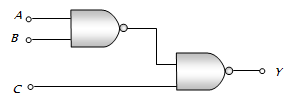
Reason : In the following circuit, for output inputs ABC are 101
  • A
    If both assertion and reason are true and the reason is the correct explanation of the assertion.
  • B
     If both assertion and reason are true but reason is not the correct explanation of the assertion.
  •  If assertion is true but reason is false.
  • D
     If the assertion and reason both are false.
Answer

Correct option: C.
 If assertion is true but reason is false.
 If assertion is true but reason is false.

Need a full question paper?

Generate a complete, print-ready paper with questions like this in minutes — across 16+ boards, with answer keys.

Start Generating Free

Similar questions

In the ideal double-slit experiment, when a glass-plate (refractive index $1.5$) of thickness t is introduced in the path of one of the interfering beams (wavelength $\lambda$), the intensity at the position where the central maximum occurred previously remains unchanged. The minimum thickness of the glass-plate is
When the current through a solenoid increases at a constant rate, the induced current
A 40 mF capacitor in a defibrillator is charged to 3000 V. The energy stored in the capacitor is sent through the patient during a pulse of duration 2ms. The power delivered to the patient is
Energy is stored in a capacitor in the form of:
A mathematical representation of electromagnetic wave is given by the two equations $E = E_{max}\,\, cos (kx -\omega\,t)$ and $B = B_{max} cos\, (kx -\omega\,t),$ where $E_{max}$ is the amplitude of the electric field and $B_{max}$ is the amplitude of the magnetic field. What is the intensity in terms of $E_{max}$ and universal constants $μ_0, \in_0.$
For the circuit shown, which of the following statements is true
The minimum energy required to remove an electron is called
The graph between $\frac{1}{ u }$ and $\frac{1}{ v }$ for a thin convex lens in order to determine its focal length is plotted as shown in the figure. The refractive index of length is $1.5$ and its both the surfaces have same radius of curvatures $R$. The value of $R$ will be $cm$

(Where $u =$ object distance, $v =$ image distance)

Diffraction effects are easier to notice in the case of sound waves than in the case of light waves because
A telescope has an objective lens of $10\, cm$ diameter and is situated at a distance of $1\, km$ from two objects. The minimum distance between these two objects which can be resolved by the telescope, when the mean wavelength of light is $5000\,\mathop A\limits^o $, is the order of