MCQ
When the current through a solenoid increases at a constant rate, the induced current
  • A
     Is constant and is in the direction of the inducing current
  •  Is a constant and is opposite to the direction of the inducing current
  • C
    Increases with time and is in the direction of the inducing current
  • D
    Increases with time and opposite to the direction of the inducing current
Answer

Correct option: B.
 Is a constant and is opposite to the direction of the inducing current
 Is a constant and is opposite to the direction of the inducing current

Need a full question paper?

Generate a complete, print-ready paper with questions like this in minutes — across 16+ boards, with answer keys.

Start Generating Free

Similar questions

Match List $I$ (Wavelength range of electromagnetic spectrum) with List $II$ (Method of production of these waves) and select the correct option from the options given below the lists
List $I$ List $II$
$(1)$ $700\, nm$ to $1\,mm$ $(i)$ Vibration of atoms and molecules
$(2)$ $1\,nm$ to $400\, nm$ $(ii)$ Inner shell electrons in atoms moving from one energy level to a lower level
$(3)$ $ < 10^{-3}\,nm$ $(iii)$ Radioactive decay of the nucleus
$(4)$ $1\,mm$ to $0.1\,m$ $(iv)$ Magnetron valve
Two non ideal batteries are connected in series. Consider the following statements
$(A)$ The equivalent emf is larger than either of the two emfs.
$(B)$ The equivalent internal resistance is smaller than either of the two internal resistances.
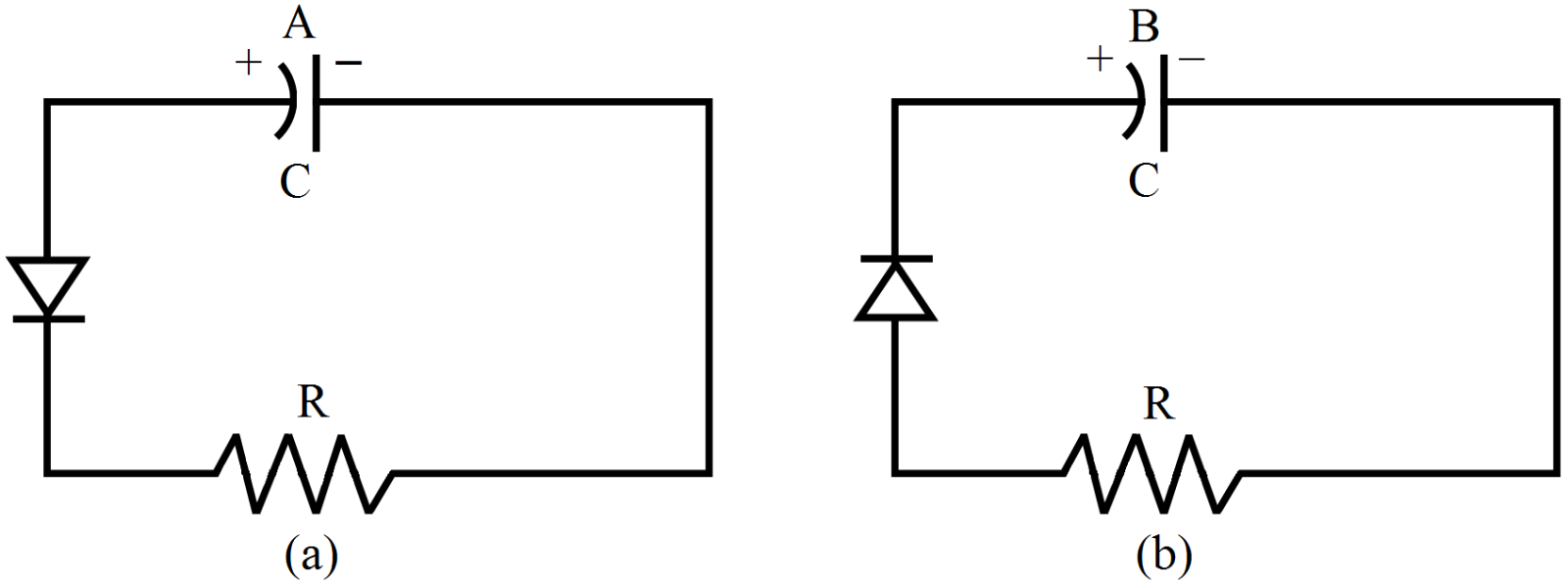
Two identical capacitors A and B are charged to the same potential V and are connected in two circuits at t = 0 as shown in figure. The charges on the capahltors at a time t = CR are, respectively:
he half-life of a radioactive substance is 48 hours. How much time will it take to disintegrate to its $\frac {1}{16}$ th part
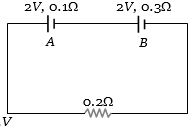
The internal resistances of two cells shown are $0.1\,\Omega $ and $0.3\,\Omega $. If $R = 0.2\,\Omega $, the potential difference across the cell
A microscope is focused on a mark. Then a glass slab of refractive index 1.5 and thickness 6 cm is placed on the mark. To get the mark again in focus the microscope should be moved
In $LCR$ circuit, the capacitance is changed from $C$ to $4C$. For the same resonant frequency, the inductance should be changed from $ L$ to
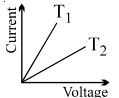
The current in a metallic conductor is plotted against voltage at two different temperatures $T_1$ and $T_2$. Which is correct
Two identical moving coil galvanometer have $10 \Omega$ resistance and full scale deflection at $2 \mu A$ current. One of them is converted into a voltmeter of $100 mV$ full scale reading and the other into an Ammeter of $1 mA$ full scale current using appropriate resistors. These are then used to measure the voltage and current in the Ohm's law experiment with $R =1000 \Omega$ resistor by using an ideal cell. Which of the following statement( $s$ ) is/are correct?

$(1)$ The measured value of $R$ will be $978 \Omega$

$(2)$ The resistance of the Voltmeter will be $100 k \Omega$.

$(3)$ The resistance of the Ammeter will be $0.02 \Omega$ (round off to $2^{\text {nd }}$ decimal place)

$(4)$ If the ideal cell is replaced by a cell having internal resistance of $5 \Omega$ then the measured value of $R$ will be more than $1000 \Omega$.

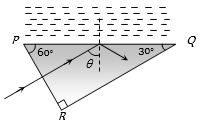
$PQR$ is a right angled prism with other angles as $60^o$ and $30^o$. Refractive index of prism is $1.5$. $PQ$ has a thin layer of liquid. Light falls normally on the face $PR$. For total internal reflection, maximum refractive index of liquid is