Question

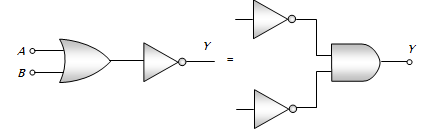
Assertion  :   De-morgan's theorem   may be explained by the following circuit
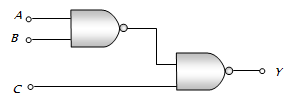
Reason  :  In the following circuit, for output inputs ABC are 101
(a) If both assertion and reason are true and the reason is the correct explanation of the assertion.

(b) If both assertion and reason are true but reason is not the correct explanation of the assertion.

(c) If assertion is true but reason is false.

(d) If the assertion and reason both are false.

Answer

(c) If assertion is true but reason is false.

Need a full question paper?

Generate a complete, print-ready paper with questions like this in minutes — across 16+ boards, with answer keys.

Start Generating Free

Similar questions

On giving $40 \mu C$ charge to a parallel plate capacitor of $10 \mu F$ capacitance, the value of its total energy in joules will be :

If work function of metal is 3eV then threshold wavelength will be

(a) 4125 Å

(b) 4000 Å

(c) 4500 Å

(d) 5000 Å

Wavelength associated with an electron having kinetic energy 3 × 10⁻²⁵J is x × 10−7 m. What is the value of x?
An AC source rated 100V (rms) supplies a current of 10A (rms) to a circuit. The average power delivered by the source:
  1. Must be 1000W.
  2. May be 1000W.
  3. May be greater than 1000W.
  4. May be less than 1000W.
A standing wave is produced on a string clamped at one end and free at the other. The length of the string.
  1. Must be an integral multiple of $\frac{\lambda}{4}$
  2. Must be an integral multiple of $\frac{\lambda}{2}$
  3. Must be an integral multiple of $\lambda$
  4. May be an integral multiple of $\frac{\lambda}{2}.$
A very small magnet is placed in the magnetic meridian with its south pole pointing north. The null point is obtained 20cm away from the centre of the magnet. If the earth¢s magnetic field (horizontal component) at this point be 0.3 gauss, the magnetic moment of the magnet is:

Thermionic emission from a heated filament varies with its temperature T as

(a)  

(b) T

(c)  

(d)  

The refractive index of water is 1.33. What will be the speed of light in water

(a) 3

(b) 2.25

(c) 4

(d) 1.33

When the particle and its anti-particle unite, the result is:

In determining the temperature of a distant star, one makes use of

(a) Kirchhoff's law

(b) Stefan's law

(c) Wien's displacement law

(d) None of these