Questions · Page 1 of 9

M.C.Q (1 Marks)

🎯

Test yourself on this topic

50 questions · timed · auto-graded

Question 11 Mark

Assertion  : 29 is the equivalent decimal number of binary number 11101.

Reason      : (11101)2 = (1 × 24 + 1 × 23 + 1 × 22 + 0 × 21 + 1 × 20 )10   = (16 + 8 + 4 + 0 + 1)10 = (29)10

(a) If both assertion and reason are true and the reason is the correct explanation of the assertion.
(b) If both assertion and reason are true but reason is not the correct explanation of the assertion.

(c) If assertion is true but reason is false.

(d) If the assertion and reason both are false.

Answer

(a) If both assertion and reason are true and the reason is the correct explanation of the assertion.

View full question & answer
Question 31 Mark

In the grid circuit of a triode a signal E = 2  is applied. If m = 14 and rp =10 kW then root mean square current flowing through   will be

(a) 1.27 mA

(b) 10 mA

(c) 1.5 mA

(d) 12.4 mA

Answer

(a) 1.27 mA

View full question & answer
Question 41 Mark

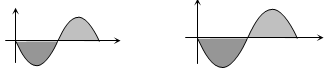
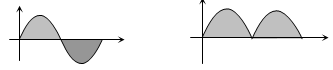
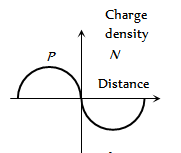
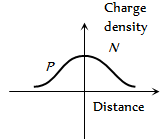
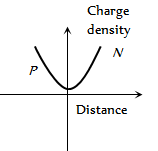
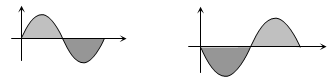
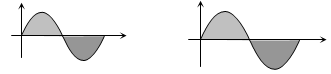
Which of the following figures correctly shows the phase relation between the input signal and the output signal of triode amplifier

 (a)

(b)

(c)

(d)

Answer

 (a)

View full question & answer
Question 51 Mark

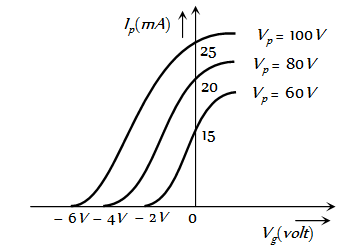
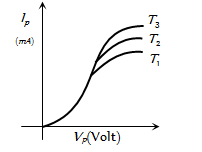
The variation of anode current in a triode corresponding to a change in grid potential at three different values of the plate potential is shown in the diagram. The mutual conductance of the triode is

(a) 2.5 m mho

(b) 5.0 m mho

(c) 7.5 m mho

(d) 10.0 m mho

Answer

(a) 2.5 m mho

View full question & answer
Question 61 Mark

The plate current in a triode is given by    where Ip, Vp and Vg are the values of plate current, plate voltage and grid voltage, respectively. What are the triode parameters m, rp and gm for the operating point at   and  ?

(a) 10, 16.7 kW, 0.6 m mho

(b) 15, 16.7 kW, 0.06 m mho

(c) 20, 6 kW, 16.7 m mho

(d) None of these

Answer

(a) 10, 16.7 kW, 0.6 m mho

View full question & answer
Question 71 Mark

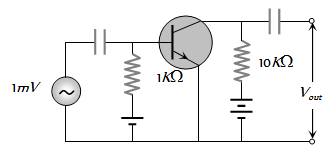
In the following common emitter configuration an NPN transistor with current gain b = 100 is used. The output voltage of the amplifier will be

(a) 10 mV

(b) 0.1 V

(c) 1.0 V

(d) 10 V

Answer

(c) 1.0 V

View full question & answer
Question 81 Mark

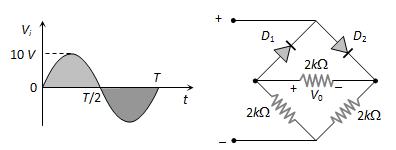
In the circuit shown in figure the maximum output voltage V0 is

(a) 0 V

(b) 5 V

(c) 10 V

(d)  

Answer

(b) 5 V

View full question & answer
Question 91 Mark

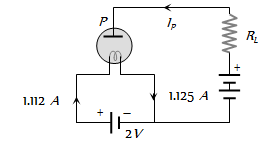
The value of plate current in the given circuit diagram will be

(a) 3 mA

(b) 8 mA

(c) 13 mA

(d) 18 mA

Answer

(c) 13 mA

View full question & answer
Question 111 Mark

The truth table shown in figure is for

A

0

0

1

1

B

0

1

0

1

y

1

0

0

1

(a) XOR

(b) AND

(c) XNOR

(d) OR

Answer

(c) XNOR

View full question & answer
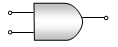
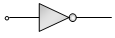
Question 121 Mark

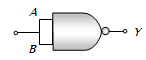
Given below are four logic gate symbol (figure). Those for OR, NOR and NAND are respectively

(a) 1, 4, 3

(b) 4, 1, 2

(c) 1, 3, 4

(d) 4, 2, 1

Answer

(c) 1, 3, 4

View full question & answer
Question 131 Mark

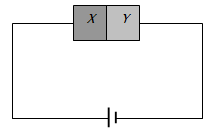
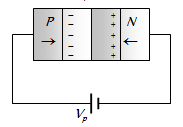
A semiconductor X is made by doping a germanium crystal with arsenic (Z = 33). A second semiconductor Y is made by doping germanium with indium (Z = 49). The two are joined end to end and connected to a battery as shown. Which of the following statements is correct

(a) X is P-type, Y is N-type and the junction is forward biased

(b) X is N-type, Y is P-type and the junction is forward biased

(c) X is P-type, Y is N-type and the junction is reverse biased

(d) X is N-type, Y is P-type and the junction is reverse biased

Answer

(d) X is N-type, Y is P-type and the junction is reverse biased

View full question & answer
Question 141 Mark

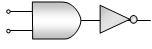
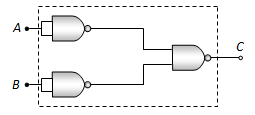
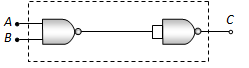
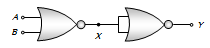
The combination of ‘NAND’ gates shown here under (figure) are equivalent to

(a) An OR gate and an AND gate respectively

(b) An AND gate and a NOT gate respectively

(c) An AND gate and an OR gate respectively

(d) An OR gate and a NOT gate respectively.

Answer

(a) An OR gate and an AND gate respectively

View full question & answer
Question 151 Mark

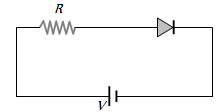
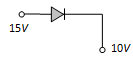
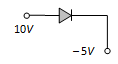
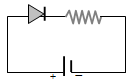
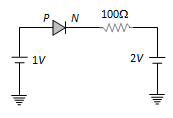
For the given circuit of PN-junction diode, which of the following statement is correct

(a) In forward biasing the voltage across R is V

(b) In forward biasing the voltage across R is 2V

(c) In reverse biasing the voltage across R is V

(d) In reverse biasing the voltage across R is 2V

Answer

(a) In forward biasing the voltage across R is V

View full question & answer
Question 171 Mark

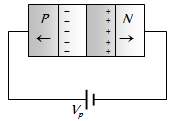
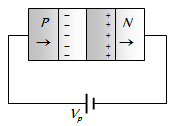
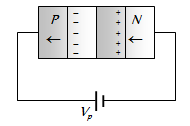
In the case of forward biasing of PN-junction, which one of the following figures correctly depicts the direction of flow of carriers

(a)

(b)

(c)

(d)

Answer
(c)

View full question & answer
Question 191 Mark

P-type semiconductor is formed when

A. As impurity is mixed in Si                                                                         B. Al impurity is mixed in Si

C. B impurity is mixed in Ge                                                                         D. P impurity is mixed in Ge

(a) A and C

(b) A and D

(c) B and C

(d) B and D

Answer

(c) B and C

View full question & answer
Question 201 Mark

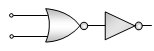
Assertion   : The following circuit represents 'OR' gate

Reason     : For the above circuit Y =

(a) If both assertion and reason are true and the reason is the correct explanation of the assertion.
(b) If both assertion and reason are true but reason is not the correct explanation of the assertion.

(c) If assertion is true but reason is false.

(d) If the assertion and reason both are false.

Answer

(a) If both assertion and reason are true and the reason is the correct explanation of the assertion.
View full question & answer
Question 211 Mark

In a common emitter transistor, the current gain is 80. What is the change in collector current, when the change in base current is 250 mA

(a) 80  × 250 mA

(b) (250 – 80) mA

(c) (250 + 80) mA

(d) 250/80 mA

Answer

(a) 80  × 250 mA

View full question & answer
Question 231 Mark

For a crystal system, a = b = c, a = b = g  ¹ 90o, the system is

(a) Tetragonal system

(b) Cubic system

(c) Orthorhombic system

(d) Rhombohedral system

Answer

(d) Rhombohedral system

View full question & answer
Question 241 Mark

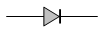
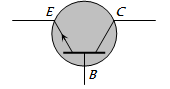
The symbol given in figure represents

(a) NPN transistor

(b) PNP transistor

(c) Forward biased PN junction diode

(d) Reverse biased NP junction diode

Answer

(a) NPN transistor

View full question & answer
Question 251 Mark

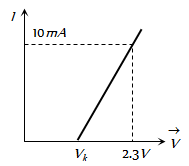
The resistance of a germanium junction diode whose V - I  is shown in figure is  

(a) 5 kW

(b) 0.2 kW

(c) 2.3 kW

(d)  

Answer

(b) 0.2 kW

View full question & answer
Question 271 Mark

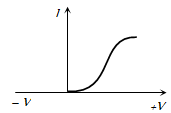
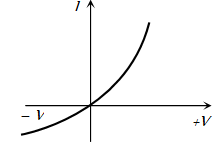
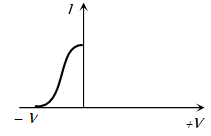
Different voltages are applied across a P-N junction and the currents are measured for each value. Which of the following graphs is obtained between voltage and current

(a)

(b)

(c)

(d)

Answer
(c)

View full question & answer
Question 291 Mark

For the diode, the characteristic curves are given at different temperature. The relation between the temperatures is

(a)  

(b)  

(c)  

(d) None of the above

Answer
(b)  
View full question & answer
Question 301 Mark

When a potential difference is applied across, the current passing through

(a) An insulator at 0 K  is zero

(b) A semiconductor at 0 K  is zero

(c) A P-N diode at 300 K  is finite, if it is reverse biased

(d) a, b, c

Answer

(d) a, b, c

View full question & answer
Question 311 Mark

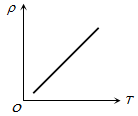
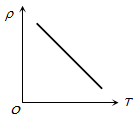
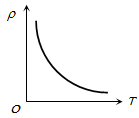
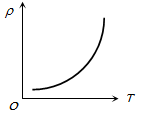
The temperature (T) dependence of resistivity (r) of a semiconductor is represented by

(a)

(b)

(c)

(d)

Answer
(c)

View full question & answer
Question 321 Mark

The following truth table corresponds to the logic gate

A

0

0

1

1

B

0

1

0

1

X

0

1

1

1

(a) NAND    

(b) OR

(c) AND

(d) XOR

Answer

(b) OR

View full question & answer
Question 331 Mark

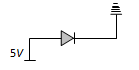
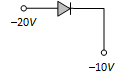
The current through an ideal PN-junction shown in the following circuit diagram will be

(a) Zero

(b) 1 mA

(c) 10 mA

(d) 30 mA

Answer

(a) Zero

View full question & answer
Question 341 Mark

Before the saturation state of a diode at the plate voltages of 400 V and 200 V respectively the currents are i1 and i2 respectively. The ratio i1/i2 will be

(a)  

(b) 2 

(c) 2  

(d) 1/2

Answer

(c) 2  

View full question & answer
Question 351 Mark

For a given plate-voltage, the plate current in a triode is maximum when the potential of

(a) The grid is positive and plate is negative

(b) The grid is positive and plate is positive

(c) The grid is zero and plate is positive

(d) The grid is negative and plate is positive

Answer

(b) The grid is positive and plate is positive

View full question & answer
Question 361 Mark

The relation between a and b parameters of current gains for a transistors is given by

(a) α =  

(b) α =

(c) α =

(d) α =

Answer

(b) α =

View full question & answer
Question 371 Mark

For a transistor, in a common emitter arrangement, the alternating current gain b  is given by

(a) β =  

(b) β =

(c) β =

(d) β =

Answer

(a) β =  

View full question & answer
Question 381 Mark

Which of these is unipolar transistor

(a) Point contact transistor

(b) Field effect transistor

(c) PNP transistor

(d) None of these

Answer

(b) Field effect transistor

View full question & answer
Question 401 Mark

In forward bias, the width of potential barrier in a P-N junction diode

(a) Increases

(b) Decreases

(c) Remains constant

(d) First increases then decreases

Answer

(b) Decreases

View full question & answer
Question 411 Mark

The depletion layer in the P-N junction region is caused by

(a) Drift of holes

(b) Diffusion of charge carriers

(c) Migration of impurity ions

(d) Drift of electrons

Answer

(b) Diffusion of charge carriers

View full question & answer
Question 421 Mark

In P-N junction, avalanche current flows in circuit when biasing is

(a) Forward

(b) Reverse

(c) Zero  

(d) Excess

Answer

(b) Reverse

View full question & answer
Question 431 Mark

In the depletion region of an unbiased P-N junction diode there are

(a) Only electrons

(b) Only holes

(c) Both electrons and holes

(d) Only fixed ions

Answer

(d) Only fixed ions

View full question & answer
Question 441 Mark

If the forward voltage in a semiconductor diode is doubled, the width of the depletion layer will

(a) Become half

(b) Become one-fourth

(c) Remain unchanged

(d) Become double

Answer

(a) Become half

View full question & answer
Question 451 Mark

The electrical resistance of depletion layer is large because

(a) It has no charge carriers

(b) It has a large number of charge carriers

(c) It contains electrons as charge carriers

(d) It has holes as charge carriers

Answer

(a) It has no charge carriers

View full question & answer
Question 461 Mark

The reverse biasing in a PN junction diode

(a) Decreases the potential barrier

(b) Increases the potential barrier

(c) Increases the number of minority charge carriers

(d) Increases the number of majority charge carriers

Answer

(b) Increases the potential barrier

View full question & answer
Question 471 Mark

PN-junction diode works as a insulator, if connected

(a) To A.C.

(b) In forward bias

(c) In reverse bias

(d) None of these

Answer

(c) In reverse bias

View full question & answer
Question 481 Mark

The electrical circuit used to get smooth dc output from a rectifier circuit is called

(a) Oscillator

(b) Filter

(c) Amplifier

(d) Logic gates

Answer

(b) Filter

View full question & answer
Question 491 Mark

The cut-in voltage for silicon diode is approximately

(a) 0.2 V

(b) 0.6 V

(c) 1.1 V

(d) 1.4 V

Answer

(b) 0.6 V

View full question & answer
Question 501 Mark

In a junction diode, the holes are due to

(a) Protons

(b) Neutrons

(c) Extra electrons

(d) Missing of electrons

Answer

(d) Missing of electrons

View full question & answer