MCQ
$Assertion$ : For a system of particles under central force field, the total angular momentum is conserved.
$Reason$ : The torque acting on such a system is zero.
  • If both Assertion and Reason are correct and the Reason is a correct explanation of the Assertion.
  • B
    If both Assertion and Reason are correct but Reason is not a correct explanation of the Assertion.
  • C
    If the Assertion is correct but Reason is incorrect.
  • D
    If both the Assertion and Reason are incorrect.
Answer

Correct option: A.
If both Assertion and Reason are correct and the Reason is a correct explanation of the Assertion.
a
Under central force field, force acts along the line joining the bodies so it does not have rotatory effect i.e., torque is zero. Hence angular momentum is conservative

Need a full question paper?

Generate a complete, print-ready paper with questions like this in minutes — across 16+ boards, with answer keys.

Start Generating Free

Similar questions

A vehicle of mass $200\,kg$ is moving along a levelled curved road of radius $70\,m$ with angular velocity of $0.2\,rad / s$. The centripetal force acting on the vehicle is $.........\,N$
In a rocket of mass $1000\, kg$ fuel is consumed at a rate of $40 \,kg/s$. The velocity of the gases ejected from the rocket is $5 \times {10^4}\,m/s$. The thrust on the rocket is
At about $4^\circ C,$ a certain amount of water has maximum:
A particle executes simple harmonic motion (amplitude $= A$) between $x = - A$ and $x = + A$. The time taken for it to go from $0$ to $A/2$ is ${T_1}$ and to go from $A/2$ to $A$ is ${T_2}$. Then
A ball rises to surface at a constant velocity in a liquid whose density is $4$ times greater than that of the material of the ball. The ratio of the force of friction acting on the rising ball and its weight is
A car of mass $m$ has an engine which can deliver power $P$. The minimum time in which car can be accelerated from rest to a speed $v$ is .............
A cylinder rolls without slipping down an inclined plane, the number of degrees of freedom it has, is
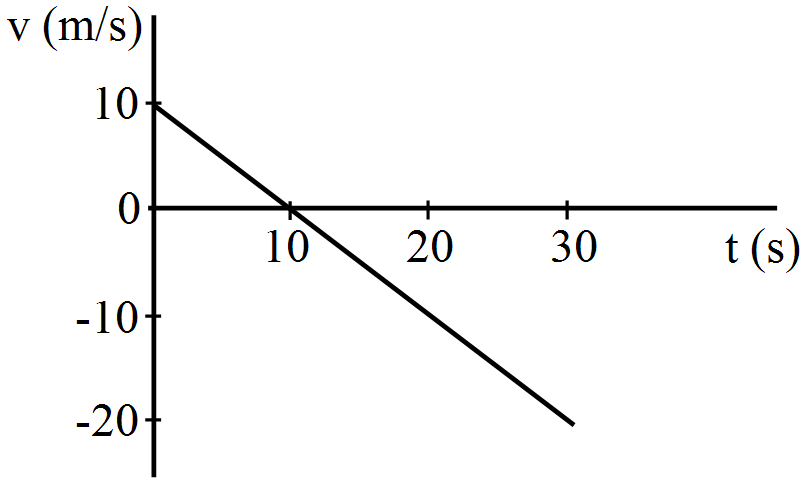
The velocity$-$time plot for a particle moving on a straight line is shown in the figure:
A particle is projected from the mid - point of the line joining two fixed particles each of mass $'m$'. If the separation between fixed particles is $'l$', the minimum velocity of projection of the particle so as to escape is equal to
When a disc rotates with uniform angular velocity, which of the following is not true?