$Assertion :$ For higher temperature the peak emission wavelength of a blackbody shifts to lower wavelengths.
$Reason :$ Peak emission wavelengths of a black body is proportional to the fourth-power of temperature.
AIIMS 2005, Easy


Download our appand get started for free
Experience the future of education. Simply download our apps or reach out to us for more information. Let's shape the future of learning together!No signup needed.*
Similar Questions
- 1In the Ingen Hauz’s experiment the wax melts up to lengths $10$ and $25 cm$ on two identical rods of different materials. The ratio of thermal conductivities of the two materials isView Solution
- 2View SolutionFrom Kirchoff’s law the ratio of emissive power and absorption power of all bodies
- 3View SolutionFor cooking the food, which of the following type of utensil is most suitable
- 4The maximum wavelength of radiation emitted at $2000\;K$is $4\mu m$. What will be the maximum wavelength of radiation emitted at $2400\,K$ is ...... $\mu m$View Solution
- 5An object kept in a large room having air temperature of $25^{\circ} \mathrm{C}$ takes $12$ minutes to cool from $80^{\circ} \mathrm{C}$ to $70^{\circ} \mathrm{C}$. The time taken to cool for the same object from $70^{\circ} \mathrm{C}$ to $60^{\circ} \mathrm{C}$ would be nearly.....$min$View Solution
- 6Radiation from a black body at the thermodynamic temperature $T_1$ is measured by a small detector at distance $d_1$ from it. When the temperature is increased to $T_2$ and the distance to $d_2$ , the power received by the detector is unchanged . What is the ratio $d_2/d_1$ ?View Solution
- 7A small object is placed at the center of a large evacuated hollow spherical container. Assume that the container is maintained at $0 K$. At time $t =0$, the temperature of the object is $200 K$. The temperature of the object becomes $100 K$ at $t = t _1$ and $50 K$ at $t = t _2$. Assume the object and the container to be ideal black bodies. The heat capacity of the object does not depend on temperature. The ratio $\left( t _2 / t _1\right)$ is. . . . .View Solution
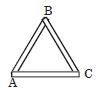
- 8Three rods $AB, BC$ and $AC$ having thermal resistances of $10\, units, \,10 \,units$ and $20 \,units,$ respectively, are connected as shown in the figure. Ends $A$ and $C$ are maintained at constant temperatures of $100^o C$ and $0^o C,$ respectively. The rate at which the heat is crossing junction $B$ is ........ $ \mathrm{units}$View Solution
- 9Two spherical stars $A$ and $B$ emit blackbody radiation. The radius of $A$ is $400$ times that of $B$ and $A$ emits $10^4$ times the power emitted from $B$. The ratio $\left(\lambda_A / \lambda_B\right)$ of their wavelengths $\lambda_A$ and $\lambda_B$ at which the peaks occur in their respective radiation curves isView Solution
- 10If two metallic plates of equal thicknesses and thermal conductivities ${K_1}$ and ${K_2}$ are put together face to face and a common plate is constructed, then the equivalent thermal conductivity of this plate will beView Solution