In the Ingen Hauz’s experiment the wax melts up to lengths $10$ and $25 cm$ on two identical rods of different materials. The ratio of thermal conductivities of the two materials is
Medium
Download our app for free and get started
(a) $K \propto {l^2} \Rightarrow \frac{{{K_1}}}{{{K_2}}} = \frac{{l_1^2}}{{l_2^2}} = {\left( {\frac{{10}}{{25}}} \right)^2} = \frac{1}{{6.25}}$

Download our appand get started for free
Experience the future of education. Simply download our apps or reach out to us for more information. Let's shape the future of learning together!No signup needed.*
Similar Questions
- 1Two identical metal balls at temperature ${200^o}C$and ${400^o}C$ kept in air at ${27^o}C$. The ratio of net heat loss by these bodies isView Solution
- 2A body of area $1\, cm^2$ is heated to a temperature $1000\, K$. The amount of energy radiated by the body in $1\, second$ is .......... $Joule$ (Stefan's constant $\sigma = 5.67 \times 10^{-8}\, W\, m^{-2}K^{-4}$)View Solution
- 3Temperature of a black body increases from ${327^o}C\,{\rm{to}}\,{\rm{92}}{{\rm{7}}^{\rm{o}}}C$, the initial energy possessed is $ 2KJ$ , what is its final energy ..... $KJ$View Solution
- 4View SolutionWhen the body has the same temperature as that of surroundings
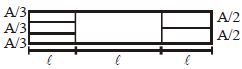
- 5For the shown figure, calculate the equivalent thermal resistance if the bricks made of the same material of conductivity $K$View Solution
- 6If wavelengths of maximum intensity of radiations emitted by the sun and the moon are $0.5 \times {10^{ - 6}}m$ and ${10^{ - 4}}m$ respectively, the ratio of their temperatures isView Solution
- 7Three rods of identical area of cross-section and made from the same metal form the sides of an isosceles triangle $ABC$, right angled at $B$. The points $A$ and $B$ are maintained at temperatures $T$ and $\sqrt 2 T$ respectively. In the steady state the temperature of the point C is ${T_C}$. Assuming that only heat conduction takes place, $\frac{{{T_C}}}{T}$ is equal toView Solution
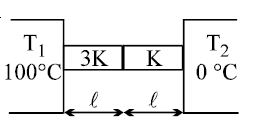
- 8Two rods $A$ and $B$ of same cross-sectional are $A$ and length $l$ connected in series between a source $(T_1 = 100^o C)$ and a sink $(T_2 = 0^o C)$ as shown in figure. The rod is laterally insulated If $G_A$ and $G_B$ are the temperature gradients across the rod $A$ and $B$, thenView Solution
- 9Column $I$ gives some devices and Column $II$ gives some process on which the functioning of these devices depend. Match the devices in Column $I$ with the processes in Column $II$ and indicate your answer by darkening appropriate bubbles in the $4 \times 4$ matrix given in the $ORS$.View Solution
Column $I$ Column $II$ $(A)$ Bimetallic strip $(p)$ Radiation from a hot body $(B)$ Steam engine $(q)$ Energy conversion $(C)$ Incandescent lamp $(r)$ Melting $(D)$ Electric fuse $(s)$ Thermal expansion of solids - 10Suppose the sun expands so that its radius becomes $100$ times its present radius and its surface temperature becomes half of its present value. The total energy emitted by it then will increase by a factor ofView Solution