$Assertion :$ For Reynold’s number $Re > 2000$, the flow of fluid is turbulent.
$Reason :$ Inertial forces are dominant compared to the viscous forces at such high Reynold’s numbers.
$Reason :$ Inertial forces are dominant compared to the viscous forces at such high Reynold’s numbers.
AIIMS 2005, Easy


Download our appand get started for free
Experience the future of education. Simply download our apps or reach out to us for more information. Let's shape the future of learning together!No signup needed.*
Similar Questions
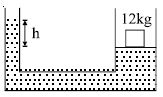
- 1The area of cross-section of the wider tube shown in figure is $800$ $cm^2$. If a mass of $12$ $ kg $ is placed on the massless piston, the difference in heights $h$ in the level of water in the two tubes is ........ $cm$View Solution
- 2A sudden drop in the mercury level by $10 \,mm$ or more is a sign of ..........View Solution
- 3A ball of density $'\rho '$ is released from deep inside of a viscous liquid of density $'2\rho '$ . It will move upView Solution
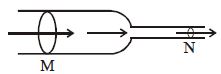
- 4Horizontal tube of non-uniform cross-section has radii of $0.1\,m$ and $0.05\,m$ respectively at $M$ and $N.$ For a stream-line flow of liquid the rate of liquid flow isView Solution
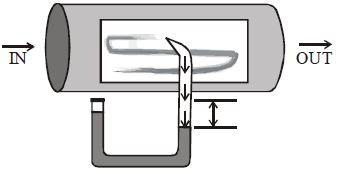
- 5The Pitot tube shown in the figure is used to measure fluid flow velocity in a pipe of cross sectional area $S$. It was invented by a French engineer Henri Pitot in the early $18^{th}$ century. The volume of the gas flowing across the section of the pipe per unit time is (The difference in the liquid columns is $\Delta h, \rho_0$ and $\rho$ are the densities of liquid and the gas respectively) :-View Solution
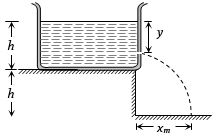
- 6A tank is filled upto a height $h$ with a liquid and is placed on a platform of height h from the ground. To get maximum range ${x_m}$ a small hole is punched at a distance of $y$ from the free surface of the liquid. ThenView Solution
- 7View SolutionTo get the maximum flight, a ball must be thrown as
- 8The Bhagirathi and the Alaknanda merge at Deoprayag to form the Ganga with their speeds in the ratio $1: 1: 5$. The cross-sectional areas of the Bhagirathi, the Alaknanda and the Ganga are in the ratio $1: 2: 3$. Assuming streamline flow, the ratio of the speed of Ganga to that of the Alaknanda isView Solution
- 9A large tank is filled with water to a height $H$. A small hole is made at the base of the tank. It takes ${T_1}$ time to decrease the height of water to $\frac{H}{\eta }\,(\eta > 1)$; and it takes ${T_2}$ time to take out the rest of water. If ${T_1} = {T_2}$, then the value of $\eta $ isView Solution
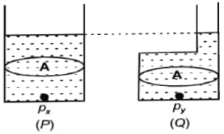
- 10Figure shows two containers $P$ and $Q$ with same base area $A$ and each filled upto same height with same liquid. Select the correct alternative .............View Solution