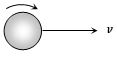
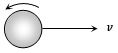
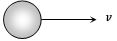
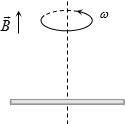
To get the maximum flight, a ball must be thrown as
A
B
C
DAny of $(a), (b)$ and $(c)$
Easy
Download our app for free and get started
B
b (b) If a ball is moving from left to right and also spinning about a horizontal axis in anticlockwise wise direction about a horizontal axis perpendicular to the direction of motion then relative to the ball air will be moving form right to left. The resultant $v$
Download our app
and get started for free
Experience the future of education. Simply download our apps or reach out to us for more information. Let's shape the future of learning together!No signup needed.*
A $U$ tube with both ends open to the atmosphere, is partially filled with water. Oil, which is immiscible with water, is poured into one side until it stands at a distance of $10\,\, mm$ above the water level on the other side. Meanwhile the water rises by $65\,\, mm$ from its original level (see diagram). The density of the oil is ......... $kg/m^3$
In the diagram shown, the difference in the two tubes of the manometer is $5\, cm$, the cross section of the tube at $A$ and $B$ is $6\, mm^2$ and $10\, mm^2$ respectively. The rate at which water flows through the tube is ........ $ cc/s$ $(g\, = 10\, ms^{-2})$
A ball of relative density $0.8$ falls into water from a height of $2$ $m$. The depth to which the ball will sink is ........ $ m$ (neglect viscous forces) :
Water is flowing through a channel (lying in a vertical plane) as shown in the figure. Three sections $A, B$ and $C$ are shown. Sections $B$ and $C$ have equal area of cross section. If $P_A, P_B$ and $P_C$ are the pressures at $A, B$ and $C$ respectively then
A cubical block of wood of edge $10$ $cm$ and mass $0.92$ $kg$ floats on a tank of water with oil of rel. density $0.6$ to a depth of $4$ $cm$ above water. When the block attains equilibrium with four of its sides edges vertical
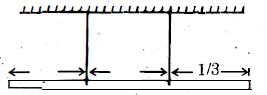
A slender homogeneous rod of length $2L$ floats partly immersed in water, being supported by a string fastened to one of its ends, as shown. The specific gravity of the rod is $0.75$. The length of rod that extends out of water is :
The figure shows a liquid of given density flowing steadily in horizontal tube of varying cross-section. Cross sectional areas at $A$ is $1.5\,cm ^2$, and $B$ is $25\,mm ^2$, if the speed of liquid at $B$ is $60\,cm / s$ then $\left( P _{ A }- P _{ B }\right)$ is :(Given $P _{ A }$ and $P _{ B }$ are liquid pressures at $A$ and $B$ points.Density $\rho=1000\,kg\,m ^{-3}$
$A$ and $B$ are on the axis of tube $............\,Pa$
Alarge tank is filled with water to a height $H$.A small hole is made at the base of the tank. It takes $T_1$ time to decrease the height of water to $H/ \eta , (\eta > 1)$ and it takes $T_2$ time to take out the rest of water. If $T_1 = T_2$ , then the value of $\eta$ is :