$Assertion :$ For the formation of stationary waves the medium must be bounded having definite boundaries.
$Reason :$ In the stationary wave, some particles of the medium remain permanently at rest.
$Reason :$ In the stationary wave, some particles of the medium remain permanently at rest.
AIIMS 2010, Medium
Download our app for free and get started
For the formation of stationary waves, it is necessary that the medium should not be unlimited but it should have a boundary. The wave propagating in such a medium will reflect at the boundary and produce a wave of the same kind travelling in the opposite direction. The position of two waves will give rise to a stationary wave. At free end, transverse wave is reflected without change of phase. Hence as essential requirement for the formation of stationary wave is that the medium must be bounded having definite boundaries. In stationary waves, there are certain points of the medium, which are permanently at rest i.e., their displacement is zero throughout. These points are called nodes. Similarly, there are some other points which vibrate about their mean position with largest amplitude. These points are called antinodes.

Download our appand get started for free
Experience the future of education. Simply download our apps or reach out to us for more information. Let's shape the future of learning together!No signup needed.*
Similar Questions
- 1Two tuning forks have frequencies $380$ and $384 Hz$ respectively. When they are sounded together, they produce $4$ beats. After hearing the maximum sound, how long will it take to hear the minimum sound .... $\sec$View Solution
- 2In a closed organ pipe of length $105 \,cm$, standing waves are set up corresponding to third overtone. What distance from the closed end, a pressure node is formed .............. $cm$View Solution
- 3A motor car blowing a horn of frequency $124\,vib/sec$ moves with a velocity $72\, km/hr$ towards a tall wall. The frequency of the reflected sound heard by the driver will be .... $vib/sec$ (velocity of sound in air is $330\, m/s$)View Solution
- 4The speed of a wave in a certain medium is $960\, m/s$. If $3600$ waves pass over a certain point of the medium in $1\, minute$, the wavelength is .... $metres$View Solution
- 5$Assertion :$ Speed of wave $=\frac{wavelength}{time period}$View Solution
$Reason :$ Wavelength is the distance between two nearest particles in phase. - 6The first resonance length of a resonance tube is $40\,\, cm$ and the second resonance length is $122\,\, cm$. The third resonance length of the tube will be... $cm$View Solution
- 7View SolutionIt is desired to increase the fundamental resonance frequency in a tube which is closed at one end. This can be achieved by
- 8If $n _{1}, n_{2}$ and $n _{3}$ are the fundamental frequencies of three segments into which a string is divided, then the original fundamental frequency $n$ of the string is given byView Solution
- 9View SolutionIt is possible to distinguish between the transverse and longitudinal waves by studying the property of
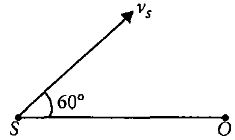
- 10A source of sound $S$ emitting waves of frequency $100\,\, Hz$ and an observer $O$ are ocated at some distance from each other. The source is moving with a speed of $19 .4\,\, m s^{-1}$ at an angle of $60^o $ with the source observer line as shown in the figure. The observer is at rest. The apparent frequency observed by the observer .... $Hz$ (velocity of sound in air $330 \,\, m s^{-1}$), isView Solution