It is desired to increase the fundamental resonance frequency in a tube which is closed at one end. This can be achieved by
Medium
Download our app for free and get started
(d) Fundamental frequency of closed pipe $n = \frac{v}{{4l}}$
where $v = \sqrt {\frac{{\gamma RT}}{M}} $ ==>$v \propto \frac{1}{{\sqrt M }}$
$\because$ ${M_{{H_2}}} < {M_{air}}\,\, \Rightarrow \,\,{v_{{H_2}}} > {v_{air}}$
Hence fundamental frequency with $H_2$ will be more as compared to air. So option $(a)$ is correct.
Also $n \propto \frac{1}{l}$, hence if $l$ decreases $n$ increases so option $(b)$ is correct.
It is well known that $(n)$ Open $= 2(n)$ Closed, hence option $(c)$ is correct.
where $v = \sqrt {\frac{{\gamma RT}}{M}} $ ==>$v \propto \frac{1}{{\sqrt M }}$
$\because$ ${M_{{H_2}}} < {M_{air}}\,\, \Rightarrow \,\,{v_{{H_2}}} > {v_{air}}$
Hence fundamental frequency with $H_2$ will be more as compared to air. So option $(a)$ is correct.
Also $n \propto \frac{1}{l}$, hence if $l$ decreases $n$ increases so option $(b)$ is correct.
It is well known that $(n)$ Open $= 2(n)$ Closed, hence option $(c)$ is correct.

Download our appand get started for free
Experience the future of education. Simply download our apps or reach out to us for more information. Let's shape the future of learning together!No signup needed.*
Similar Questions
- 1When an air column at $15\,^oC$ and a tunning fork are sounded together then $4$ beats per second are produced, the frequency of the fork is less then that of air column. When the temperature falls to $10\,^oC$ , then the beat frequency decreases by one. The frequency of the fork will be ..... $Hz$ $[V_{sound}$ at $0\,^oC = 332\,m/s]$View Solution
- 2The speed of sound in oxygen at $S.T.P. $will be approximately:View Solution
(Given, $\mathrm{R}=8.3 \mathrm{JK}^{-1}, \gamma=1.4$ )
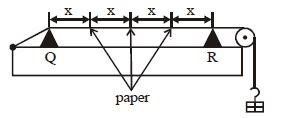
- 3The given diagram shows three light pieces of paper placed on a wire that is stretched over two supports, $Q$ and $R$ , a distance $4x$ apart. When the wire is made to vibrate at a particular frequency, all the pieces of paper, except the middle one, fall off the wire. Which of the following could be the wavelength of the vibration?View Solution
- 4Two sound waves (expressed in $CGS$ units) given by ${y_1} = 0.3\sin \frac{{2\pi }}{\lambda }(vt - x)$ and ${y_2} = 0.4\sin \frac{{2\pi }}{\lambda }(vt - x + \theta )$ interfere. The resultant amplitude at a place where phase difference is $\pi /2$ will be .... $ cm$View Solution
- 5The equation $y = 0.15\sin 5x\cos 300t$, describes a stationary wave. The wavelength of the stationary wave is .... $m$View Solution
- 6The equation of a progressive wave is $y = 0.02\,\sin \,2\pi \left[ {\frac{t}{{0.01}} - \frac{x}{{0.30}}} \right]$ Here $x$ and $y$ are in metre and $t$ is in second. The velocity of propagation of the wave is .... $ms^{-1}$View Solution
- 7The fundamental frequency in an open organ pipe is equal to the third harmonic of a closed organ pipe. If the length of the closed organ pipe is $20\, cm,$ the length of the open organ pipe is .... $cm$View Solution
- 8A string fixed at both ends is in resonance in its $2^{nd}$ harmonic with a tuning fork of frequency $f_1$. Now its one end becomes free. If the frequency of the tuning fork is increased slowly from $f_1$ then again a resonance is obtained when the frequency is $f_2$. If in this case the string vibrates in $n^{th}$ harmonic thenView Solution
- 9When a tuning fork of frequency $341$ is sounded with another tuning fork, six beats per second are heard. When the second tuning fork is loaded with wax and sounded with the first tuning fork, the number of beats is two per second. The natural frequency of the second tuning fork isView Solution
- 10The equation of wave is given by $Y=10^{-2} \sin 2 \pi\left(160 t-0.5 x+\frac{\pi}{4}\right)$ Where $x$ and $Y$ are in $m$ and $t$ in $s$. The speed of the wave is $.....\,km h ^{-1}$View Solution