MCQ
$Assertion$ : For the planets orbiting around the sun, angular speed, linear speed and $K.E.$ changes with time, but angular momentum remains constant.
$Reason$ : No torque is acting on the rotating planet. So its angular momentum is constant.
  • If both Assertion and Reason are correct and the Reason is a correct explanation of the Assertion.
  • B
    If both Assertion and Reason are correct but Reason is not a correct explanation of the Assertion.
  • C
    If the Assertion is correct but Reason is incorrect.
  • D
    If both the Assertion and Reason are incorrect.
Answer

Correct option: A.
If both Assertion and Reason are correct and the Reason is a correct explanation of the Assertion.
a
Net torque acting on the rotating planet is zero i.e. $\tau=0$

Using $\frac{d L}{d t}=\tau$

Thus $\tau=0 \Longrightarrow L=$ constant

Hence angular momentum is constant.

So, reason statement is correct.

Now $L=m v r=$ constant

$\Longrightarrow v r=$ constant

Thus as the distance between sun and planet changes, linear speed of the planet changes and thus its kinetic energy also changes.

Also using $L=m r^{2} w=$ constant

$\Longrightarrow r^{2} w=$ constant

Thus as the distance between sun and planet changes, angular speed of the planet changes.

Hence assertion statement is also correct and reason explains the assertion very well.

Need a full question paper?

Generate a complete, print-ready paper with questions like this in minutes — across 16+ boards, with answer keys.

Start Generating Free

Similar questions

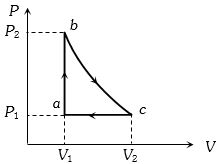
Carbon monoxide is carried around a closed cycle $abc$ in which bc is an isothermal process as shown in the figure. The gas absorbs $7000 J$ of heat as its temperature increases from $300 K$ to $1000 K$ in going from $a$ to $b$. The quantity of heat rejected by the gas during the process $ca$ is ..... $J$
Water flows in a horizontal tube (see figure). The pressure of water changes by $700\; \mathrm{Nm}^{-2}$ between $\mathrm{A}$ and $\mathrm{B}$ where the area of cross section are $40\; \mathrm{cm}^{2}$ and $20\; \mathrm{cm}^{2},$ respectively. Find the rate of flow of water through the tube. ........ $\mathrm{cm}^{3} / \mathrm{s}$

(density of water $=1000\; \mathrm{kgm}^{-3}$ )

Two sources are called coherent if they produce waves:
Water rises in a capillary upto a height of $4\, cm$. If it is titled to $30^o$ from the vertical, then the length of water column in it will be
body radiates energy $5W$ at a temperature of ${127^o}C$. If the temperature is increased to ${927^o}C$, then it radiates energy at the rate of ...... $W$
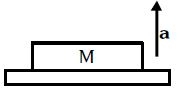
A block of mass $M$ is kept on a platform which starts accelerating upwards from rest with a constant acceleration $a$ . During the time interval $T$ the work done by contact force on mass $M$ is
When an electron strikes the target in a Coolidge tube, its entire kinetic energy:
For a gas, the difference between the two specific heats is $4150\, J\, kg^{-1}\, K^{-1}$ and the ratio of the two specific heats is $1.4$. What is the specific heat of the gas at constant volume in units of $J\, kg^{-1}\, K^{-1}$ ?
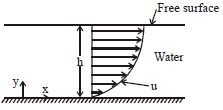
For the situation shown in the figure, water flows on the surface of a fixed plate. The
velocity of water as a function of distance $'y'$ is given as : $u = \alpha \left[ {\frac{y}{h} - 2{{\left( {\frac{y}{h}} \right)}^2}} \right]$ . Determine the magnitude of the shear stress that the water applies at the base of the plate. Coefficient of viscosity is $\eta$
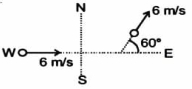
A particle is moving eastwards with a speed of $6 \,m / s$. After $6 \,s$, the particle is found to be moving with same speed in a direction $60^{\circ}$ north of east. The magnitude of average acceleration in this interval of time is ....... $m / s ^2$