Assertion : Free electrons always keep on moving in a conductor even then no magnetic force act on them in magnetic field unless a current is passed through it.
Reason : The average velocity of free electron is zero.
AIIMS 2011, Easy
Download our app for free and get started
In the absence of the electric current, the free electrons in a conductor are in a state of random motion, like molecule in a gas. Their average velocity is zero. i.e. they do not have any net velocity in a direction. As a result, there is no net magnetic force on the free electrons in the magnetic field. On passing the current, the free electrons acquire drift velocity in a definite direction, hence magnetic force acts on them, unless the field has no perpendicular component.

Download our appand get started for free
Experience the future of education. Simply download our apps or reach out to us for more information. Let's shape the future of learning together!No signup needed.*
Similar Questions
- 1The resistance of $10\, metre$ long potentiometer wire is $1\,ohm/meter$. A cell of $e.m.f.$ $2.2\, volts$ and a high resistance box are connected in series to this wire. The value of resistance taken from resistance box for getting potential gradient of $2.2\, millivolt/metre$ will be ............... $\Omega $View Solution
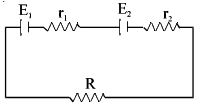
- 2Under what condition current passing through the resistance $R$ can be increased by short circuiting the battery of emf $E_2$. The internal resistances of the two batteries are $r_1$ and $r_2$ respectively.View Solution
- 3In an electric heater $4\, amp$ current passes for $1$ minute at potential difference of $250\, volt$, the power of heater and energy consumed will be respectivelyView Solution
- 4A storage battery has $e.m.f.$ $15\, volts$ and internal resistance $0.05\, ohm$. Its terminal voltage when it is delivering $10\, ampere$ is ............... $volts$View Solution
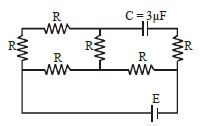
- 5In steady state the potential difference across the capacitor is $10\,\, V.$ Each resistance is of $3\,\Omega $. The cell is ideal. The $emf$ of the cell is .............. $\mathrm{V}$View Solution
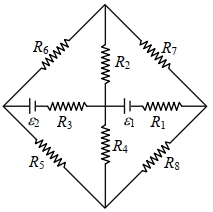
- 6The figure shows a circuit having eight resistances of $1 \Omega$ each, labelled $R_1$ to $R_8$, and two ideal batteries with voltages $\varepsilon_1=12 V$ and $\varepsilon_2=6 V$.View Solution
Which of the following statement($s$) is(are) correct?
$(A)$ The magnitude of current flowing through $R_1$ is $7.2 A$.
$(B)$ The magnitude of current flowing through $R_2$ is $1.2 A$.
$(C)$ The magnitude of current flowing through $R_3$ is $4.8 A$.
$(D)$ The magnitude of current flowing through $R_5$ is $2.4 A$.
- 7View SolutionAn electric heater kept in vacuum is heated continuously by passing electric current. Its temperature
- 8When $5\ V$ potential difference is applied across a wire of length $0.1\ m$, the drift speed of electrons is $2.5 \times 10^{-4}$ $ms^{-1}$ . If the electron density in the wire is $8 \times 10^{28}$ $m^{-3}$ the resistivity of the material is close toView Solution
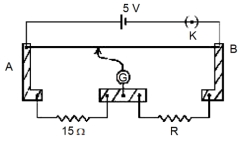
- 9A meter bridge setup is shown in the figure. It is used to determine an unknown resistance $R$ using a given resistor of $15\,\Omega$. The galvanometer $(G)$ shows null deflection when tapping key is at $43\,cm$ mark from end $A$. If the end correction for end $A$ is $2\,cm$. then the determined value of $R$ will be__________ $\Omega$View Solution
- 10Heater of electric kettle is made of a wire of length $L$ and diameter $d$. It takes $4$ minutes to raise the temperature of $0.5 \ kg$ water by $40\ K$. This heater is replaced by a new heater having two wires of the same material, each of length $L$ and diameter $2 d$. The way these wires are connected is given in the options. How much time in minutes will it take to raise the temperature of the same amount of water by $40K$ ?View Solution
$(A)$ $4$ if wires are in parallel
$(B)$ $2$ if wires are in series
$(C)$ $1$ if wires are in series
$(D)$ $0.5$ if wires are in parallel.