Question
Assertion :   Gauss theorem is not applicable in magnetism.
Reason    : Mono magnetic pole does not exist.(a) If both assertion and reason are true and the reason is the correct explanation of the assertion.(b) If both assertion and reason are true but reason is not the correct explanation of the assertion.(c) If assertion is true but reason is false.(d) If the assertion and reason both are false.


Answer

(a) If both assertion and reason are true and the reason is the correct explanation of the assertion.

Need a full question paper?

Generate a complete, print-ready paper with questions like this in minutes — across 16+ boards, with answer keys.

Start Generating Free

Similar questions

The positive terminal of 12V battery is connected to the ground. Then the negative terminal will be at:
Work done by a sample of an ideal gas in a process $A$ is double the work done in another process $B$. The temperature rises through the same amount in the two processes. If $C_A$ and $C_B$ be the molar heat capacities for the two processes:
An electric lamp is marked 60 W, 230 V. The cost of a 1 kWh of energy is Rs. 1.25. The cost of using this lamp 8 hrs a day for 30 day is(a) Rs. 10 (b) Rs. 16(c) Rs. 18 (d) Rs. 20
       
A star moves away from earth at speed $0.8\ c$ while emitting light of frequency $6\times 10^{14} Hz$ What frequency will be observed on the earth $($in units of $10^{14}Hz) (c =$ speed of light$)$
Light waves can be polarised as they are(a) Transverse(b) Of high frequency(c) Longitudinal(d) Reflected
       
A diminished image of an object is to be obtained on a screen 1.0 m from it. This can be achieved by appropriately placing(a) A convex mirror of suitable focal length(b) A concave mirror of suitable focal length(c) A concave lens of suitable focal length(d) A convex lens of suitable focal length less than 0.25 m


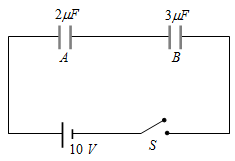
Two capacitors $A$ and $B$ are connected in series with a battery as shown in the figure. When the switch $S$ is closed and the two capacitors get charged fully, then
Relation between current (i) and drift velocity $\left(v_d\right)$ is :
X−ray falling on a material.
The electric field due to a uniformly charged sphere of radius $R$ as a function of the distance from its centre is represented graphically by