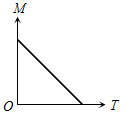
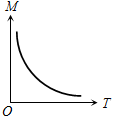
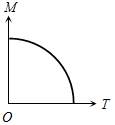
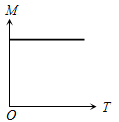
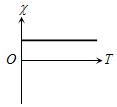
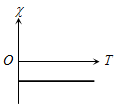
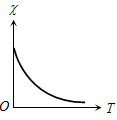
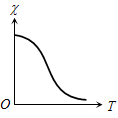
MCQ 11 Mark
Two magnets $A$ and $B$ are identical in mass, length and breadth but have different magnetic moments. In a vibration magnetometer, if the time period of $B$ is twice the time period of $A.$ The ratio of the magnetic moments
$\mathrm{M}_{\mathrm{A}} / \mathrm{M}_{\mathrm{B}}$ ot the magnets will be
View full question & answer→Question 21 Mark
Curie temperature is the temperature above which(a) A paramagnetic material becomes ferromagnetic(b) A ferromagnetic material becomes paramagnetic(c) A paramagnetic material becomes diamagnetic(d) A ferromagnetic material becomes diamagnetic
Answer(b) A ferromagnetic material becomes paramagnetic
View full question & answer→MCQ 31 Mark
In a vibration magnetometer, the time period of a bar magnet oscillating in horizontal component of earth's magnetic field is $2 \sec.$ When a magnet is brought near and parallel to it, the time period reduces to $1 \sec.$ The ratio $\frac{H}{F}$ of the horizontal component $H$ and the field $F$ due to magnet will be
- A
$3$
- ✓
$\frac{1}{3}$
- C
$\sqrt{3}$
- D
$1 \sqrt{3}$
AnswerCorrect option: B. $\frac{1}{3}$
$\frac{1}{3}$
View full question & answer→Question 41 Mark
Two short magnets placed along the same axis with their like poles facing each other repel each other with a force which varies inversely as(a) Square of the distance(b) Cube of the distance(c) Distance(d) Fourth power of the distance
Answer(d) Fourth power of the distance
View full question & answer→Question 51 Mark
The magnetic moment of atomic neon is(a) Zero (b) μB/2(c) μB(d) 3μB/2
Question 61 Mark
Demagnetisation of magnets can be done by(a) Rough handling(b) Heating(c) Magnetising in the opposite direction(d) All the above
Question 71 Mark
A ferromagnetic material is heated above its curie temperature. Which one is a correct statement(a) Ferromagnetic domains are perfectly arranged(b) Ferromagnetic domains becomes random(c) Ferromagnetic domains are not influenced(d) Ferromagnetic material changes itself into diamagnetic material
Answer(b) Ferromagnetic domains becomes random
View full question & answer→Question 81 Mark
If a diamagnetic substance is brought near north or south pole of a bar magnet, it is(a) Attracted by the poles(b) Repelled by the poles(c) Repelled by the north pole and attracted by the south pole (d) Attracted by the north pole and repelled by the south pole
Answer(b) Repelled by the poles
View full question & answer→Question 91 Mark
The material of permanent magnet has(a) High retentivity, low coercivity(b) Low retentivity, high coercivity(c) Low retentivity, low coercivity(d) High retentivity, high coercivity
Answer(d) High retentivity, high coercivity
View full question & answer→Question 101 Mark
The permanent magnet is made from which one of the following substances(a) Diamagnetic(b) Paramagnetic(c) Ferromagnetic(d) Electromagnetic
Question 111 Mark
Temperature above which a ferromagnetic substance becomes paramagnetic is called(a) Critical temperature(b) Boyle's temperature(c) Debye's temperature(d) Curie temperature
Question 121 Mark
The number of turns and radius of cross-section of the coil of a tangent galvanometer are doubled. The reduction factor K will be (a) K (b) 2K(c) 4K (d) K/4
Question 131 Mark
The bob of a simple pendulum is replaced by a magnet. The oscillations are set along the length of the magnet. A copper coil is added so that one pole of the magnet passes in and out of the coil. The coil is short-circuited. Then which one of the following happens(a) Period decreases(b) Period does not change(c) Oscillations are damped(d) Amplitude increases
Answer(c) Oscillations are damped
View full question & answer→Question 141 Mark
Twists of suspension fibre should be removed in vibration magnetometer so that(a) Time period be less(b) Time period be more(c) Magnet may vibrate freely (d) Cannot be said with certainty
Answer(c) Magnet may vibrate freely
View full question & answer→Question 151 Mark
The time period of a freely suspended magnet is 4 seconds. If it is broken in length into two equal parts and one part is suspended in the same way, then its time period will be(a) 4 sec (b) 2 sec(c) 0.5 sec(d) 0.25 sec
Question 161 Mark
A magnetic needle suspended horizontally by an unspun silk fibre, oscillates in the horizontal plane because of the restoring force originating mainly from(a) The torsion of the silk fibre(b) The force of gravity(c) The horizontal component of earth's magnetic field(d) All the above factors
Answer(c) The horizontal component of earth's magnetic field
View full question & answer→Question 171 Mark
Two magnets are held together in a vibration magnetometer and are allowed to oscillate in the earth's magnetic field with like poles together, 12 oscillations per minute are made but for unlike poles together only 4 oscillations per minute are executed. The ratio of their magnetic moments is(a) 3 : 1 (b) 1 : 3(c) 3 : 5 (d) 5 : 4
MCQ 181 Mark
A certain amount of current when flowing in a properly set tangent galvanometer, produces a deflection of $45^{\circ}$. If the current be reduced by a factor of $\sqrt{3}$ , the deflection would
- A
Decrease by $30^{\circ}$
- ✓
Decrease by $15^{\circ}$
- C
Increase by $15^{\circ}$
- D
Increase by $30^{\circ}$
AnswerCorrect option: B. Decrease by $15^{\circ}$
Decrease by $15^{\circ}$
View full question & answer→MCQ 191 Mark
If a magnet is suspended at an angle $30^{\circ}$ to the magnetic meridian, it makes an angle of $45^{\circ}$ with the horizontal. The real dip is
- ✓
$\tan ^{-1}(\sqrt{3} / 2)$
- B
$\tan ^{-1}(\sqrt{3})$
- C
$\tan ^{-1}(\sqrt{3 / 2})$
- D
$\tan ^{-1}(2 / \sqrt{3})$
AnswerCorrect option: A. $\tan ^{-1}(\sqrt{3} / 2)$
$\tan ^{-1}(\sqrt{3} / 2)$
View full question & answer→MCQ 201 Mark
Two identical magnetic dipoles of magnetic moments $1.0 \mathrm{~A}-\mathrm{m}^2$ each, placed at a separation of $2 m$ with their axis perpendicular to each other. The resultant magnetic field at a point midway between the dipoles is
AnswerCorrect option: A. $5 \times 10^{-7} \mathrm{~T}$
$\sqrt{5} \times 10^{-7} \mathrm{~T}$
View full question & answer→MCQ 211 Mark
Two tangent galvanometers having coils of the same radius are connected in series. A current flowing in them produces deflections of $60^{\circ}$ and $45^{\circ}$ respectively. The ratio of the number of turns in the coils is
AnswerCorrect option: D. $\sqrt{3} / 1$
$\sqrt{3} / 1$
View full question & answer→MCQ 221 Mark
A bar magnet has a magnetic moment equal to $5 \times 10^{-5}\ \ce{weber \times m}$. It is suspended in a magnetic field which has a magnetic induction $(B)$ equal to $8 \pi \times 10^{-4}$ tesla. The magnet vibrates with a period of vibration equal to $15\sec.$ The moment of inertia of the magnet is
- A
$22.5 kg \times m ^2$
- B
$11.25 \times kg \times m ^2$
- C
$5.62 \times kg \times m ^2$
- ✓
$7.16 \times 10^{-7} kg- m ^2$
AnswerCorrect option: D. $7.16 \times 10^{-7} kg- m ^2$
$7.16 \times 10^{-7} kg- m ^2$
View full question & answer→MCQ 231 Mark
Magnets $A$ and $B$ are geometrically similar but the magnetic moment of $A$ is twice that of $B$. If $T_1$ and $T_2$ be the time periods of the oscillation when their like poles and unlike poles are kept together respectively, then $\frac{T_1}{T_2}$ will be
- A
$\frac{1}{3}$
- B
$\frac{1}{2}$
- ✓
$\frac{1}{\sqrt{3}}$
- D
$\sqrt{3}$
AnswerCorrect option: C. $\frac{1}{\sqrt{3}}$
$\frac{1}{\sqrt{3}}$
View full question & answer→MCQ 241 Mark
A magnet of magnetic moment $M$ oscillating freely in earth's horizontal magnetic field makes $n$ oscillations per minute. If the magnetic moment is quadrupled and the earth's field is doubled, the number of oscillations made per minute would be
- A
$\frac{ n }{2 \sqrt{2}}$
- B
$\frac{ n }{\sqrt{2}}$
- ✓
$2 \sqrt{2} n$
- D
$\sqrt{2} n$
AnswerCorrect option: C. $2 \sqrt{2} n$
$2 \sqrt{2} n$
View full question & answer→MCQ 251 Mark
A bar magnet $A$ of magnetic moment $M_A$ is found to oscillate at a frequency twice that of magnet $B$ of magnetic moment $M_B$ when placed in a vibrating magneto$-$meter. We may say that
- A
$\mathrm{M}_{\mathrm{A}}=2 \mathrm{M}_{\mathrm{B}}$
- B
$M_A=8 M_B$
- ✓
$\mathrm{M}_{\mathrm{A}}=4 \mathrm{M}_{\mathrm{B}}$
- D
$\mathrm{M}_{\mathrm{B}}=8 \mathrm{M}_{\mathrm{A}}$
AnswerCorrect option: C. $\mathrm{M}_{\mathrm{A}}=4 \mathrm{M}_{\mathrm{B}}$
$\mathrm{M}_{\mathrm{A}}=4 \mathrm{M}_{\mathrm{B}}$
View full question & answer→MCQ 261 Mark
Two bar magnets of the same mass, length and breadth but magnetic moments $M$ and $2 M$ respectively, when placed in same position, time period is $3 \sec.$ What will be the time period when they are placed in different position
- A
$\sqrt{3} \sec$
- ✓
$ 3 \sqrt{3} \sec$
- C
$3 \sec$
- D
$6 \sec$
AnswerCorrect option: B. $ 3 \sqrt{3} \sec$
$ 3 \sqrt{3} \sec$
View full question & answer→MCQ 271 Mark
Moment of inertia of a magnetic needle is $40 \ \mathrm{gm}-\mathrm{cm}^2$ has time period $3$ seconds in earth's horizontal field $=3.6 \times 10^{-5}$ weber $/ \mathrm{m}^2.$ Its magnetic moment will be
- ✓
$0.5 \mathrm{A} \times \mathrm{m}^2$
- B
$5 \mathrm{A} \times \mathrm{m}^2$
- C
$0.250 \mathrm{A} \times \mathrm{m}^2$
- D
$5 \times 10^2 \mathrm{A} \times \mathrm{m}^2$
AnswerCorrect option: A. $0.5 \mathrm{A} \times \mathrm{m}^2$
$0.5 \mathrm{A} \times \mathrm{m}^2$
View full question & answer→MCQ 281 Mark
The time period of oscillation of a freely suspended bar magnet with usual notations is given by
- ✓
$T =2 \pi \sqrt{\frac{ I }{ MBH _{ H }}}$
- B
$T =2 \pi \sqrt{\frac{ MB _{ H }}{ I }}$
- C
$T =\sqrt{\frac{ I }{ MBH _{ H }}}$
- D
$T =2 \pi^{\sqrt{\frac{ B _{ H }}{ MI }}}$
AnswerCorrect option: A. $T =2 \pi \sqrt{\frac{ I }{ MBH _{ H }}}$
$T =2 \pi \sqrt{\frac{ I }{ MBH _{ H }}}$
View full question & answer→MCQ 291 Mark
At a certain place a magnet makes $30$ oscillations per minute. At another place where the magnetic field is double, its time period will be
- A
$4 \sec$
- B
$2 \sec$
- C
$\frac{1}{2} \sec$
- ✓
$\sqrt{2} \sec$
AnswerCorrect option: D. $\sqrt{2} \sec$
$\sqrt{2} \sec$
View full question & answer→MCQ 301 Mark
At a certain place, the horizontal component $B _0$ and the vertical component $V _0$ of the earth's magnetic field are equal in magnitude. The total intensity at the place will be
- A
$B _0$
- B
$B _0{ }^2$
- C
$2 B_0$
- ✓
$\sqrt{2} B_0$
AnswerCorrect option: D. $\sqrt{2} B_0$
$\sqrt{2} B_0$
View full question & answer→MCQ 311 Mark
Two identical short bar magnets, each having magnetic moment of $10 \ \mathrm{Am}^2,$ are arranged such that their axial lines are perpendicular to each other and their centres be along the same straight line in a horizontal plane. If the distance between their centres is $0.2 m ,$ the resultant magnetic induction at a point midway between them is $(\left.\mu_0=4 \pi \times 10^{-7} \mathrm{Hm}^{-1}\right)$
- A
$\sqrt{2} \times 10^{-7}$
- B
$\sqrt{5} \times 10^{-7}$
- C
$\sqrt{2} \times 10^{-3}$
- ✓
$\sqrt{5} \times 10^{-3}$
AnswerCorrect option: D. $\sqrt{5} \times 10^{-3}$
$\sqrt{5} \times 10^{-3}$
View full question & answer→MCQ 321 Mark
The magnetic potential at a point on the axial line of a bar magnet of dipole moment $M$ is $V.$ What is the magnetic potential due to a bar magnet of dipole moment $\frac{M}{4}$ at the same point
- A
$4\ V$
- B
$2\ V$
- C
$\frac{\mathrm{V}}{2}$
- ✓
$\frac{V}{4}$
AnswerCorrect option: D. $\frac{V}{4}$
$\frac{V}{4}$
View full question & answer→MCQ 331 Mark
The effective length of a magnet is $31.4 \ cm$ and its pole strength is $0.05\ Am.$ The magnetic moment, if it is bent in the form of a semicircle will be
- ✓
$0.1\ Am ^2$
- B
$0.01\ Am ^2$
- C
$0.2\ Am ^2$
- D
$1.2\ Am ^2$
AnswerCorrect option: A. $0.1\ Am ^2$
$0.1\ Am ^2$
View full question & answer→MCQ 341 Mark
At a certain place the angle of dip is $30^{\circ}$ and the horizontal component of earth's magnetic field is $0.50$ Oersted. The earth's total magnetic field is
- A
$\sqrt{3}$
- B
$1$
- ✓
$\frac{1}{\sqrt{3}}$
- D
$\frac{1}{2}$
AnswerCorrect option: C. $\frac{1}{\sqrt{3}}$
$\frac{1}{\sqrt{3}}$
View full question & answer→MCQ 351 Mark
At a place the earth's horizontal component of magnetic field is $0.36 \times 10^{-4}$ weber $/ \mathrm{m}^2.$ It the angle of dip at that place is $60^{\circ}$, then the vertical component of earth's field at that place in weber $/ \mathrm{m}^2$ will be approximately
- A
$0.12 \times 10^{-4}$
- B
$0.24 \times 10^{-4}$
- C
$0.40 \times 10^{-4}$
- ✓
$0.62 \times 10^{-4}$
AnswerCorrect option: D. $0.62 \times 10^{-4}$
$0.62 \times 10^{-4}$
View full question & answer→MCQ 361 Mark
If the angles of dip at two places are $30^{\circ}$ and $45^{\circ}$ respectively, then the ratio of horizontal components of earth's magnetic field at the two places will be
- ✓
$\sqrt{3}: \sqrt{2}$
- B
$1 : \sqrt{2}$
- C
$1 : \sqrt{3}$
- D
$1: 2$
AnswerCorrect option: A. $\sqrt{3}: \sqrt{2}$
$\sqrt{3}: \sqrt{2}$
View full question & answer→MCQ 371 Mark
The correct relation is $($Where $B_H=$ Horizontal component of earth's magnetic field $;\mathrm{B}_{\mathrm{V}} =$ Vertical component of earth's magnetic field and $\mathrm{B}=$ Total intensity of earth's magnetic field$)$
- A
$B=\frac{\mathrm{B}_{\mathrm{v}}}{\mathrm{B}_{\mathrm{H}}}$
- B
$\mathrm{B}=\mathrm{B}_{\mathrm{v}} \times \mathrm{B}_{\mathrm{H}}$
- ✓
$|\mathrm{B}|=\sqrt{B_H{ }^2+B_v{ }^2}$
- D
$\mathrm{B}=\mathrm{B}_{\mathrm{H}}+\mathrm{B}_{\mathrm{v}}$
AnswerCorrect option: C. $|\mathrm{B}|=\sqrt{B_H{ }^2+B_v{ }^2}$
$|\mathrm{B}|=\sqrt{B_H{ }^2+B_v{ }^2}$
View full question & answer→MCQ 381 Mark
A small bar magnet of moment $M$ is placed in a uniform field $H .$ If magnet makes an angle of $30^{\circ}$ with field, the torque acting on the magnet is
- A
$MH$
- ✓
$\frac{ MH }{2}$
- C
$\frac{ MH }{3}$
- D
$\frac{ MH }{4}$
AnswerCorrect option: B. $\frac{ MH }{2}$
$\frac{ MH }{2}$
View full question & answer→Question 391 Mark
Vibration magnetometer before use, should be set(a) In magnetic meridian(b) In geographical meridian(c) Perpendicular to magnetic meridian(d) In any position
Question 401 Mark
The period of oscillation of a magnet in vibration magnetometer is 2 sec. The period of oscillation of a magnet whose magnetic moment is four times that of the first magnet is(a) 1 sec(b) 4 sec(c) 8 sec (d) 0.5 sec
Question 411 Mark
Two magnets of same size and mass make respectively 10 and 15 oscillations per minute at certain place. The ratio of their magnetic moments is(a) 4 : 9(b) 9 : 4(c) 2 : 3 (d) 3 : 2
Question 421 Mark
Time period of a freely suspended magnet does not depend upon(a) Length of the magnet(b) Pole strength of the magnet(c) Horizontal component of earth's magnetic field(d) Length of the suspension thread
Answer(d) Length of the suspension thread
View full question & answer→Question 431 Mark
In sum and difference method in vibration magnetometer, the time period is more if(a) Similar poles of both magnets are on same sides(b) Opposite poles of both magnets are on same sides(c) Both magnets are perpendicular to each other(d) Nothing can be said
Answer(b) Opposite poles of both magnets are on same sides
View full question & answer→Question 441 Mark
Due to the earth's magnetic field, charged cosmic ray particles(a) Require greater kinetic energy to reach the equator than the poles(b) Require less kinetic energy to reach the equator than the poles(c) Can never reach the equator(d) Can never reach the poles
Answer(c) Can never reach the equator
View full question & answer→Question 451 Mark
The angle between the earth's magnetic and the earth's geographical axes is(a) Zero(b) 17°(c) 23°(d) None of these
MCQ 461 Mark
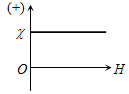
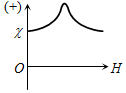
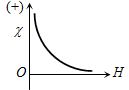
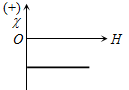
The variation of magnetic susceptibility $(x)$ with magnetising field for a paramagnetic substance is
View full question & answer→MCQ 471 Mark
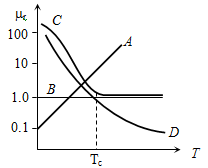
The relative permeability $\left(\mu_{\mathrm{r}}\right)$ of a ferromagnetic substance varies with temperature $(T)$ according to the curve
View full question & answer→MCQ 481 Mark
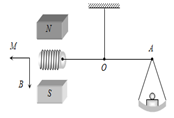
A small coil $C$ with $N = 200$ turns is mounted on one end of a balance beam and introduced between the poles of an electromagnet as shown in figure. The cross sectional area of coil is $A= 1.0 \ cm^2,$ length of arm $OA$ of the balance beam is $l = 30 \ cm$. When there is no current in the coil the balance is in equilibrium. On passing a current $I = 22\ mA$ through the coil the equilibrium is restored by putting the additional counter weight of mass $\triangle m = 60\ mg$ on the balance pan. Find the magnetic induction at the spot where coil is located.
- ✓
$0.4 T$
- B
$0.3 T$
- C
$0.2 T$
- D
$0.1 T$
AnswerCorrect option: A. $0.4 T$
$0.4 T$
View full question & answer→MCQ 491 Mark
The time period of a thin bar magnet in earth's magnetic field is $T.$ If the magnet is cut into two equal parts perpendicular to its length, the time period of each part in the same field will be
- ✓
$\frac{ T }{2}$
- B
$T$
- C
$\sqrt{2} T$
- D
$2 T$
AnswerCorrect option: A. $\frac{ T }{2}$
$\frac{ T }{2}$
View full question & answer→MCQ 501 Mark
Two small bar magnets are placed in a line with like poles facing each other at a certain distance $d$ apart. If the length of each magnet is negligible as compared to $d,$ the force between them will be inversely proportional to
- A
$d$
- B
$d ^2$
- C
$\frac{1}{d^2}$
- ✓
$d ^4$
AnswerCorrect option: D. $d ^4$
$d ^4$
View full question & answer→MCQ 511 Mark
The figure below shows the north and south poles of a permanent magnet in which $n$ turn coil of area of cross$-$section $A$ is resting, such that for a current $i$ passed through the coil, the plane of the coil makes an angle $\theta$ with respect to the direction of magnetic field $B.$ If the plane of the magnetic field and the coil are horizontal and vertical respectively, the torque on the coil will be
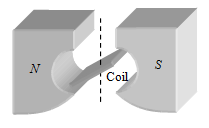 since the magnetic field is radial
 - ✓
$τ = niAB \cos\theta$
- B
$τ = niAB \sin\theta$
- C
$τ = niAB$
- D
AnswerCorrect option: A. $τ = niAB \cos\theta$
$τ = niAB \cos\theta$
View full question & answer→MCQ 521 Mark
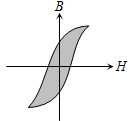
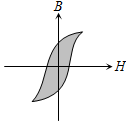
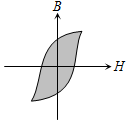
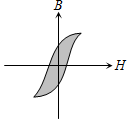
For substances hysteresis $(B - H)$ curves are given as shown in figure. For making temporary magnet which of the following is best.
View full question & answer→MCQ 531 Mark
Two identical thin bar magnets each of length $I$ and pole strength $m$ are placed at right angle to each other with north pole of one touching south pole of the other. Magnetic moment of the system is
- A
$ml$
- B
$2 ml$
- ✓
$\sqrt{2} ml$
- D
$\frac{1}{2} ml$
AnswerCorrect option: C. $\sqrt{2} ml$
$\sqrt{2} ml$
View full question & answer→MCQ 541 Mark
An iron rod of volume $10^{-4} m^3$ and relative permeability $1000$ is placed inside a long solenoid wound with $5\ \text{turns/cm.}$ If a current of $0.5\ A$ is passed through the solenoid, then the magnetic moment of the rod is
- A
$10\ Am ^2$
- B
$15\ Am ^2$
- C
$20\ Am ^2$
- ✓
$25\ Am ^2$
AnswerCorrect option: D. $25\ Am ^2$
$25\ Am ^2$
View full question & answer→MCQ 551 Mark
Which of the following statements are true about the magnetic susceptibility $x_m$ of paramagnetic substance
- A
Value of $x_m$ is inversely proportional to the absolute temperature of the sample
- B
${ }^{X_m}$ is positive at all temperature
- C
$\mathrm{x}_{\mathrm{m}}$ is negative at all temperature
- ✓
$a, b$
AnswerCorrect option: D. $a, b$
$a, b$
View full question & answer→Question 561 Mark
The period of oscillation of a vibration magnetometer depends on which of the following factors(a) I and M only(b) M and H only(c) I and H only(d) I, M and H only
Question 571 Mark
At a place, the horizontal and vertical intensities of earth's magnetic field is 0.30 Gauss and 0.173 Gauss respectively. The angle of dip at this place is(a) 30°(b) 90°(c) 60°(d) 45°
Question 581 Mark
Which of the following is most suitable for the core of electromagnets(a) Soft iron(b) Steel(c) Copper-nickel alloy(d) Air
MCQ 591 Mark
Force between two unit pole strength placed at a distance of one metre is
AnswerCorrect option: C. $10^{-7} N$
$10^{-7} N$
View full question & answer→Question 601 Mark
To measure which of the following, is a tangent galvanometer used(a) Charge(b) Angle(c) Current(d) Magnetic intensity
MCQ 611 Mark
A cylindrical rod magnet has a length of $5 \ cm$ and a diameter of $1 \ cm .$ It has a uniform magnetisation of $5.30 \times 10^3 \mathrm{Amp} / \mathrm{m}^3$. What its magnetic dipole moment
- A
$1 \times 10^{-2} \mathrm{~J} / \mathrm{T}$
- ✓
$2.08 \times 10^{-2} \mathrm{~J} / \mathrm{T}$
- C
$3.08 \times 10^{-2} \mathrm{~J} / \mathrm{T}$
- D
$1.52 \times 10^{-2} \mathrm{~J} / \mathrm{T}$
AnswerCorrect option: B. $2.08 \times 10^{-2} \mathrm{~J} / \mathrm{T}$
$2.08 \times 10^{-2} \mathrm{~J} / \mathrm{T}$
View full question & answer→MCQ 621 Mark
A small bar magnet A oscillates in a horizontal plane with a period $T$ at a place where the angle of dip is $60^{\circ}.$ When the same needle is made to oscillate in a vertical plane coinciding with the magnetic meridian, its period will be
AnswerCorrect option: A. $\frac{\mathrm{T}}{\sqrt{2}}$
$\frac{\mathrm{T}}{\sqrt{2}}$
View full question & answer→Question 631 Mark
The time period of a bar magnet suspended horizontally in the earth's magnetic field and allowed to oscillate(a) Is directly proportional to the square root of its mass(b) Is directly proportional to its pole strength(c) Is inversely proportional to its magnetic moment(d) Decreases if the length increases but pole strength remains same
Answer(a) Is directly proportional to the square root of its mass
View full question & answer→MCQ 641 Mark
At two places $A$ and $B$ using vibration magnetometer, a magnet vibrates in a horizontal plane and its respective periodic time are $2 \sec$ and $3 \sec$ and at these places the earth's horizontal components are $H_A$ and $H_B$ respectively. Then the ratio between $H_A$ and $H_B$ will be
- A
$9 : 4$
- B
$ 3 : 2$
- ✓
$4 : 9$
- D
$2 : 3$
AnswerCorrect option: C. $4 : 9$
$9 : 4$
View full question & answer→Question 651 Mark
Lines which represent places of constant angle of dip are called(a) Isobaric lines(b) Isogonic lines(c) Isoclinic lines(d) Isodynamic lines
Question 661 Mark
In two separate experiments the neutral points due to two small magnets are at a distance of r and 2r in broad side-on position. The ratio of their magnetic moments will be(a) 4 : 1(b) 1 : 2(c) 2 : 1(d) 1 : 8
Question 671 Mark
The line on the earth's surface joining the points where the field is horizontal is(a) Magnetic meridian(b) Magnetic axis(c) Magnetic line(d) Magnetic equator
Question 681 Mark
Intensity of magnetic field due to earth at a point inside a hollow steel box is(a) Less than outside(b) More than outside(c) Same(d) Zero
Question 691 Mark
A magnet of magnetic moment M is rotated through 360° in a magnetic field H, the work done will be(a) MH(b) 2MH(c) 2πMH(d) Zero
Question 701 Mark
The distance of two points on the axis of a magnet from its centre is 10 cm and 20 cm respectively. The ratio of magnetic intensity at these points is 12.5 : 1. The length of the magnet will be(a) 5 cm(b) 25 cm(c) 10 cm(d) 20 cm
Question 711 Mark
Magnetic moments of two bar magnets may be compared with the help of(a) Deflection magnetometer(b) Vibration magnetometer(c) Both of the above(d) None of the above
Question 721 Mark
A line passing through places having zero value of magnetic dip is called(a) Isoclinic line(b) Agonic line(c) Isogonic line(d) Aclinic line
MCQ 731 Mark
A short magnet of moment $6.75 \mathrm{Am}^2$ produces a neutral point on its axis. If horizontal component of earth's magnetic field is $5 \times 10^{-5} \mathrm{wb} / \mathrm{m}^2$, then the distance of the neutral point should be
- A
$10 \ cm$
- B
$20 \ cm$
- ✓
$30 \ cm$
- D
$40 \ cm$
AnswerCorrect option: C. $30 \ cm$
$30 \ cm$
View full question & answer→Question 741 Mark
Ratio between total intensity of magnetic field at equator to poles is(a) 1 : 1(b) 1 : 2(c) 2 : 1(d) 1 : 4
Question 751 Mark
The magnetic field of earth is due to(a) Motion and distribution of some material in and outside the earth(b) Interaction of cosmic rays with the current of earth(c) A magnetic dipole buried at the centre of the earth(d) Induction effect of the sun
Answer(a) Motion and distribution of some material in and outside the earth
View full question & answer→Question 761 Mark
A compass needle will show which one of the following directions at the earth's magnetic pole (a) Vertical(b) No particular direction(c) Bent at 45° to the vertical(d) Horizontal
Question 771 Mark
The vertical component of the earth's magnetic field is zero at a place where the angle of dip is(a) 0°(b) 45°(c) 60°(d) 90°
Question 781 Mark
When the N-pole of a bar magnet points towards the south and S-pole towards the north, the null points are at the(a) Magnetic axis(b) Magnetic centre(c) Perpendicular divider of magnetic axis(d) N and S poles
MCQ 791 Mark
The value of the horizontal component of the earth's magnetic field and angle of dip are $1.8 \times 10^{-5}$ Weber $/ m ^2$ and $30^\circ$ respectively at some place. The total intensity of earth's magnetic field at that place will be
- ✓
$2.08 \times 10^{-5}$ Weber $/ m ^2$
- B
$3.67 \times 10^{-5}$ Weber $/ m ^2$
- C
$3.18 \times 10^{-5}$ Weber $/ m ^2$
- D
$5.0 \times 10^{-5}$ Weber $/ m ^2$
AnswerCorrect option: A. $2.08 \times 10^{-5}$ Weber $/ m ^2$
$2.08 \times 10^{-5}$ Weber $/ m ^2$
View full question & answer→MCQ 801 Mark
The earth's magnetic field at a certain place has a horizontal component $0.3$ Gauss and the total strength $0.5$ Gauss. The angle of dip is
- A
$\tan ^{-1} \frac{3}{4}$
- B
$\sin ^{-1} \frac{3}{4}$
- ✓
$\tan ^{-1} \frac{4}{3}$
- D
$\sin ^{-1} \frac{3}{5}$
AnswerCorrect option: C. $\tan ^{-1} \frac{4}{3}$
$\tan ^{-1} \frac{4}{3}$
View full question & answer→Question 811 Mark
The magnetic field due to the earth is closely equivalent to that due to(a) A large magnet of length equal to the diameter of the earth(b) A magnetic dipole placed at the centre of the earth(c) A large coil carrying current(d) Neither of the above
Answer(a) A large magnet of length equal to the diameter of the earth
View full question & answer→Question 821 Mark
A bar magnet is placed north-south with its north pole due north. The points of zero magnetic field will be in which direction from the centre of the magnet(a) North and south(b) East and west(c) North-east and south-west(d) North-west and south-east
Question 831 Mark
A dip circle is at right angle to the magnetic meridian. What will be the apparent dip(a) 0°(b) 30°(c) 60° (d) 90°
Question 841 Mark
At a place, the magnitudes of the horizontal component and total intensity of the magnetic field of the earth are 0.3 and 0.6 Oersted respectively. The value of the angle of dip at this place will be(a) 60°(b) 45°(c) 30°(d) 0°
Question 851 Mark
At the magnetic north pole of the earth, the value of horizontal component of earth's magnetic field and angle of dip are, respectively(a) Zero, maximum(b) Maximum, minimum(c) Maximum, maximum(d) Minimum, minimum
Question 861 Mark
The angle of dip at a place on the earth gives(a) The horizontal component of the earth's magnetic field(b) The location of the geographic meridian(c) The vertical component of the earth's field(d) The direction of the earth's magnetic field
Answer(d) The direction of the earth's magnetic field
View full question & answer→Question 871 Mark
The angle of dip at a place is 60°. At this place the total intensity of earth's magnetic field is 0.64 units. The horizontal intensity of earth's magnetic field at this place is(a) 1.28 units(b) 0.64 units(c) 0.16 units(d) 0.32 units
Question 881 Mark
A dip needle in a plane perpendicular to magnetic meridian will remain (a) Vertical(b) Horizontal(c) In any direction(d) At an angle of dip to the horizontal
MCQ 891 Mark
At magnetic poles of earth, angle of dip is
- A
- B
$45^\circ$
- ✓
$90^\circ$
- D
$180^\circ$
AnswerCorrect option: C. $90^\circ$
$90^\circ$
View full question & answer→Question 901 Mark
The angle of dip at the magnetic equator is(a) 0°(b) 45°(c) 30°(d) 90°
MCQ 911 Mark
The angle of dip at a place is $40.6^{\circ}$ and the intensity of the vertical component of the earth's magnetic field $\mathrm{V}=6 \times 10^{-5}$ Tesla. The total intensity of the earth's magnetic field $(I)$ at this place is
AnswerCorrect option: D. $9.5 \times 10^{-5}$ Tesla
$9.5 \times 10^{-5}$ Tesla
View full question & answer→Question 921 Mark
At a place, if the earth's horizontal and vertical components of magnetic fields are equal, then the angle of dip will be(a) 30°(b) 90°(c) 45° (d) 0°
Question 931 Mark
The lines of forces due to earth's horizontal component of magnetic field are(a) Parallel straight lines(b) Concentric circles(c) Elliptical(d) Parabolic
Answer(a) Parallel straight lines
View full question & answer→Question 941 Mark
The vertical component of earth's magnetic field is zero at or The earth's magnetic field always has a vertical component except at the(a) Magnetic poles(b) Geographical poles(c) Every place(d) Magnetic equator
MCQ 951 Mark
At a certain place, the horizontal component of earth's magnetic field is $\sqrt{3}$ times the vertical component. The angle of dip at that place is
- A
$60^{\circ}$
- B
$45^{\circ}$
- C
$90^{\circ}$
- ✓
$30^{\circ}$
AnswerCorrect option: D. $30^{\circ}$
$30^{\circ}$
View full question & answer→MCQ 961 Mark
A very small magnet is placed in the magnetic meridian with its south pole pointing north. The null point is obtained $20 \ cm$ away from the centre of the magnet. If the earth's magnetic field $($horizontal component$)$ at this point be $0.3$ gauss, the magnetic moment of the magnet is
AnswerCorrect option: B. $1.2 \times 10^3$ e. m.u.
$1.2 \times 10^3$ e. m.u.
View full question & answer→MCQ 971 Mark
Earth's magnetic field always has a horizontal component except at or Horizontal component of earth's magnetic field remains zero at
MCQ 981 Mark
A small bar magnet has a magnetic moment $1.2 A-m^2$. The magnetic field at a distance $0.1 m$ on its axis will be : $(m_0 = 4p \times 10^{–7} T-m/A)$
- A
$1.2 \times 10^{–4} T$
- ✓
$2.4 \times 10^{–4} T $
- C
$2.4 \times 10^4 T$
- D
$1.2 \times 10^4 T$
AnswerCorrect option: B. $2.4 \times 10^{–4} T $
$2.4 \times 10^{–4} T$
View full question & answer→Question 991 Mark
Rate of change of torque τ with deflection θ is maximum for a magnet suspended freely in a uniform magnetic field of induction B, when(a) θ = 0°(b) θ = 45°(c) θ = 60°(d) θ = 90°
Question 1001 Mark
Magnetic lines of force(a) Always intersect(b) Are always closed(c) Tend to crowd far away from the poles of magnet(d) Do not pass through vacuum
Question 1011 Mark
If a hole is made at the centre of a bar magnet, then its magnetic moment will(a) Increase(b) Decrease(c) Not change(d) None of these
MCQ 1021 Mark
Unit of magnetic flux density $($or magnetic induction$)$ is
- A
- B
Weber/metre$^{2}$
- C
Newton/ampere$-$metre
- ✓
View full question & answer→MCQ 1031 Mark
The time period of a freely suspended magnet is $2 \sec .$ If it is broken in length into two equal parts and one part is suspended in the same way, then its time period will be
AnswerCorrect option: D. $1 \sec$
$1 \sec$
View full question & answer→Question 1041 Mark
The period of oscillations of a magnetic needle in a magnetic field is 1.0 sec. If the length of the needle is halved by cutting it, the time period will be(a) 1.0 sec(b) 0.5 sec(c) 0.25 sec(d) 2.0 sec
MCQ 1051 Mark
When $\sqrt{3}$ ampere current is passed in a tangent galvanometer, there is a deflection of $30^{\circ}$ in it. The deflection obtained when $3$ amperes current is passed, is
- A
$30^{\circ}$
- ✓
$45^{\circ}$
- C
$60^{\circ}$
- D
$75^{\circ}$
AnswerCorrect option: B. $45^{\circ}$
$45^{\circ}$
View full question & answer→MCQ 1061 Mark
A short magnetic needle is pivoted in a uniform magnetic field of strength $1 T .$ When another magnetic field of strength $\sqrt{3} \mathrm{~T}$ is applied to the needle in a perpendicular direction, the needle deflects through an angle $\theta$, where $\theta$ is
- A
$30^{\circ}$
- B
$45^{\circ}$
- C
$90^{\circ}$
- ✓
$60^{\circ}$
AnswerCorrect option: D. $60^{\circ}$
$60^{\circ}$
View full question & answer→Question 1071 Mark
The strength of the magnetic field in which the magnet of a vibration magnetometer is oscillating is increased 4 times its original value. The frequency of oscillation would then become(a) Twice its original value(b) Four times its original value(c) Half its original value(d) One-fourth its original value
Answer(a) Twice its original value
View full question & answer→Question 1081 Mark
Using a bar magnet P, a vibration magnetometer has time period 2seconds. When a bar Q (identical to P in mass and size) is placed on top of P, the time period is unchanged. Which of the following statements is true(a) Q is of non-magnetic material(b) Q is a bar magnet identical to P, and its north pole placed on top of P's north pole(c) Q is of unmagnetized ferromagnetic material(d) Nothing can be said about Q's properties
Answer(b) Q is a bar magnet identical to P, and its north pole placed on top of P's north pole
View full question & answer→Question 1091 Mark
The sensitivity of a tangent galvanometer is increased if(a) Number of turn decreases (b) Number of turn increases(c) Field increases(d) None of the above
Answer(b) Number of turn increases
View full question & answer→Question 1101 Mark
A magnetic needle suspended by a silk thread is vibrating in the earth's magnetic field. If the temperature of the needle is increased by 500°C, then(a) The time period decreases(b) The time period remains unchanged(c) The time period increases(d) The needle stops vibrating
Answer(c) The time period increases
View full question & answer→Question 1111 Mark
Time period in vibration magnetometer will be infinity at(a) Magnetic equator(b) Magnetic poles(c) Equator(d) At all places
Question 1121 Mark
Keeping dissimilar poles of two magnets of equal pole strength and length same side, their time period will be(a) Zero(b) One second(c) Infinity(d) Any value
Question 1131 Mark
Tangent galvanometer is used to measure(a) Steady currents(b) Current impulses(c) Magnetic moments of bar magnets(d) Earth's magnetic field
Question 1141 Mark
Vibration magnetometer works on the principle of(a) Torque acting on the bar magnet(b) Force acting on the bar magnet(c) Both the force and the torque acting on the bar magnet(d) None of these
Answer(a) Torque acting on the bar magnet
View full question & answer→MCQ 1151 Mark
A magnet is suspended in such a way that it oscillates in the horizontal plane. It makes $20$ oscillations per minute at a place where dip angle is $30^{\circ}$ and $15$ oscillations per minute at a place where dip angle is $60^{\circ}$. The ratio of total earth's magnetic field at the two places is
- A
$3 \sqrt{3}: 8$
- ✓
$16: 9 \sqrt{3}$
- C
$4: 9$
- D
$2 \sqrt{3}: 9$
AnswerCorrect option: B. $16: 9 \sqrt{3}$
$16: 9 \sqrt{3}$
View full question & answer→Question 1161 Mark
The time period of oscillation of a magnet in a vibration magnetometer is 1.5 seconds. The time period of oscillation of another magnet similar in size, shape and mass but having one-fourth magnetic moment than that of first magnet, oscillating at same place will be(a) 0.75 sec(b) 1.5 sec(c) 3 sec (d) 6 sec
Question 1171 Mark
To compare magnetic moments of two magnets by vibration magnetometer, 'sum and difference method' is better because(a) Determination of moment of inertia is not needed which minimises the errors(b) Less observations are required(c) Comparatively less calculations(d) All the above
Question 1181 Mark
Vibration magnetometer is used for comparing(a) Magnetic fields(b) Earth's field(c) Magnetic moments(d) All of the above
Question 1191 Mark
Assertion : A compass needle when placed on the magnetic north pole of the earth rotates in vertical direction.
Reason : The earth has only horizontal component of its magnetic field at the north poles.(a) If both assertion and reason are true and the reason is the correct explanation of the assertion.(b) If both assertion and reason are true but reason is not the correct explanation of the assertion.(c) If assertion is true but reason is false.(d) If the assertion and reason both are false.
Answer(d) If the assertion and reason both are false.
View full question & answer→Question 1201 Mark
Assertion : Gauss theorem is not applicable in magnetism.
Reason : Mono magnetic pole does not exist.(a) If both assertion and reason are true and the reason is the correct explanation of the assertion.(b) If both assertion and reason are true but reason is not the correct explanation of the assertion.(c) If assertion is true but reason is false.(d) If the assertion and reason both are false.
Answer(a) If both assertion and reason are true and the reason is the correct explanation of the assertion.
View full question & answer→Question 1211 Mark
Assertion : For a perfectly diamagnetic substance permeability is always one.
Reason : The ability of a material of permit the passage of magnetic lines of force through it is called magnetic permeability.(a) If both assertion and reason are true and the reason is the correct explanation of the assertion.(b) If both assertion and reason are true but reason is not the correct explanation of the assertion.(c) If assertion is true but reason is false.(d) If assertion is false but reason is true.
Answer(d) If assertion is false but reason is true.
View full question & answer→Question 1221 Mark
Assertion : The permeability of a ferromagnetic material is independent of the magnetic field.
Reason : Permeability of a material is a constant quantity.(a) If both assertion and reason are true and the reason is the correct explanation of the assertion.(b) If both assertion and reason are true but reason is not the correct explanation of the assertion.(c) If assertion is true but reason is false.(d) If the assertion and reason both are false.
Answer(d) If the assertion and reason both are false.
View full question & answer→Question 1231 Mark
Assertion : Reduction factor (K) of a tangent galvanometer helps in reducing deflection to current.
Reason : Reduction factor increases with increase of current.(a) If both assertion and reason are true and the reason is the correct explanation of the assertion.(b) If both assertion and reason are true but reason is not the correct explanation of the assertion.(c) If assertion is true but reason is false.(d) If the assertion and reason both are false.
Answer(c) If assertion is true but reason is false.
View full question & answer→Question 1241 Mark
Assertion : Basic difference between an electric line and magnetic line of force is that former is discontinuous and the latter is continuous or endless.
Reason : No electric lines of forces exist inside a charged body but magnetic lines do exist inside a magnet.(a) If both assertion and reason are true and the reason is the correct explanation of the assertion.(b) If both assertion and reason are true but reason is not the correct explanation of the assertion.(c) If assertion is true but reason is false.(d) If the assertion and reason both are false.
Answer(a) If both assertion and reason are true and the reason is the correct explanation of the assertion.
View full question & answer→Question 1251 Mark
Assertion : When a magnetic dipole is placed in a non uniform magnetic field, only a torque acts on the dipole.
Reason : Force would also acts on dipole if magnetic field were uniform.(a) If both assertion and reason are true and the reason is the correct explanation of the assertion.(b) If both assertion and reason are true but reason is not the correct explanation of the assertion.(c) If assertion is true but reason is false.(d) If the assertion and reason both are false.
Answer(d) If the assertion and reason both are false.
View full question & answer→Question 1261 Mark
Assertion : When a magnet is brought near iron nails, only translatory force act on it.
Reason : The field due to a magnet is generally uniform.(a) If both assertion and reason are true and the reason is the correct explanation of the assertion.(b) If both assertion and reason are true but reason is not the correct explanation of the assertion.(c) If assertion is true but reason is false.(d) If the assertion and reason both are false.
Answer(d) If the assertion and reason both are false.
View full question & answer→Question 1271 Mark
Ratio of magnetic intensities for an axial point and a point on broad side-on position at equal distance d from the centre of magnet will be
or The magnetic field at a distance d from a short bar magnet in longitudinal and transverse positions are in the ratio(a) 1 : 1(b) 2 : 3(c) 2 : 1(d) 3 : 2
MCQ 1281 Mark
Two normal uniform magnetic field contain a magnetic needle making an angle $60^\circ$ with $F.$ Then the ratio of $\frac{F}{H}$ is
- A
$1 : 2$
- B
$2 : 1$
- C
$\sqrt{3}:1$
- ✓
$1:\sqrt{3}$
AnswerCorrect option: D. $1:\sqrt{3}$
$1:\sqrt{3}$
View full question & answer→MCQ 1291 Mark
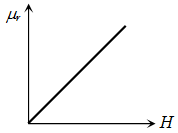
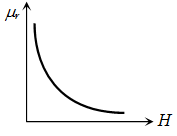
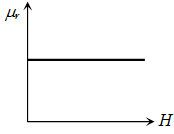
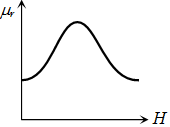
For ferromagnetic material, the relative permeability $\left.(\mu_r\right)$ versus magnetic intensity $(H)$ has the following shape
View full question & answer→MCQ 1301 Mark
The $X – 1/T$ graph for an alloy of paramagnetic nature is shown in Fig. The curie constant is, then
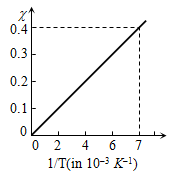
AnswerCorrect option: A. $57 K$
$57 K$
View full question & answer→MCQ 1311 Mark
A curve between magnetic moment and temperature of magnet is
MCQ 1321 Mark
Two identical bar magnets with a length $10 \ cm$ and weight $50$ $gm-$weight are arranged freely with their like poles facing in a inverted vertical glass tube. The upper magnet hangs in the air above the lower one so that the distance between the nearest pole of the magnet is $3\ mm.$ Pole strength of the poles of each magnet will be
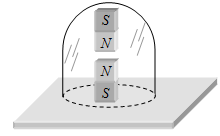
- ✓
$6.64\ amp \times m$
- B
$2\ amp \times m$
- C
$10.25\ amp \times m$
- D
AnswerCorrect option: A. $6.64\ amp \times m$
$6.64\ amp \times m$
View full question & answer→MCQ 1331 Mark
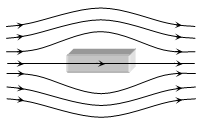
The given figure represents a material which is
MCQ 1341 Mark
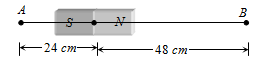
A bar magnet of length $3 \ cm$ has points $A$ and $B$ along its axis at distances of $24 \ cm$ and $48 \ cm$ on the opposite sides. Ratio of magnetic fields at these points will be
- ✓
$8$
- B
$\frac{1}{2} \sqrt 2 $
- C
$3$
- D
$4$
View full question & answer→MCQ 1351 Mark
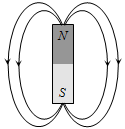
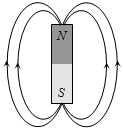
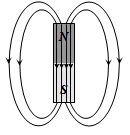
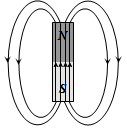
The magnetic field lines due to a bar magnet are correctly shown in
Question 1361 Mark
Assertion : To protect any instrument from external magnetic field, it is put inside an iron body.
Reason : Iron is a magnetic substance.(a) If both assertion and reason are true and the reason is the correct explanation of the assertion.(b) If both assertion and reason are true but reason is not the correct explanation of the assertion.(c) If assertion is true but reason is false.(d) If the assertion and reason both are false.
Answer(a) If both assertion and reason are true and the reason is the correct explanation of the assertion.
View full question & answer→Question 1371 Mark
Assertion : A paramagnetic sample display greater magnetisation (for the same magnetising field) when cooled.
Reason : The magnetisation does not depend on temperature.(a) If both assertion and reason are true and the reason is the correct explanation of the assertion.(b) If both assertion and reason are true but reason is not the correct explanation of the assertion.(c) If assertion is true but reason is false.(d) If the assertion and reason both are false.
Answer(c) If assertion is true but reason is false.
View full question & answer→MCQ 1381 Mark
Assertion : Magnetic moment of an atom is due to both, the orbital motion and spin motion of every electron.
Reason : A charged particle produces a magnetic field.
- A
If both assertion and reason are true and the reason is the correct explanation of the assertion.
- B
If both assertion and reason are true but reason is not the correct explanation of the assertion.
- ✓
If assertion is true but reason is false.
- D
If the assertion and reason both are false.
AnswerCorrect option: C. If assertion is true but reason is false.
If assertion is true but reason is false.
View full question & answer→Question 1391 Mark
Assertion : Magnetism is relativistic.
Reason : When we move along with the charge so that there is no motion relative to us, we find no magnetic field associated with the charge.(a) If both assertion and reason are true and the reason is the correct explanation of the assertion.(b) If both assertion and reason are true but reason is not the correct explanation of the assertion.(c) If assertion is true but reason is false.(d) If the assertion and reason both are false.
Answer(a) If both assertion and reason are true and the reason is the correct explanation of the assertion.
View full question & answer→Question 1401 Mark
Assertion : The properties of paramagnetic and ferromagnetic substance are not effected by heating.
Reason : As temperature rises, the alignment of molecular magnets gradually decreases.(a) If both assertion and reason are true and the reason is the correct explanation of the assertion.(b) If both assertion and reason are true but reason is not the correct explanation of the assertion.(c) If assertion is true but reason is false.(d) If assertion is false but reason is true.
Answer(d) If assertion is false but reason is true.
View full question & answer→Question 1411 Mark
Assertion : When radius of circular loop carrying current is doubled, its magnetic moment becomes four times.
Reason : Magnetic moment depends on area of the loop.(a) If both assertion and reason are true and the reason is the correct explanation of the assertion.(b) If both assertion and reason are true but reason is not the correct explanation of the assertion.(c) If assertion is true but reason is false.(d) If the assertion and reason both are false.
Answer(b) If both assertion and reason are true but reason is not the correct explanation of the assertion.
View full question & answer→MCQ 1421 Mark
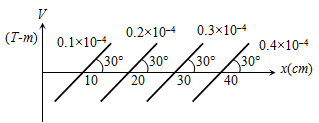
Some equipotential surfaces of the magnetic scalar potential are shown in the figure. Magnetic field at a point in the region is
AnswerCorrect option: B. $2 \times 10^{-4} \mathrm{~T}$
$2\times 10^{-4} \mathrm{~T}$
View full question & answer→MCQ 1431 Mark
The variation of magnetic susceptibility $(x)$ with temperature for a diamagnetic substance is best represented by
View full question & answer→MCQ 1441 Mark
A dip needle lies initially in the magnetic meridian when it shows an angle of dip $\theta$ at a place. The dip circle is rotated through an angle $x$ in the horizontal plane and then it shows an angle of dip $\theta^{\prime}.$ Then $\frac{\tan \theta^{\prime}}{\tan _{13} \theta}$
- ✓
$\frac{1}{\cos x}$
- B
$\frac{1}{\sin x}$
- C
$\frac{1}{\tan x}$
- D
$\cos x$
AnswerCorrect option: A. $\frac{1}{\cos x}$
$\frac{1}{\cos x}$
View full question & answer→Question 1451 Mark
A short magnet oscillates with a time period 0.1 s at a place where horizontal magnetic field is 24μT. A downward current of 18 A is established in a vertical wire 20 cm east of the magnet. The new time period of oscillator(a) 0.1 s(b) 0.089 s(c) 0.076 s(d) 0.057 s
MCQ 1461 Mark
The unit for molar susceptibility is
- ✓
$m^{3}$
- B
$kg-m^{–3}$
- C
$kg^{–1} m^{3}$
- D
AnswerCorrect option: A. $m^{3}$
$m^3$
View full question & answer→MCQ 1471 Mark
A dip needle vibrates in the vertical plane perpendicular to the magnetic meridian. The time period of vibration is found to be $2$ seconds. The same needle is then allowed to vibrate in the horizontal plane and the time period is again found to be $2$ seconds. Then the angle of dip is
- A
$0^\circ$
- B
$30^\circ$
- ✓
$45^\circ$
- D
$90^\circ$
AnswerCorrect option: C. $45^\circ$
$45^\circ$
View full question & answer→MCQ 1481 Mark
A magnet is suspended in the magnetic meridian with an untwisted wire. The upper end of wire is rotated through $180^{\circ}$ to deflect the magnet by $30^{\circ}$ from magnetic meridian. When this magnet is replaced by another magnet, the upper end of wire is rotated through $270^{\circ}$ to deflect the magnet $30^{\circ}$ from magnetic meridian. The ratio of magnetic moments of magnets is
- A
$1: 5$
- B
$1: 8$
- ✓
$5: 8$
- D
$8: 5$
AnswerCorrect option: C. $5: 8$
$5: 8$
View full question & answer→MCQ 1491 Mark
Two magnets of equal mass are joined at right angles to each other as shown the magnet $1$ has a magnetic moment $3$ times that of magnet $2.$ This arrangement is pivoted so that it is free to rotate in the horizontal plane. In equilibrium what angle will the magnet $1$ subtend with the magnetic meridian
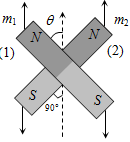
AnswerCorrect option: B. $\tan ^{-1}\left(\frac{1}{3}\right)$
$\tan ^{-1}\left(\frac{1}{3}\right)$
View full question & answer→MCQ 1501 Mark
A bar magnet has coercivity $4 \times 10^3 Am^{-1}.$ It is desired to demagnetise it by inserting it inside a solenoid $12 \ cm$ long and having $60$ turns. The current that should be sent through the solenoid is
View full question & answer→MCQ 1511 Mark
Each atom of an iron bar $(5\ cm \times 1 \ cm \times 1 \ cm)$ has a magnetic moment $1.8 \times 10^{-23} Am^2.$ Knowing that the density of iron is $7.78 \times 10^3 kg^{-3} m$ atomic weight is $56$ and Avogadro's number is $6.02 \times 10^{23}$ the magnetic moment of bar in the state of magnetic saturation will be
- A
$4.75\ Am ^2$
- B
$5.74\ Am ^2$
- ✓
$7.54\ Am ^2$
- D
$75.4\ Am ^2$
AnswerCorrect option: C. $7.54\ Am ^2$
$7.54\ Am ^2$
View full question & answer→Question 1521 Mark
Assertion : The earth’s magnetic field does not affect the working of a moving coil galvanometer.
Reason : Earth’s magnetic field is very weak.(a) If both assertion and reason are true and the reason is the correct explanation of the assertion.(b) If both assertion and reason are true but reason is not the correct explanation of the assertion.(c) If assertion is true but reason is false.(d) If the assertion and reason both are false.
Answer(a) If both assertion and reason are true and the reason is the correct explanation of the assertion.
View full question & answer→MCQ 1531 Mark
Two magnets $A$ and $B$ are identical and these are arranged as shown in the figure. Their length is negligible in comparison to the separation between them. A magnetic needle is placed between the magnets at point $P$ which gets deflected through an angle $\theta$ under the influence of magnets. The ratio of distance $d_1$ and $d_2$ will be
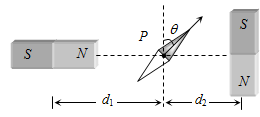
- A
$(2 \tan \theta)^{1 / 3}$
- B
$(2 \tan \theta)^{-1 / 3}$
- ✓
$(2 \cot \theta)^{1 / 3}$
- D
$(2 \cot \theta)^{-1 / 3}$
AnswerCorrect option: C. $(2 \cot \theta)^{1 / 3}$
$(2 \cot \theta)^{1 / 3}$
View full question & answer→Question 1541 Mark
Assertion : The earth’s magnetic field is due to iron present in its core.
Reason : At a high temperature magnet losses its magnetic property or magnetism.(a) If both assertion and reason are true and the reason is the correct explanation of the assertion.(b) If both assertion and reason are true but reason is not the correct explanation of the assertion.(c) If assertion is true but reason is false.(d) If assertion is false but reason is true.
Answer(d) If assertion is false but reason is true.
View full question & answer→Question 1551 Mark
Assertion : The poles of magnet cannot be separated by breaking into two pieces.
Reason : The magnetic moment will be reduced to half when a magnet is broken into two equal pieces.(a) If both assertion and reason are true and the reason is the correct explanation of the assertion.(b) If both assertion and reason are true but reason is not the correct explanation of the assertion.(c) If assertion is true but reason is false.(d) If the assertion and reason both are false.
Answer(b) If both assertion and reason are true but reason is not the correct explanation of the assertion.
View full question & answer→Question 1561 Mark
A diamagnetic material in a magnetic field moves(a) From weaker to the stronger parts of the field(b) Perpendicular to the field(c) From stronger to the weaker parts of the field(d) In none of the above directions
Answer(c) From stronger to the weaker parts of the field
View full question & answer→MCQ 1571 Mark
A vibration magnetometer consists of two identical bar magnets placed one over the other such that they are perpendicular and bisect each other. The time period of oscillation in a horizontal magnetic field is $2^{5 / 4}$ seconds. One of the magnets is removed and if the other magnet oscillates in the same field, then the time period in seconds is
- A
$2^{1 / 4}$
- B
$2^{1 / 2}$
- ✓
$2$
- D
$2^{3 / 4}$
View full question & answer→MCQ 1581 Mark
The variation of the intensity of magnetisation $(I)$ with respect to the magnetising field $(H)$ in a diamagnetic substance is described by the graph
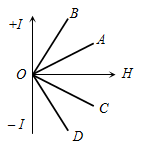
View full question & answer→MCQ 1591 Mark
The figure illustrate how $B$, the flux density inside a sample of unmagnetised ferromagnetic material varies with $B_0,$ the magnetic flux density in which the sample is kept. For the sample to be suitable for making a permanent magnet
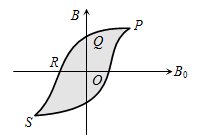
- A
$OQ$ should be large, $OR$ should be small
- ✓
$OQ$ and $OR$ should both be large
- C
$OQ$ should be small and $OR$ should be large
- D
$OQ$ and $OR$ should both be small
AnswerCorrect option: B. $OQ$ and $OR$ should both be large
$OQ$ and $OR$ should both be large
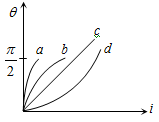
View full question & answer→MCQ 1601 Mark
Which curve may best represent the current deflection in a tangent galvanometer
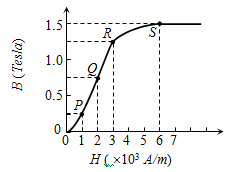
MCQ 1611 Mark
The basic magnetization curve for a ferromagnetic material is shown in figure. Then, the value of relative permeability is highest for the point
MCQ 1621 Mark
Two identical short bar magnets, each having magnetic moment $M,$ are placed a distance of $2d$ apart with axes perpendicular to each other in a horizontal plane. The magnetic induction at a point midway between them is
- A
$\frac{\mu_0}{4 \pi}(\sqrt{2}) \frac{ M }{ d ^3}$
- B
$\frac{\mu_0}{4 \pi}(\sqrt{3}) \frac{ M }{ d ^3}$
- C
$\left(\frac{2 \mu_0}{\pi}\right) \frac{M}{d^3}$
- ✓
$\frac{\mu_0}{4 \pi}(\sqrt{5}) \frac{M}{d^3}$
AnswerCorrect option: D. $\frac{\mu_0}{4 \pi}(\sqrt{5}) \frac{M}{d^3}$
$\frac{\mu_0}{4 \pi}(\sqrt{5}) \frac{M}{d^3}$
View full question & answer→MCQ 1631 Mark
A short bar magnet with its north pole facing north forms a neutral point at $P$ in the horizontal plane. If the magnet is rotated by $90^{\circ}$ in the horizontal plane, the net magnetic induction at $P$ is $($Horizontal component of earth's magnetic field $=B_H)$
AnswerCorrect option: D. $\sqrt{5} \mathrm{~B}_{\mathrm{H}}$
$\sqrt{5} \mathrm{~B}_{\mathrm{H}}$
View full question & answer→Question 1641 Mark
Among the following properties describing diamagnetism identify the property that is wrongly stated(a) Diamagnetic material do not have permanent magnetic moment(b) Diamagnetism is explained in terms of electromagnetic induction(c) Diamagnetic materials have a small positive susceptibility(d) The magnetic moment of individual electrons neutralize each other
Answer(c) Diamagnetic materials have a small positive susceptibility
View full question & answer→MCQ 1651 Mark
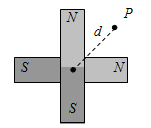
Two short magnets of equal dipole moments $M$ are fastened perpendicularly at their centre $($figure$).$ The magnitude of the magnetic field at a distance $d$ from the centre on the bisector of the right angle is
- A
$\frac{\mu_0}{4 \pi} \frac{ M }{ d ^3}$
- B
$\frac{\mu_0}{4 \pi} \frac{ M \sqrt{2}}{d^3}$
- ✓
$\frac{\mu_0}{4 \pi} \frac{2 \sqrt{2} M}{d^3}$
- D
$\frac{\mu_0}{4 \pi} \frac{2 M}{d^3}$
AnswerCorrect option: C. $\frac{\mu_0}{4 \pi} \frac{2 \sqrt{2} M}{d^3}$
$\frac{\mu_0}{4 \pi} \frac{2 \sqrt{2} M}{d^3}$
View full question & answer→MCQ 1661 Mark
If the magnetic dipole moment of an atom of diamagnetic material, paramagnetic material and ferromagnetic material denoted by $\mu_d, \mu_p, \mu_f$ respectively then
- A
$\mu_d \neq 0$ and $\mu_f \neq 0$
- B
$\mu_p=0$ and $\mu_f \neq 0$
- ✓
$\mu_d=0$ and $\mu_p \neq 0$
- D
$\mu_d \neq 0$ and $\mu_p=0$
AnswerCorrect option: C. $\mu_d=0$ and $\mu_p \neq 0$
$\mu_d=0$ and $\mu_p \neq 0$
View full question & answer→Question 1671 Mark
In the hysteresis cycle, the value of H needed to make the intensity of magnetisation zero is called(a) Retentivity(b) Coercive force(c) Lorentz force(d) None of the above
Question 1681 Mark
Which of the following is diamagnetism(a) Aluminium(b) Quartz(c) Nickel (d) Bismuth
Question 1691 Mark
When a piece of a ferromagnetic substance is put in a uniform magnetic field, the flux density inside it is four times the flux density away from the piece. The magnetic permeability of the material is(a) 1(b) 2(c) 3(d) 4
Question 1701 Mark
The magnetic susceptibility of any paramagnetic material changes with absolute temperature T as(a) Directly proportional to T(b) Remains constant(c) Inversely proportional to T(d) Exponentially decaying with T
Answer(c) Inversely proportional to T
View full question & answer→MCQ 1711 Mark
For an isotropic medium $B, m, H$ and $M$ are related as $($where $B, \mu_0, H$ and $M$ have their usual meaning in the context of magnetic material
- A
$(B-M)=\mu_0 H$
- B
$M=\mu_0(H+M)$
- C
$H=\mu_0(H+M)$
- ✓
$B=\mu_0(H+M)$
AnswerCorrect option: D. $B=\mu_0(H+M)$
$B=\mu_0(H+M)$
View full question & answer→Question 1721 Mark
The materials suitable for making electromagnets should have(a) High retentivity and high coercivity(b) Low retentivity and low coercivity(c) High retentivity and low coercivity(d) Low retentivity and high coercivity
Answer(c) High retentivity and low coercivity
View full question & answer→Question 1731 Mark
Liquid oxygen remains suspended between two pole faces of a magnet because it is(a) Diamagnetic(b) Paramagnetic(c) Ferromagnetic(d) Antiferromagnetic
Question 1741 Mark
Which one of the following is a non-magnetic substance(a) Iron(b) Nickel(c) Cobalt(d) Brass
Question 1751 Mark
A frog can be deviated in a magnetic field produced by a current in a vertical solenoid placed below the frog. This is possible because the body of the frog behaves as(a) Paramagnetic(b) Diamagnetic(c) Ferromagnetic(d) Antiferromagnetic
Question 1761 Mark
A small rod of bismuth is suspended freely between the poles of a strong electromagnet. It is found to arrange itself at right angles to the magnetic field. This observation establishes that bismuth is(a) Diamagnetic(b) Paramagnetic(c) Ferri-magnetic(d) Antiferro-magnetic
Question 1771 Mark
Curie-Weiss law is obeyed by iron at a temperature ......(a) Below Curie temperature(b) Above Curie temperature(c) At Curie temperature only(d) At all temperatures
Answer(b) Above Curie temperature
View full question & answer→Question 1781 Mark
Which of the following statements is incorrect about hysteresis(a) This effect is common to all ferromagnetic substances(b) The hysteresis loop area is proportional to the thermal energy developed per unit volume of the material(c) The hysteresis loop area is independent of the thermal energy developed per unit volume of the material(d) The shape of the hysteresis loop is characteristic of the material
Answer(c) The hysteresis loop area is independent of the thermal energy developed per unit volume of the material
View full question & answer→Question 1791 Mark
The universal property of all substances is(a) Diamagnetism(b) Ferromagnetism(c) Paramagnetism(d) All of these
Question 1801 Mark
The magnetic susceptibility is negative for(a) Paramagnetic materials(b) Diamagnetic materials(c) Ferromagnetic materials(d) Paramagnetic and ferromagnetic materials
Answer(b) Diamagnetic materials
View full question & answer→Question 1811 Mark
If a magnetic substance is kept in a magnetic field, then which of the following is thrown out(a) Paramagnetic(b) Ferromagnetic(c) Diamagnetic(d) Antiferromagnetic
Question 1821 Mark
Susceptibility of ferromagnetic substance is(a) > 1(b) < 1(c) 0 (d) 1
Question 1831 Mark
Identify the paramagnetic substance(a) Iron(b) Aluminium(c) Nickel (d) Hydrogen
Question 1841 Mark
The magnetic susceptibility does not depend upon the temperature in(a) Ferrite substances(b) Ferromagnetic substances(c) Diamagnetic substances(d) Paramagnetic substances
Answer(c) Diamagnetic substances
View full question & answer→Question 1851 Mark
Which of the following is true(a) Diamagnetism is temperature dependent(b) Paramagnetism is temperature dependent(c) Paramagnetism is temperature independent(d) None of these
Answer(b) Paramagnetism is temperature dependent
View full question & answer→Question 1861 Mark
If a diamagnetic solution is poured into a U-tube and one arm of this U-tube placed between the poles of a strong magnet with the meniscus in a line with the field, then the level of the solution will(a) Rise(b) Fall(c) Oscillate slowly(d) Remain as such
Question 1871 Mark
Magnetic permeability is maximum for(a) Diamagnetic substance(b) Paramagnetic substance(c) Ferromagnetic substance(d) All of these
Answer(c) Ferromagnetic substance
View full question & answer→Question 1881 Mark
The use of study of hysteresis curve for a given material is to estimate the(a) Voltage loss(b) Hysteresis loss(c) Current loss(d) All of these
Question 1891 Mark
An example of a diamagnetic substance is(a) Aluminium(b) Copper(c) Iron (d) Nickel
Question 1901 Mark
Assertion : The ferromagnetic substance do not obey Curie’s law.
Reason : At Curie point a ferromagnetic substance start behaving as a paramagnetic substance.(a) If both assertion and reason are true and the reason is the correct explanation of the assertion.(b) If both assertion and reason are true but reason is not the correct explanation of the assertion.(c) If assertion is true but reason is false.(d) If the assertion and reason both are false.
Answer(b) If both assertion and reason are true but reason is not the correct explanation of the assertion.
View full question & answer→MCQ 1911 Mark
Relative permeability of iron is $5500,$ then its magnetic susceptibility will be
- A
$5500 \times 10^7$
- B
$5500 \times 10^{–7}$
- C
$5501$
- ✓
$5499$
AnswerCorrect option: D. $5499$
$5499$
View full question & answer→Question 1921 Mark
Diamagnetic substances are(a) Feebly attracted by magnets(b) Strongly attracted by magnets(c) Feebly repelled by magnets(d) Strongly repelled by magnets
Answer(c) Feebly repelled by magnets
View full question & answer→MCQ 1931 Mark
The dipole moment of each molecule of a paramagnetic gas is $1.5 \times 10^{-23} \ \mathrm{amp} \times \mathrm{m}^2$. The temperature of gas is $27^{\circ} \mathrm{C}$ and the number of molecules per unit volume in it is $2 \times 10^{26} \mathrm{~m}^{-3}$. The maximum possible intensity of magnetisation in the gas will be
- ✓
$3 \times 10^3 \mathrm{amp} / \mathrm{m}$
- B
$4 \times 10^{-3} \mathrm{amp} / \mathrm{m}$
- C
$5 \times 10^5 \mathrm{amp} / \mathrm{m}$
- D
$6 \times 10^{-4} \mathrm{amp} / \mathrm{m}$
AnswerCorrect option: A. $3 \times 10^3 \mathrm{amp} / \mathrm{m}$
$3 \times 10^3 \mathrm{amp} / \mathrm{m}$
View full question & answer→Question 1941 Mark
Substances in which the magnetic moment of a single atom is not zero, is known as(a) Diamagnetism(b) Ferromagnetism(c) Paramagnetism(d) Ferrimagnetism
Question 1951 Mark
The only property possessed by ferromagnetic substance is(a) Hysteresis(b) Susceptibility(c) Directional property(d) Attracting magnetic substances
MCQ 1961 Mark
When $2$ amperes current is passed through a tangent galvanometer, it gives a deflection of $30^{\circ}$. For $60^{\circ}$ deflection, the current must be
AnswerCorrect option: D. $6 \ \mathrm{amp}$
$6 \ \mathrm{amp}$
View full question & answer→MCQ 1971 Mark
A magnet freely suspended in a vibration magnetometer makes $10$ oscillations per minute at a place $A$ and $20$ oscillations per minute at a place $B$. If the horizontal component of earth’s magnetic field at $A$ is $36 \times 10^{-6}T$ , then its value at $B$ is
- A
$36 \times 10^{–6} T$
- B
$72 \times 10^{–6} T$
- ✓
$144 \times 10^{–6} T$
- D
$288 \times 10^{–6} T$
AnswerCorrect option: C. $144 \times 10^{–6} T$
$144 \times 10^{–6} T$
View full question & answer→MCQ 1981 Mark
Before using the tangent galvanometer, its coil is set in
AnswerCorrect option: A. Magnetic meridian $($or vertically north south$)$
Magnetic meridian $($or vertically north south$)$
View full question & answer→MCQ 1991 Mark
The error in measuring the current with a tangent galvanometer is minimum when the deflection is about
- A
$0^\circ$
- B
$30^\circ$
- ✓
$45^\circ$
- D
$60^\circ$
AnswerCorrect option: C. $45^\circ$
$45^\circ$
View full question & answer→MCQ 2001 Mark
Which of the following statement is not the true
AnswerCorrect option: A. While taking reading of tangent galvanometer, the plane of the coil must be set at right angles to the earth’s magnetic meridian
While taking reading of tangent galvanometer, the plane of the coil must be set at right angles to the earth’s magnetic meridian
View full question & answer→Question 2011 Mark
When a magnetic substance is heated, then it(a) Becomes a strong magnet(b) Losses its magnetism(c) Does not effect the magnetism(d) Either (a) or (c)
MCQ 2021 Mark
A magnet oscillating in a horizontal plane has a time period of $2$ second at a place where the angle of dip is $30^{\circ}$ and $3$ seconds at another place where the angle of dip is $60^{\circ}.$ The ratio of resultant magnetic fields at the two places is
- A
$\frac{4 \sqrt{3}}{7}$
- B
$\frac{4}{9 \sqrt{3}}$
- ✓
$\frac{9}{4 \sqrt{3}}$
- D
$\frac{9}{\sqrt{3}}$
AnswerCorrect option: C. $\frac{9}{4 \sqrt{3}}$
$\frac{9}{4 \sqrt{3}}$
View full question & answer→MCQ 2031 Mark
The length of a magnet is large compared to its width and breadth. The time period of its oscillation in a vibration magnetometer is $2 s.$ The magnet is cut along its length into three equal parts and three parts are then placed on each other with their like poles together. The time period of this combination will be
AnswerCorrect option: B. $2 / 3 \mathrm{~s}$
$2 / 3 \mathrm{~s}$
View full question & answer→Question 2041 Mark
A bar magnet is oscillating in the earth's magnetic field with time period T. If its mass is increased four times then its time period will be (a) 4 T (b) 2T(c) T (d) T/2
MCQ 2051 Mark
A bar magnet is oscillating in the Earth’s magnetic field with a period $T.$ What happens to its period and motion if its mass is quadrupled
- ✓
Motion remains $\text{S.H.M.}$ with time period $= 2T$
- B
Motion remains $\text{S.H.M.}$ with time period $= 4T$
- C
Motion remains $\text{S.H.M.}$ and period remains nearly constant
- D
Motion remains $\text{S.H.M.}$ with time period $= \frac{T}{2}$
AnswerCorrect option: A. Motion remains $\text{S.H.M.}$ with time period $= 2T$
Motion remains $\text{S.H.M.}$ with time period $= 2T$
View full question & answer→MCQ 2061 Mark
In a tangent galvanometer a current of $0.1 A$ produces a deflection of $30^\circ$. The current required to produce a deflection of
$60^\circ$ is
- A
$0.2 A $
- ✓
$0.3 A$
- C
$0.4 A $
- D
$0.5 A$
AnswerCorrect option: B. $0.3 A$
$0.3 A$
View full question & answer→MCQ 2071 Mark
The magnetic susceptibility is
- ✓
$x=\frac{1}{H}$
- B
$x=\frac{B}{H}$
- C
$x =\frac{ M }{ V }$
- D
$x=\frac{M}{H}$
AnswerCorrect option: A. $x=\frac{1}{H}$
$x=\frac{1}{H}$
View full question & answer→MCQ 2081 Mark
The magnetic needle of a tangent galvanometer is deflected at an angle $30^{\circ}$ due to a magnet. The horizontal component of earth's magnetic field $0.34 \times 10^{-4} \mathrm{T}$ is along the plane of the coil. The magnetic intensity is
- A
$1.96 \times 10^{-4} \mathrm{~T}$
- ✓
$1.96 \times 10^{-5} \mathrm{~T}$
- C
$1.96 \times 10^4 \mathrm{~T}$
- D
$1.96 \times 10^5 \mathrm{~T}$
AnswerCorrect option: B. $1.96 \times 10^{-5} \mathrm{~T}$
$1.96 \times 10^{-5} \mathrm{~T}$
View full question & answer→Question 2091 Mark
The period of oscillations of a magnet is 2 sec. When it is remagnetised so that the pole strength is 4 times its period will be(a) 4 sec (b) 2 sec(c) 1 sec (d) 1/2 sec
MCQ 2101 Mark
The time period of a vibration magnetometer is $T_0$. Its magnet is replaced by another magnet whose moment of inertia is $3$ times and magnetic moment is $1 / 3$ of the initial magnet. The time period now will be
AnswerCorrect option: A. $3 \mathrm{T}_0$
$3 \mathrm{T}_0$
View full question & answer→MCQ 2111 Mark
A magnet makes $40$ oscillations per minute at a place having magnetic field intensity of $0.1 \times 10^{–5} T$. At another place, it takes $2.5 \sec$ to complete one vibration. The value of earth’s horizontal field at that place is
- A
$0.25 \times 10^{–6} T$
- ✓
$0.36 \times 10^{–6} T$
- C
$0.66 \times 10^{–8} T$
- D
$1.2 \times 10^{–6} T$
AnswerCorrect option: B. $0.36 \times 10^{–6} T$
$0.36 \times 10^{–6} T$
View full question & answer→Question 2121 Mark
The magnet of a vibration magnetometer is heated so as to reduce its magnetic moment by 19%. By doing this the periodic time of the magnetometer will(a) Increase by 19%(b) Decrease by 19%(c) Increase by 11%(d) Decrease by 21%
MCQ 2131 Mark
When two magnetic moments are compared using equal distance method the deflections produced are $45^{\circ}$ and $30^{\circ}.$ If the length of magnets are in the ratio $1: 2,$ the ratio of their pole strengths is
- A
$3: 1$
- B
$3: 2$
- C
$\sqrt{3}: 1$
- ✓
$2 \sqrt{3}: 1$
AnswerCorrect option: D. $2 \sqrt{3}: 1$
$2 \sqrt{3}: 1$
View full question & answer→Question 2141 Mark
Two short magnets having magnetic moments in the ratio 27 : 8, when placed on opposite sides of a deflection magnetometer, produce no deflection. If the distance of the weaker magnet is 0.12 m from the centre of deflection magnetometer, the distance of the stronger magnet from the centre is(a) 0.06 m(b) 0.08 m(c) 0.12 m(d) 0.18 m
MCQ 2151 Mark
Two identical bar magnets are placed on above the other such that they are mutually perpendicular and bisect each other. The time period of this combination in a horizontal magnetic field is $T.$ The time period of each magnet in the same field is
- A
$\sqrt{2} \mathrm{~T}$
- B
$2^{1 / 4} \mathrm{~T}$
- ✓
$2^{-1 / 4} \mathrm{~T}$
- D
$2^{-1 / 2} \mathrm{~T}$
AnswerCorrect option: C. $2^{-1 / 4} \mathrm{~T}$
$2^{-1 / 4} \mathrm{~T}$
View full question & answer→Question 2161 Mark
Which of the following statement is true about magnetic moments of atoms of different elements(a) All have a magnetic moment(b) None has a magnetic moment(c) All acquire a magnetic moment under external magnetic field and in same direction as the field(d) None of the above statements are accurate
Answer(d) None of the above statements are accurate
View full question & answer→MCQ 2171 Mark
A thin rectangular magnet suspended freely has a period of oscillation equal to $T.$ Now it is broken into two equal halves $($each having half of the original length$)$ and one piece is made to oscillate freely in the same field. If its period of oscillation is $T ¢,$ then ratio $\frac{ T ^\ {\prime}}{ T }$ is
- A
$\frac{1}{4}$
- B
$\frac{1}{2 \sqrt{2}}$
- ✓
$\frac{1}{2}$
- D
$2$
AnswerCorrect option: C. $\frac{1}{2}$
$\frac{1}{2}$
View full question & answer→MCQ 2181 Mark
At a certain place the horizontal component of the earth's magnetic field is $\mathrm{B}_0$ and the angle of dip is $45^{\circ}.$ The total intensity of the field at that place will be
- A
$\mathrm{B}_0$
- ✓
$\sqrt{2} \mathrm{B}_0$
- C
$2 \mathrm{B}_0$
- D
$\mathrm{B}_0{ }^2$
AnswerCorrect option: B. $\sqrt{2} \mathrm{B}_0$
$\sqrt{2} \mathrm{B}_0$
View full question & answer→MCQ 2191 Mark
Angle of dip is $90^\circ$ at
View full question & answer→MCQ 2201 Mark
Two bar magnets with magnetic moments $2 M$ and $M$ are fastened together at right angles to each other at their centres to form a crossed system, which can rotate freely about a vertical axis through the centre. The crossed system sets in earth’s magnetic field with magnet having magnetic moment $2M$ making and angle $q$ with the magnetic meridian such that
- A
$\theta=\tan ^{-1}\left(\frac{1}{\sqrt{3}}\right)$
- B
$\theta=\tan ^{-1}(\sqrt{3})$
- ✓
$\theta=\tan ^{-1}\left(\frac{1}{2}\right)$
- D
$\theta=\tan ^{-1}\left(\frac{3}{4}\right)$
AnswerCorrect option: C. $\theta=\tan ^{-1}\left(\frac{1}{2}\right)$
$\theta=\tan ^{-1}\left(\frac{1}{2}\right)$
View full question & answer→MCQ 2211 Mark
At the magnetic poles of the earth, a compass needle will be
Question 2221 Mark
Let V and H be the vertical and horizontal components of earth's magnetic field at any point on earth. Near the north pole(a) V >> H(b) V << H (c) V = H (d) V = H = 0
MCQ 2231 Mark
A current carrying coil is placed with its axis perpendicular to $N-S$ direction. Let horizontal component of earth's magnetic field be $\mathrm{H}_{\mathrm{o}}$ and magnetic field inside the loop is $H.$ If a magnet is suspended inside the loop, it makes angle $\theta$ with $H .$ Then $\theta=$
- A
$\tan ^{-1}\left(\frac{\mathrm{H}_{\mathrm{o}}}{\mathrm{H}}\right)$
- ✓
$\tan ^{-1}\left(\frac{\mathrm{H}}{\mathrm{H}_0}\right)$
- C
$\operatorname{cosec}^{-1}\left(\frac{\mathrm{H}}{\mathrm{H}_0}\right)$
- D
$\cot ^{-1}\left(\frac{\mathrm{H}_0}{\mathrm{H}}\right)$
AnswerCorrect option: B. $\tan ^{-1}\left(\frac{\mathrm{H}}{\mathrm{H}_0}\right)$
$\tan ^{-1}\left(\frac{\mathrm{H}_{\mathrm{o}}}{\mathrm{H}}\right)$
View full question & answer→Question 2241 Mark
Isogonic lines on magnetic map will have(a) Zero angle of dip(b) Zero angle of declination(c) Same angle of declination(d) Same angle of dip
Answer(c) Same angle of declination
View full question & answer→Question 2251 Mark
At which place, earth's magnetism become horizontal(a) Magnetic pole(b) Geographical pole(c) Magnetic meridian(d) Magnetic equator
Question 2261 Mark
A bar magnet is situated on a table along east-west direction in the magnetic field of earth. The number of neutral points, where the magnetic field is zero, are(a) 2(b) 0(c) 1(d) 4
Question 2271 Mark
The direction of the null points is on the equatorial line of a bar magnet, when the north pole of the magnet is pointing(a) North(b) South(c) East(d) West
MCQ 2281 Mark
Which of the following relation is correct in magnetism
- ✓
$I ^2= V ^2+ H ^2$
- B
$I = V + H$
- C
$V = I ^2+ H ^2$
- D
$V ^2= I + H$
AnswerCorrect option: A. $I ^2= V ^2+ H ^2$
$I ^2= V ^2+ H ^2$
View full question & answer→Question 2291 Mark
The value of angle of dip is zero at the magnetic equator because on it(a) V and H are equal(b) The value of V and H is zero(c) The value of V is zero(d) The value of H is zero
Answer(c) The value of V is zero
View full question & answer→Question 2301 Mark
Magnetic meridian is a(a) Point(b) Horizontal plane(c) Vertical plane(d) Line along N-S
MCQ 2311 Mark
The horizontal component of the earth's magnetic field is $0.22$ Gauss and total magnetic field is $0.4$ Gauss. The angle of dip. is
- A
$\tan ^{-1}(1)$
- B
$\tan ^{-1}(\infty)$
- ✓
$\tan ^{-1}(1.518)$
- D
$\tan ^{-1}(\pi)$
AnswerCorrect option: C. $\tan ^{-1}(1.518)$
$\tan ^{-1}(1.518)$
View full question & answer→Question 2321 Mark
The magnetic compass is not useful for navigation near the magnetic poles because(a) The magnetic field near the poles is zero(b) The magnetic field near the poles is almost vertical(c) At low temperature, the compass needle looses its magnetic properties(d) Neither of the above
Answer(b) The magnetic field near the poles is almost vertical
View full question & answer→MCQ 2331 Mark
The magnetic moment of a magnet of length $10 \ cm$ and pole strength $4.0 \ Am$ will be
- ✓
$0.4 \ \mathrm{Am}^2$
- B
$1.6 \ \mathrm{Am}^2$
- C
$20 \ \mathrm{Am}^2$
- D
$8.0 \ \mathrm{Am}^2$
AnswerCorrect option: A. $0.4 \ \mathrm{Am}^2$
$0.4 \ \mathrm{Am}^2$
View full question & answer→Question 2341 Mark
The angle of dip is the angle(a) Between the vertical component of earth's magnetic field and magnetic meridian(b) Between the vertical component of earth's magnetic field and geographical meridian(c) Between the earth's magnetic field direction and horizontal direction(d) Between the magnetic meridian and the geographical meridian
Answer(c) Between the earth's magnetic field direction and horizontal direction
View full question & answer→Question 2351 Mark
Two like magnetic poles of strength 10 and 40 SI units are separated by a distance 30 cm. The intensity of magnetic field is zero on the line joining them(a) At a point 10 cm from the stronger pole(b) At a point 20 cm from the stronger pole(c) At the mid-point(d) At infinity
Answer(b) At a point 20 cm from the stronger pole
View full question & answer→MCQ 2361 Mark
Two magnets, each of magnetic moment $' M\ '$ are placed so as to form a cross at right angles to each other. The magnetic moment of the system will be
- A
$2 M$
- ✓
$\sqrt{2} \mathrm{M}$
- C
$0.5 M$
- D
$M$
AnswerCorrect option: B. $\sqrt{2} \mathrm{M}$
$\sqrt{2} \mathrm{M}$
View full question & answer→Question 2371 Mark
Magnetic dipole moment is a(a) Scalar quantity(b) Vector quantity(c) Constant quantity(d) None of these
MCQ 2381 Mark
The torque on a bar magnet due to the earth's magnetic field is maximum when the axis of the magnet is
AnswerCorrect option: A. Perpendicular to the field of the earth
Perpendicular to the field of the earth
View full question & answer→MCQ 2391 Mark
The work done in rotating a magnet of magnetic moment $2 A-m^2$ in a magnetic field of $5 \times 10^{–3} T$ from the direction along the magnetic field to opposite direction to the magnetic field, is
- A
- ✓
$2 \times 10^{–2} J$
- C
$10^{–2} J$
- D
$10 J$
AnswerCorrect option: B. $2 \times 10^{–2} J$
$2 \times 10^{–2} J$
View full question & answer→Question 2401 Mark
If a magnet is hanged with its magnetic axis then it stops in(a) Magnetic meridian(b) Geometric meridian(c) Angle of dip(d) None of these
Question 2411 Mark
The ultimate individual unit of magnetism in any magnet is called(a) North pole(b) South pole(c) Dipole(d) Quadrupole
Question 2421 Mark
Two lines of force due to a bar magnet(a) Intersect at the neutral point(b) Intersect near the poles of the magnet(c) Intersect on the equatorial axis of the magnet(d) Do not intersect at all
Answer(d) Do not intersect at all
View full question & answer→MCQ 2431 Mark
A bar magnet when placed at an angle of $30^\circ$ to the direction of magnetic field induction of $5 \times 10^{–2} T,$ experiences a moment of couple $25 \times 10^{–6} N-m$. If the length of the magnet is $5 \ cm$ its pole strength is
- ✓
$2 \times 10^{–2} A-m$
- B
$5 \times 10^{–2} A-m$
- C
$2 A-m$
- D
$5 A-m$
AnswerCorrect option: A. $2 \times 10^{–2} A-m$
$2 \times 10^{–2} A-m$
View full question & answer→MCQ 2441 Mark
A bar magnet of magnetic moment $3.0 \mathrm{A}-\mathrm{m}^2$ is placed in a uniform magnetic induction field of $2 \times 10^{-5} \mathrm{T}.$ If each pole of the magnet experiences a force of $6 \times 10^{-4} \mathrm{N},$ the length of the magnet is
- A
$0.5 m$
- B
$ 0.3 m$
- C
$ 0.2 m$
- ✓
$ 0.1 m$
AnswerCorrect option: D. $ 0.1 m$
$ 0.1 m$
View full question & answer→Question 2451 Mark
There is no couple acting when two bar magnets are placed coaxially separated by a distance because(a) There are no forces on the poles(b) The forces are parallel and their lines of action do not coincide(c) The forces are perpendicular to each other(d) The forces act along the same line
Answer(d) The forces act along the same line
View full question & answer→MCQ 2461 Mark
A bar magnet is held perpendicular to a uniform magnetic field. If the couple acting on the magnet is to be halved by rotating it, then the angle by which it is to be rotated is
- A
$30^{\circ}$
- B
$45^{\circ}$
- ✓
$60^{\circ}$
- D
$90^{\circ}$
AnswerCorrect option: C. $60^{\circ}$
$60^{\circ}$
View full question & answer→MCQ 2471 Mark
A bar magnet of magnetic moment $200 \ \mathrm{A}-\mathrm{m}^2$ is suspended in a magnetic field of intensity $0.25 \ \mathrm{N} / \mathrm{A}-\mathrm{m}$. The couple required to deflect it through $30^{\circ}$ is
- A
$50 \mathrm{N}-\mathrm{m}$
- ✓
$25 \mathrm{N}-\mathrm{m}$
- C
$20 \mathrm{N}-\mathrm{m}$
- D
$15 \mathrm{N}-\mathrm{m}$
AnswerCorrect option: B. $25 \mathrm{N}-\mathrm{m}$
$25 \mathrm{N}-\mathrm{m}$
View full question & answer→Question 2481 Mark
The intensity of magnetic field is H and moment of magnet is M. The maximum potential energy is(a) MH(b) 2 MH(c) 3 MH (d) 4 MH
MCQ 2491 Mark
If a magnet of length $10 \ cm$ and pole strength $40 \mathrm{A}-\mathrm{m}$ is placed at an angle of $45^{\circ} \mathrm{in}$ an uniform induction field of intensity $2 \times 10^{-4} \mathrm{T}$, the couple acting on it is
- A
$0.5656 \times 10^{-4} \mathrm{~N}-\mathrm{m}$
- B
$0.5656 \times 10^{-3} \mathrm{~N}-\mathrm{m}$
- ✓
$0.656 \times 10^{-4} \mathrm{~N}-\mathrm{m}$
- D
$0.656 \times 10^{-5} \mathrm{~N}-\mathrm{m}$
AnswerCorrect option: C. $0.656 \times 10^{-4} \mathrm{~N}-\mathrm{m}$
$0.5656 \times 10^{-3} \mathrm{~N}-\mathrm{m}$
View full question & answer→Question 2501 Mark
The direction of line of magnetic field of bar magnet is(a) From south pole to north pole(b) From north pole to south pole(c) Across the bar magnet(d) From south pole to north pole inside the magnet and from north pole to south pole outside the magnet
Answer(d) From south pole to north pole inside the magnet and from north pole to south pole outside the magnet
View full question & answer→MCQ 2511 Mark
A magnet of magnetic moment $50 \hat{ i } A - m ^2$ is placed along the $x-$axis in a magnetic field $\overrightarrow{ B }=(0.5 \hat{ i }+3.0 \hat{ j }) T.$ The torque acting on the magnet is
AnswerCorrect option: B. $150 \hat{k} N - m$
$150 \hat{k} N - m$
View full question & answer→MCQ 2521 Mark
Weber $/ \mathrm{m}^2$ is equal to
View full question & answer→MCQ 2531 Mark
A magnet when placed perpendicular to a uniform field of strength $10^{-4} Wb / m ^2$ experiences a maximum couple of moment $4 \times 10^{-5} N / m$.. What is its magnetic moment
- ✓
$0.4A \times m ^2$
- B
$0.2A \times m ^2$
- C
$0.16 A \times m ^2$
- D
$0.04 A \times m ^2$
AnswerCorrect option: A. $0.4A \times m ^2$
$0.4A \times m ^2$
View full question & answer→Question 2541 Mark
A current loop placed in a magnetic field behaves like a(a) Magnetic dipole(b) Magnetic substance(c) Magnetic pole(d) All are true
Question 2551 Mark
The magnet can be completely demagnetized by(a) Breaking the magnet into small pieces(b) Heating it slightly(c) Droping it into ice cold water(d) A reverse field of appropriate strength
Answer(d) A reverse field of appropriate strength
View full question & answer→Question 2561 Mark
If a piece of metal was thought to be magnet, which one of the following observations would offer conclusive evidence(a) It attracts a known magnet(b) It repels a known magnet(c) Neither (a) nor (b)(d) It attracts a steel screw driver
Answer(b) It repels a known magnet
View full question & answer→Question 2571 Mark
For protecting a sensitive equipment from the external magnetic field, it should be(a) Placed inside an aluminium cane(b) Placed inside an iron cane(c) Wrapped with insulation around it when passing current through it(d) Surrounded with fine copper sheet
Answer(b) Placed inside an iron cane
View full question & answer→Question 2581 Mark
The incorrect statement regarding the lines of force of the magnetic field B is(a) Magnetic intensity is a measure of lines of force passing through unit area held normal to it(b) Magnetic lines of force form a close curve(c) Inside a magnet, its magnetic lines of force move from north pole of a magnet towards its south pole(d) Due to a magnet magnetic lines of force never cut each other
Answer(c) Inside a magnet, its magnetic lines of force move from north pole of a magnet towards its south pole
View full question & answer→MCQ 2591 Mark
The magnetic field to a small magnetic dipole of magnetic moment $M,$ at distance r from the centre on the equatorial line is given by $($in $\text{M.K.S.}$ system$)$
- A
$\frac{\mu_0}{4 \pi} \times \frac{ M }{ r ^2}$
- ✓
$\frac{\mu_0}{4 \pi} \times \frac{ M }{ r ^3}$
- C
$\frac{\mu_0}{4 \pi} \times \frac{2 M}{r^2}$
- D
$\frac{\mu_0}{4 \pi} \times \frac{2 M}{r^3}$
AnswerCorrect option: B. $\frac{\mu_0}{4 \pi} \times \frac{ M }{ r ^3}$
$\frac{\mu_0}{4 \pi} \times \frac{ M }{ r ^3}$
View full question & answer→Question 2601 Mark
A short bar magnet placed with its axis at 30° with a uniform external magnetic field of 0.16 Tesla experiences a torque of magnitude 0.032 Joule. The magnetic moment of the bar magnet will be(a) 0.23 Joule/Tesla(b) 0.40 Joule/Tesla(c) 0.80Joule/Tesla(d) Zero
MCQ 2611 Mark
The $S.I.$ unit of magnetic permeability is
- A
$\mathrm{Am}^{-1}$
- B
$Am$
- ✓
Henry $\mathrm{m}^{-1}$
- D
No unit, it is a dimensionless number
AnswerCorrect option: C. Henry $\mathrm{m}^{-1}$
Henry $\mathrm{m}^{-1}$
View full question & answer→Question 2621 Mark
A permanent magnet(a) Attracts all substances(b) Attracts only magnetic substances(c) Attracts magnetic substances and repels all non-magnetic substances(d) Attracts non-magnetic substances and repels magnetic substances
Answer(b) Attracts only magnetic substances
View full question & answer→MCQ 2631 Mark
The unit of magnetic moment is
- A
$\mathrm{Wb} / \mathrm{m}$
- B
$\mathrm{Wb}. \mathrm{m}^2$
- C
$\mathrm{A.m}$
- ✓
$\mathrm{A}. \mathrm{m}^2$
AnswerCorrect option: D. $\mathrm{A}. \mathrm{m}^2$
$\mathrm{A}. \mathrm{m}^2$
View full question & answer→Question 2641 Mark
Magnetic lines of force due to a bar magnet do not intersect because(a) A point always has a single net magnetic field(b) The lines have similar charges and so repel each other(c) The lines always diverge from a single point(d) The lines need magnetic lenses to be made to intersect
Answer(a) A point always has a single net magnetic field
View full question & answer→MCQ 2651 Mark
A bar magnet of magnetic moment $10^4 \mathrm{J} / \mathrm{T}$ is free to rotate in a horizontal plane. The work done in rotating the magnet slowly from a direction parallel to a horizontal magnetic field of $4 \times$ $10^{-5} T$ to a direction $60^{\circ}$ from the field will be
AnswerCorrect option: A. $0.2 J$
$0.2 J$
View full question & answer→Question 2661 Mark
Force between two identical bar magnets whose centres are r metre apart is 4.8 N, when their axes are in the same line. If separation is increased to 2r, the force between them is reduced to(a) 2.4N(b) 1.2N(c) 0.6N(d) 0.3N
Question 2671 Mark
The work done in turning a magnet of magnetic moment 'M' by an angle of 90° from the meridian is 'n' times the corresponding work done to turn it through an angle of 60°, where 'n' is given by(a) 1/2(b) 2(c) 1/4(d) 1
MCQ 2681 Mark
A straight wire carrying current $i$ is turned into a circular loop. If the magnitude of magnetic moment associated with it in $\text{M.K.S.}$ unit is $M,$ the length of wire will be
AnswerCorrect option: B. $\sqrt{\frac{4 \pi M}{i}}$
$\sqrt{\frac{4 \pi M}{i}}$
View full question & answer→Question 2691 Mark
A sensitive magnetic instrument can be shielded very effectively from outside magnetic fields by placing it inside a box of(a) Teak wood(b) Plastic material(c) Soft iron of high permeability(d) A metal of high conductivity
Answer(c) Soft iron of high permeability
View full question & answer→Question 2701 Mark
What happens to the force between magnetic poles when their pole strength and the distance between them are both doubled(a) Force increases to two times the previous value(b) No change(c) Force decreases to half the previous value(d) Force increases to four times the previous value
Question 2711 Mark
Magnetic induction is a(a) Scalar quantity(b) Vector quantity(c) Both (a) and (b)(d) None of the above
MCQ 2721 Mark
A long magnetic needle of length $2L,$ magnetic moment $M$ and pole strength $m$ units is broken into two pieces at the middle. The magnetic moment and pole strength of each piece will be
- A
$\frac{\mathrm{M}}{2}, \frac{\mathrm{~m}}{2}$
- B
$M, \frac{m}{2}$
- ✓
$\frac{\mathrm{M}}{2}, \mathrm{~m}$
- D
$M, m$
AnswerCorrect option: C. $\frac{\mathrm{M}}{2}, \mathrm{~m}$
$\frac{\mathrm{M}}{2}, \mathrm{~m}$
View full question & answer→MCQ 2731 Mark
A magnetic needle lying parallel to a magnetic field requires $W$ units of work to turn it through $60^{\circ}.$ The torque required to maintain the needle in this position will be
AnswerCorrect option: A. $\sqrt{3} \mathrm{~W}$
$\sqrt{3} \mathrm{~W}$
View full question & answer→MCQ 2741 Mark
The magnetic induction in air at a distance $d$ from an isolated point pole of strength $m$ unit will be
AnswerCorrect option: B. $\frac{\mathrm{m}}{\mathrm{d}^2}$
$\frac{\mathrm{m}}{\mathrm{d}^2}$
View full question & answer→MCQ 2751 Mark
If the magnetic flux is expressed in weber, then magnetic induction can be expressed in
- ✓
Weber$/m^{2}$
- B
Weber$/m$
- C
Weber$-m$
- D
Weber$-m^2$
AnswerCorrect option: A. Weber$/m^{2}$
Weber$/m^2$
View full question & answer→Question 2761 Mark
Magnetic field intensity is defined as(a) Magnetic moment per unit volume(b) Magnetic induction force acting on a unit magnetic pole(c) Number of lines of force crossing per unit area(d) Number of lines of force crossing per unit volume
Answer(b) Magnetic induction force acting on a unit magnetic pole
View full question & answer→MCQ 2771 Mark
A bar magnet of length $10 \ cm$ and having the pole strength equal to $10^{-3}$ weber is kept in a magnetic field having magnetic induction $(B)$ equal to $4 \pi \times 10^{-3}$ Tesla. It makes an angle of $30^{\circ}$ with the direction of magnetic induction. The value of the torque acting on the magnet is $\left.\mu_0=4 \pi \times 10^{-7} \text { weber } / \text { amp } \times \mathrm{m}\right)$
- ✓
$2 \pi \times 10^{-7} \mathrm{~N} \times \mathrm{m}$
- B
$2 \pi \times 10^{-5} \mathrm{~N} \times \mathrm{m}$
- C
$0.5 \mathrm{~N} \times \mathrm{m}$
- D
$0.5\times 10^2 \mathrm{~N} \times m$
AnswerCorrect option: A. $2 \pi \times 10^{-7} \mathrm{~N} \times \mathrm{m}$
$2 \pi \times 10^{-7} \mathrm{~N} \times \mathrm{m}$
View full question & answer→Question 2781 Mark
A long magnet is cut in two parts in such a way that the ratio of their lengths is 2 : 1. The ratio of pole strengths of both the section is(a) Equal(b) In the ratio of 2 : 1(c) In the ratio of 1 : 2(d) In the ratio of 4 : 1
Question 2791 Mark
If a bar magnet of magnetic moment M is freely suspended in a uniform magnetic field of strength B, the work done in rotating the magnet through an angle θ is(a) MB(1- sinθ(b) MB sinθ(c) MB cosθ(d) MB(1 – cosθ)
MCQ 2801 Mark
Two short magnets with their axes horizontal and perpendicular to the magnetic meridian are placed with their centres $40 \ cm$ east and $50 \ cm$ west of magnetic needle. If the needle remains undeflected, the ratio of their magnetic moments $M_1: M_2$ is
- A
$4: 5$
- B
$16: 25$
- ✓
$64: 125$
- D
$2 :\sqrt{5}$
AnswerCorrect option: C. $64: 125$
$64: 125$
View full question & answer→Question 2811 Mark
Points A and B are situated perpendicular to the axis of a 2cm long bar magnet at large distances X and 3X from its centre on opposite sides. The ratio of the magnetic fields at A and B will be approximately equal to(a) 1 : 9(b) 2 : 9(c) 27 : 1(d) 9 : 1
MCQ 2821 Mark
A magnet of magnetic moment $2 \ \mathrm{JT}^{-1}$ is aligned in the direction of magnetic field of $0.1 T .$ What is the net work done to bring the magnet normal to the magnetic field
- A
$0.1 J$
- ✓
$0.2 J$
- C
$1 J$
- D
$2 J$
AnswerCorrect option: B. $0.2 J$
$0.2 J$
View full question & answer→MCQ 2831 Mark
The field due to a magnet at a distance $R$ from the centre of the magnet is proportional to
- A
$\mathrm{R}^2$
- ✓
$\mathrm{R}^3$
- C
$1 / R^2$
- D
$1 / R^3$
AnswerCorrect option: B. $\mathrm{R}^3$
$1 / R^3$
View full question & answer→Question 2841 Mark
In the case of bar magnet, lines of magnetic induction(a) Start from the north pole and end at the south pole(b) Run continuously through the bar and outside(c) Emerge in circular paths from the middle of the bar(d) Are produced only at the north pole like rays of light from a bulb
Answer(b) Run continuously through the bar and outside
View full question & answer→Question 2851 Mark
Which of the following, the most suitable material for making permanent magnet is(a) Steel (b) Soft iron(c) Copper(d) Nickel
MCQ 2861 Mark
Two similar bar magnets $P$ and $Q,$ each of magnetic moment $M,$ are taken, If $P$ is cut along its axial line and $Q$ is cut along its equatorial line, all the four pieces obtained have
AnswerCorrect option: C. Magnetic moment $\frac{M}{2}$
Magnetic moment $\frac{M}{2}$
View full question & answer→Question 2871 Mark
The magnetic field due to a short magnet at a point on its axis at distance X cm from the middle point of the magnet is 200 Gauss. The magnetic field at a point on the neutral axis at a distance X cm from the middle of the magnet is(a) 100 Gauss(b) 400 Gauss(c) 50 Gauss(d) 200 Gauss
MCQ 2881 Mark
A magnet of magnetic moment $20 \ \ce{C.G.S}.$ units is freely suspended in a uniform magnetic field of intensity $0.3\ \ce{C.G.S}.$ units. The amount of work done in deflecting it by an angle of $30^{\circ}$ in $\ce{C.G.S}.$ units is
- A
$6$
- B
$3 \sqrt{3}$
- ✓
$3 (2- \sqrt{3})$
- D
$3$
AnswerCorrect option: C. $3 (2- \sqrt{3})$
$3 (2- \sqrt{3})$
View full question & answer→MCQ 2891 Mark
The magnetic field at a point $x$ on the axis of a small bar magnet is equal to the field at a point $y$ on the equator of the same magnet. The ratio of the distances of $x$ and $y$ from the centre of the magnet is
- A
$2^{-3}$
- B
$2^{-1 / 3}$
- C
$2^3$
- ✓
$2^{1 / 3}$
AnswerCorrect option: D. $2^{1 / 3}$
$2^{1 / 3}$
View full question & answer→MCQ 2901 Mark
The pole strength of a bar magnet is $48$ ampere$-$metre and the distance between its poles is $25 \ cm$. The moment of the couple by which it can be placed at an angle of $30^\circ$ with the uniform magnetic intensity of flux density $0.15$ Newton /ampere$-$metre will be
- A
$12$ Newton $\times$ metre
- B
$18$ Newton $\times$ metre
- ✓
$0.9$ Newton $\times$ metre
- D
AnswerCorrect option: C. $0.9$ Newton $\times$ metre
$0.9$ Newton $\times$ metre
View full question & answer→Question 2911 Mark
A magnet is placed in iron powder and then taken out, then maximum iron powder is at(a) Some away from north pole(b) Some away from south pole(c) The middle of the magnet(d) The end of the magnet
Answer(d) The end of the magnet
View full question & answer→Question 2921 Mark
A magnet of magnetic moment M and pole strength m is divided in two equal parts, then magnetic moment of each part will be(a) M(b) M/2(c) M/4(d) 2M
Question 2931 Mark
Points A and B are situated along the extended axis of 2 cm long bar magnet at a distance x and 2x cm respectively. From the pole nearer to the points, the ratio of the magnetic field at A and B will be (a) 4 : 1 exactly(b) 4 : 1 approx.(c) 8 : 1 exactly(d) 8 : 1 approx.
Question 2941 Mark
If a magnet of pole strength m is divided into four parts such that the length and width of each part is half that of initial one, then the pole strength of each part will be(a) m/4(b) m/2(c) m/8(d) 4m
Question 2951 Mark
The magnetism of magnet is due to(a) The spin motion of electron(b) Earth(c) Pressure of big magnet inside the earth(d) Cosmic rays
Answer(a) The spin motion of electron
View full question & answer→MCQ 2961 Mark
A bar magnet of magnetic moment $\overrightarrow{\mathrm{M}}$ is placed in a magnetic field of induction $\overrightarrow{\mathrm{B}}.$ The torque exerted on it is
- A
$\overrightarrow{\mathrm{M}} \cdot \overrightarrow{\mathrm{B}}$
- B
$\overrightarrow{\mathrm{M}} \cdot \overrightarrow{\mathrm{B}}$
- ✓
$\overrightarrow{\mathrm{M}} \times \overrightarrow{\mathrm{B}}$
- D
$\overrightarrow{\mathrm{B}} \times \overrightarrow{\mathrm{M}}$
AnswerCorrect option: C. $\overrightarrow{\mathrm{M}} \times \overrightarrow{\mathrm{B}}$
$\overrightarrow{\mathrm{M}} \times \overrightarrow{\mathrm{B}}$
View full question & answer→MCQ 2971 Mark
Magnetic intensity for an axial point due to a short bar magnet of magnetic moment $M$ is given by
- A
$\frac{\mu_0}{4 \pi} \times \frac{ M }{ d ^3}$
- B
$\frac{\mu_0}{4 \pi} \times \frac{ M }{ d ^2}$
- ✓
$\frac{\mu_0}{2 \pi} \times \frac{ M }{ d ^3}$
- D
$\frac{\mu_0}{2 \pi \times} \frac{ M }{ d ^2}$
AnswerCorrect option: C. $\frac{\mu_0}{2 \pi} \times \frac{ M }{ d ^3}$
$\frac{\mu_0}{2 \pi} \times \frac{ M }{ d ^3}$
View full question & answer→MCQ 2981 Mark
A bar magnet having centre $O$ has a length of $4 \ cm .$ Point $P_1$ is in the broad side-on and $P_2$ is in the end side$-$on position with $O P_1=O P_2=10$ metres. The ratio of magnetic intensities $H$ at $P_1$ and $P_2$ is
- A
$\mathrm{H}_1: \mathrm{H}_2=16: 100$
- ✓
$\mathrm{H}_1: \mathrm{H}_2=2: 1$
- C
$\mathrm{H}_1: \mathrm{H}_2=1: 2$
- D
$\mathrm{H}_1: \mathrm{H}_2=100: 16$
AnswerCorrect option: B. $\mathrm{H}_1: \mathrm{H}_2=2: 1$
$\mathrm{H}_1: \mathrm{H}_2=2: 1$
View full question & answer→Question 2991 Mark
Assertion : The tangent galvanometer can be made more sensitive by increasing the number of turns of its coil.
Reason : Current through galvanometer is proportional to the number of turns of coil.(a) If both assertion and reason are true and the reason is the correct explanation of the assertion.(b) If both assertion and reason are true but reason is not the correct explanation of the assertion.(c) If assertion is true but reason is false.(d) If the assertion and reason both are false.
Answer(b) If both assertion and reason are true but reason is not the correct explanation of the assertion.
View full question & answer→MCQ 3001 Mark
The relative permeability is represented by $m_r$ and the susceptibility is denoted by $c$ for a magnetic substance. Then for a paramagnetic substance
- A
$m_r < 1, c < 0$
- B
$m_r < 1, c > 0$
- ✓
$m_r > 1, c < 0$
- D
$m_r > 1, c > 0$
AnswerCorrect option: C. $m_r > 1, c < 0$
$m_r > 1, c > 0$
View full question & answer→Question 3011 Mark
A magnetic needle is made to vibrate in uniform field H, then its time period is T. If it vibrates in the field of intensity 4H, its time period will be(a) 2T(b) T/2(c) 2/T(c) 2/T
MCQ 3021 Mark
Curies law can be written as
AnswerCorrect option: C. $X \propto \frac{1}{T}$
$X \propto \frac{1}{T}$
View full question & answer→MCQ 3031 Mark
Time period for a magnet is $T.$ If it is divided in four equal parts along its axis and perpendicular to its axis as shown then time period for each part will be
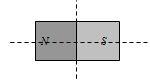
View full question & answer→