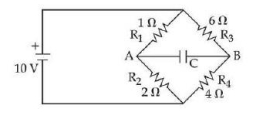
Assertion : In a simple battery circuit, the point of the lowest potential is positive terminal of the battery.
Reason : The current flows towards the point of the higher potential, as it does in such a circuit from the negative to the positive terminal.
AIIMS 2002, Easy


Download our appand get started for free
Experience the future of education. Simply download our apps or reach out to us for more information. Let's shape the future of learning together!No signup needed.*
Similar Questions
- 1When a current $I$ is passed through a wire of constant resistance, it produces a potential difference $V$ across its ends. The graph drawn between $\log\, I$ and $\log\, V$ will beView Solution
- 2For a wire $\frac{R}{l}=\frac{1}{2}$ and length of wire is $l=5\, cm .$ If potential difference $1\, V$ is applied across it, current through wire will be: $( R =$ Resistance $)$ (in $A$)View Solution
- 3Resistance of tungsten wire at $150\,^oC$ is $133\,\Omega $. Its resistance temperature coefficient is $0.0045\,^oC$. The resistance of this wire at $500\,^oC$ will be .............. $\Omega$View Solution
- 4An expression for rate of heat generated, if a current of $I$ ampere flows through a resistance of $R$ $\Omega$, isView Solution
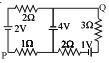
- 5In the circuit shown, what is the potential difference $V_{PQ}$? ................ $V$View Solution
- 6View SolutionWhich one is not the correct statement
- 7The length of a potentiometer wire is $l$. $A$ cell of $\mathrm{emf}$ $E$ is balanced at a length $l/3$ from the positive end of the wire. If the length of the wire is increased by $l/2$. At what distance will the same cell give a balance point.View Solution
- 8$10$ resistors each of resistance $10\,\Omega$ can be connected in such as to get maximum and minimum equivalent resistance. The ratio of maximum and minimum equivalent resistance will be $..........$.View Solution
- 9In hydrogen atom, the electron makes $6.6 \times {10^{15}}$ revolutions per second around the nucleus in an orbit of radius $0.5 \times {10^{ - 10}}\,m$. It is equivalent to a current nearlyView Solution
- 10The charge accumulated on the capacitor connected in the following circuit is________ $\mu \mathrm{C}$ (Given $\mathrm{C}=150\ \mu \mathrm{F}$ )View Solution