Question
Assertion  :  In transistor common emitter mode as an amplifier is preferred over common base mode.
Reason     : In common emitter mode the input signal is connected in series with the voltage applied to the base emitter function.(a) If both assertion and reason are true and the reason is the correct explanation of the assertion.(b) If both assertion and reason are true but reason is not the correct explanation of the assertion.(c) If assertion is true but reason is false.(d) If the assertion and reason both are false.


Answer

(b) If both assertion and reason are true but reason is not the correct explanation of the assertion.

Need a full question paper?

Generate a complete, print-ready paper with questions like this in minutes — across 16+ boards, with answer keys.

Start Generating Free

Similar questions

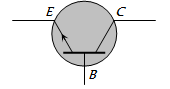
The symbol given in figure represents
How much water should be filled in a container $21 \ cm$ in height, so that it appears half filled when viewed from the top of the container $($given that $\mathrm{a}^{\mu_\omega} = 4/3)$
Two charged spheres separated at a distance $d$ exert a force $F$ on each other. If they are immersed in a liquid of dielectric constant $2 ,$ then what is the force $($if all conditions are same$)$
In order to quadruple the resistance of a uniform wire, a part of its length was uniformly stretched till the final length of the entire wire was $1.5$ times the original length, the part of the wire was fraction equal to
The diffusion current in a p-n junction is:
Two identical parallel plate capacitors are connected in series to a battery of 100 V. A dielectric slab of dielectric constant 4.0 is inserted between the plates of second capacitor.  The potential difference across the capacitors will now be respectively(a) 50 V, 50 V(b) 80 V, 20 V(c) 20 V, 80 V(d) 75 V, 25 V
       
A region surrounding a stationary electric dipoles has:
Let $F_{pp,} F_{pn}$ and $F_{nn}$ denote the magnitudes of the net force by a proton on a proton, by a proton on a neutron and by a neutron on a neutron respectively. Neglect gravitational force. When the separation is $1\ fm:$
In intrinsic semiconductors:
The reason of seeing the Sun a little before the sunrise is(a) Reflection of the light (b) Refraction of the light(c) Scattering of the light(d) Dispersion of the light