MCQ
$Assertion :$ Melting of solid causes no change in internal energy.
$Reason :$ Latent heat is the heat required to melt a unit mass of solid.
  • A
    If both Assertion and Reason are correct and the Reason is a correct explanation of the Assertion.
  • B
    If both Assertion and Reason are correct but Reason is not a correct explanation of the Assertion.
  • C
    If the Assertion is correct but Reason is incorrect.
  • If the Assertion is incorrect but the Reason is correct.
Answer

Correct option: D.
If the Assertion is incorrect but the Reason is correct.
d
Melting of solid causes change in its internal energy. Latent heat is the heat required to melt one unit mass of solid. Option $(e)$ is correct.

Need a full question paper?

Generate a complete, print-ready paper with questions like this in minutes — across 16+ boards, with answer keys.

Start Generating Free

Similar questions

A pipe open at both ends has a fundamental frequency $f$ in air. The pipe is dipped vertically in water so that half of it is in water. The fundamental frequency of the air column is now ..... $f$
What is the minimum energy required to launch a satellite of mass $m$ from the surface of a planet of mass $M$ and radius $R$ in a circular orbit at an altitute of $2R$ ?
A pendulum clock that keeps correct time on the earth is taken to the moon. It will run:
A swimmer can swim in still water with speed $v$ and the river is flowing with velocity $v/2$. To cross the river in shortest distance, he should swim making angle $\theta$ with the upstream. What is the ratio of the time taken to swim across the shortest time to that is swimming across over shortest distance
If $\vec{a}$ and $\vec{b}$ makes an angle $\cos ^{-1}\left(\frac{5}{9}\right)$ with each other, then $|\vec{a}+\vec{b}|=\sqrt{2}|\vec{a}-\vec{b}|$ for $|\vec{a}|=n|\vec{b}|$ The integer value of $n$ is . . . . . . .. 
A body falls from rest in the gravitational field of the earth. The distance travelled in the fifth second of its motion is.........$m$ $(g = 10\,m/{s^2})$
A constant power is supplied to a rotating disc. Angular velocity $\left( \omega  \right)$ of disc varies with number of rotations $(n)$ made by the disc as
In a reversible isochoric change
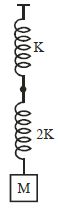
Two springs of force constant $K$ and $2K$ are connected to a mass as shown below. The frequency of oscillation of the mass is
A sphere, a cube and a thin circular plate, all of same material and same mass are initially heated to same high temperature.