MCQ
Assertion : Nitrogen and oxygen are the main components in the atmosphere but these do not react to form oxides of nitrogen.

Reason : The reaction between nitrogen and oxygen requires high temperature.

  • A
    The assertion is incorrect, but the reason is correct
  • B
    Both the assertion and reason are incorrect
  • Both assertion and reason are correct, and the reason is the correct explanation for the assertion
  • D
    Both assertion and reason are correct, but the reason is not the correct explanation for the assertion
Answer

Correct option: C.
Both assertion and reason are correct, and the reason is the correct explanation for the assertion
c
Nitrogen and oxygen in air do not react to form oxides of nitrogen in atmosphere because the reaction between nitrogen and oxygen requires high temperature.

Need a full question paper?

Generate a complete, print-ready paper with questions like this in minutes — across 16+ boards, with answer keys.

Start Generating Free

Similar questions

The frequency of radiation absorbed or emitted when transition occurs between two stationary states with energies $E_1$ (lower) and $E_2$ (higher) is given by 
$E.C.E.$ of Cu and Ag are $7 \times {10^{ - 6}}$ and $1.2 \times {10^{ - 6}}.$A certain current deposits $14\, gm$ of $Cu$. Amount of $Ag$ deposited is .............. $\mathrm{gm}$
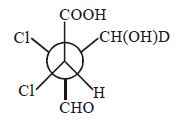
Following compound contains how many chiral centres
Equivalent weight of $KMn{O_4}$ acting as an oxidant in acidic medium is
An element of atomic number $29$ belongs to
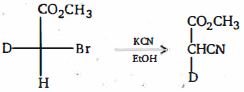
The configurations of the reactant and the product in the following reaction,  respectively, are:
Set of orbital filled just after the filling of electron in atom $z = 56$ is
The configurations of the carbon atoms $C_2$ and $C_3$ in the following compound are respectively
The electronegativity of aluminium is similar to
$2.5 \mathrm{~g}$ of a non-volatile, non-electrolyte is dissolved in $100 \mathrm{~g}$ of water at $25^{\circ} \mathrm{C}$. The solution showed a boiling point elevation by $2^{\circ} \mathrm{C}$. Assuming the solute concentration in negligible with respect to the solvent concentration, the vapour pressure of the resulting aqueous solution is . . . . . .  $\mathrm{mm}$ of $\mathrm{Hg}$ (nearest integer)

[Given : Molal boiling point elevation constant of water $\left(\mathrm{K}_{\mathrm{b}}\right)=0.52 \mathrm{K.} \mathrm{kg} \mathrm{mol}^{-1}$,

$1 \mathrm{~atm}$ pressure $=760 \mathrm{~mm}$ of $\mathrm{Hg}$, molar mass of water $\left.=18 \mathrm{~g} \mathrm{~mol}^{-1}\right\rfloor$