MCQ
Assertion : No interference pattern is detected when two coherent sources are infinitely close to each other.

Reason : The fringe width is inversely proportional to the distance between the two slits.

  • If both Assertion and Reason are correct and the Reason is a correct explanation of the Assertion.
  • B
    If both Assertion and Reason are correct but Reason is not a correct explanation of the Assertion.
  • C
    If the Assertion is correct but Reason is incorrect.
  • D
    If both the Assertion and Reason are incorrect.
Answer

Correct option: A.
If both Assertion and Reason are correct and the Reason is a correct explanation of the Assertion.
a
When $d$ is negligibly small, fringe width $\beta $ which is proportional to $1/d$ may become too large. Even a single fringe may occupy the whole screen. Hence the pattern cannot be detected.

Need a full question paper?

Generate a complete, print-ready paper with questions like this in minutes — across 16+ boards, with answer keys.

Start Generating Free

Similar questions

If light travels a distance $x$ in ${t_1}\,sec$ in air and $10\, x$ distance in ${t_2} sec$ in a medium, the critical angle of the medium will be
ike magnetic force $.......$ each other.
The $SI$ unit of inductance, the henry, can be written as
Which among the following is true about magnetic susceptibility?
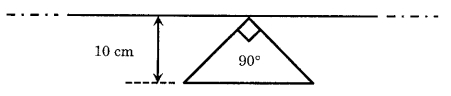
A conducting loop in the shape of a right angled isosceles triangle of height $10 \mathrm{~cm}$ is kept such that the $90^{\circ}$ vertex is very close to an infinitely long conducting wire (see the figure). The wire is electrically insulated from the loop. The hypotenuse of the triangle is parallel to the wire. The current in the triangular loop is in counterclockwise direction and increased at a constant rate of $10 \mathrm{As}^{-1}$. Which of the following statement($s$) is(are) true?

($A$) The magnitude of induced emf in the wire is $\left(\frac{\mu_0}{\pi}\right)$ volt

($B$) If the loop is rotated at a constant angular speed about the wire, an additional emf of $\left(\frac{\mu_0}{\pi}\right)$ volt is induced in the wire

($C$) The induced current in the wire is in opposite direction to the current along the hypotenuse

($D$) There is a repulsive force between the wire and the loop

What should be the current in a circular coil of radius 5cm to annul $\mathrm{B}_{\mathrm{H}}=5 \times 10^{-5} \mathrm{~T}$ 
A radioactive sample of $U^{238}$ decay to $Pb$ through a process for which half life is $4.5 × 10^9$ years. The ratio of number of nuclei of $Pb$ to $U^{238}$ after a time of $1.5 ×10^9$ years (given $2^{1/3} = 1.26$)
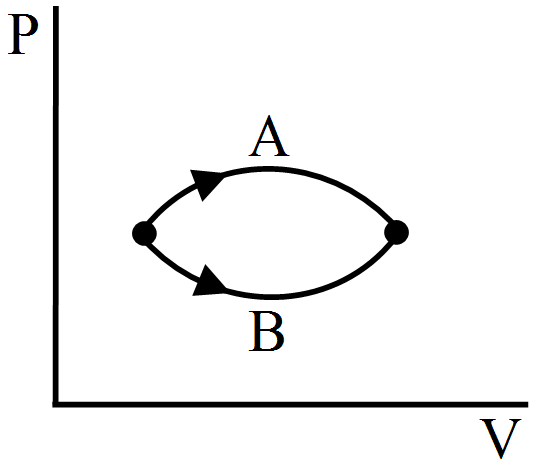
Figure. shows two processes A and B on a system. Let $\Delta\text{Q}_1$ and $\Delta\text{Q}_2$ be the heat given to the system in processes A and B respectively. Then,
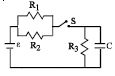
The circuit shown in the figure consists of a battery of $emf$ $\varepsilon = 10 \,V$ ; a capacitor of capacitance $C = 1.0$ $ \mu F$  and three resistor of values $R_1 = 2$ $\Omega$ , $R_2 = 2$ $\Omega$ and $R_3 = 1$ $\Omega$ . Initially the capacitor is completely uncharged and the switch $S$ is open. The switch $S$ is closed at $t = 0.$
A direct current of 4 A is flowing through any circuit. Root mean square value of the current is: