Question

Assertion :  No interference pattern is detected when two coherent sources are infinitely close to each other.

Reason     : The fringe width is inversely proportional to the distance between the two slits.

(a) If both assertion and reason are true and the reason is the correct explanation of the assertion.

(b) If both assertion and reason are true but reason is not the correct explanation of the assertion.

(c) If assertion is true but reason is false.

(d) If the assertion and reason both are false.

Answer

(b) If both assertion and reason are true but reason is not the correct explanation of the assertion.

Need a full question paper?

Generate a complete, print-ready paper with questions like this in minutes — across 16+ boards, with answer keys.

Start Generating Free

Similar questions

 and  are the focal lengths of a convex lens for violet and red light respectively and  and  are the focal lengths of a concave lens for violet and red light respectively, then

(a)   and  

(b)  and  

(c)  and  

(d)  and  

Assertion  :   Leclanche cell is used, when constant supply of electric current is not required.  

Reason     : The e.m.f. of a Leclanche cell falls, if it is used continuously.

(a) If both assertion and reason are true and the reason is the correct explanation of the assertion.

(b) If both assertion and reason are true but reason is not the correct explanation of the assertion.

(c) If assertion is true but reason is false.

(d) If the assertion and reason both are false.

In Fig. X represents time and Y represent activity of a radioactive sample. Then the activity of sample, varies with time according to the curve

(a) A

(b) B

(c) C

(d) D

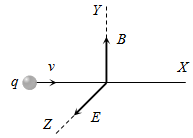
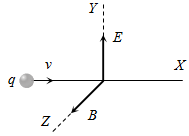
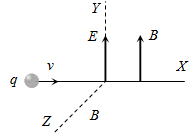
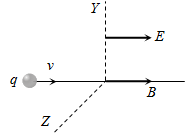
A particle of charge q and mass m is moving along the x -axis with a velocity v and enters a region of electric field E and magnetic field B as shown in figure below for which figure the net force on the charge may be zero

(a)

(b)

(c)

(d)

An electron is moving along the positive x-axis. You want to apply a magnetic field for a short time so that the electron may reverse its direction and move parallel to the negative x-axis. This can be done by applying the magnetic field along:
  1. y-axis.
  2. z-axis.
  3. y-axis only.
  4. z-axis only.
If one of the two slits of Young's double-slit experiment is painted so that it transmits half the light intensity as the second slit, then:

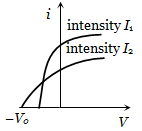
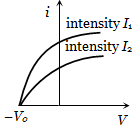
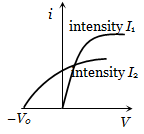
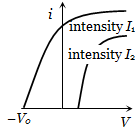
The curves (a), (b) (c) and (d) show the variation between the applied potential difference (V) and the photoelectric current (i), at two different intensities of light (I1 > I2). In which figure is the correct variation shown

 (a)

(b)

(c)

(d)

A 2μF capacitor is charged to 100 volt  and then its plates are connected by a conducting wire. The heat produced is

(a) 1 J

(b) 0.1 J

(c) 0.01 J

(d) 0.001 J

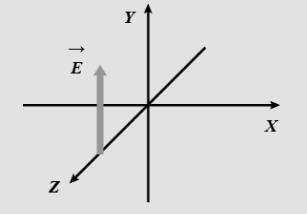
The figure here gives the electric field of an EM wave at a certain poiunt and a certain instrant. the wave is transporting energy in the negative z direction. what is tha direction of the magnetic field of the wave at that point and instant.

When a resistance of 2ohm is connected across the terminals of a cell, the current is 0.5 amperes. When the resistance is increased to 5 ohm, the current is 0.25 amperes. The internal resistance of the cell is

(a) 0.5 ohm

(b) 1.0 ohm

(c) 1.5 ohm

(d) 2.0 ohm