Question

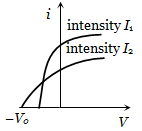
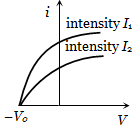
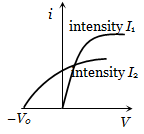
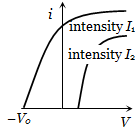
The curves (a), (b) (c) and (d) show the variation between the applied potential difference (V) and the photoelectric current (i), at two different intensities of light (I1 > I2). In which figure is the correct variation shown

 (a)

(b)

(c)

(d)

Answer

(b)

Need a full question paper?

Generate a complete, print-ready paper with questions like this in minutes — across 16+ boards, with answer keys.

Start Generating Free

Similar questions

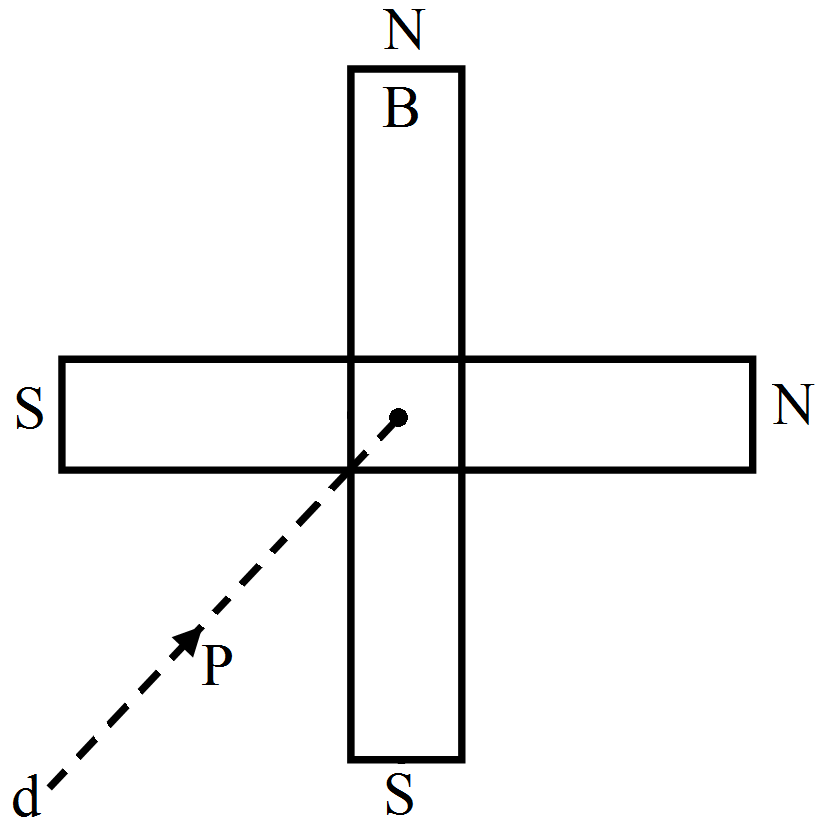
Two short magnets of equal dipole moments M are fastened perpendicularly at their centre (figure). The magnitude of the magnetic field at a distance d from the centre on the bisector of the right angle is:

In an LCR circuit, capacitance is changed from C to 2C. For the resonant frequency to remain unchanged, the inductance should be changed from L to:

Nuclear forces are

(a) Short ranged attractive and charge independent

(b) Short ranged attractive and charge dependent

(c) Long ranged repulsive and charge independent

(d) Long ranged repulsive and charge dependent

Focal length of a convex lens will be maximum for

(a) Blue light

(b) Yellow light

(c) Green light

(d) Red light

Vibration magnetometer before use, should be set

(a) In magnetic meridian

(b) In geographical meridian

(c) Perpendicular to magnetic meridian

(d) In any position

Assertion  : If the temperature of a semiconductor is increased then it's resistance decreases.

Reason      : The energy gap between conduction band and valence band is very small

(a) If both assertion and reason are true and the reason is the correct explanation of the assertion.

(b) If both assertion and reason are true but reason is not the correct explanation of the assertion.

(c) If assertion is true but reason is false.

(d) If the assertion and reason both are false.

Which theory explained that electrons revolved in circular orbits?
Which of the following is an electromagnetic wave?

Two equal point charges are fixed at x = -a  and x = +a  on the x-axis. Another point charge Q is placed at the origin. The Change in the electrical potential energy of Q, when it is displaced by a small distance x along the x-axis, is approximately proportional to

(a) x 

(b)  

(c)  

(d) 1/x

For diffraction of light, it is necessary that the size of the obstacle in comparison to the wavelength of light waves will be :