$Assertion :$ The buoyant force on a submerged rigid object can be considered to be acting at the centre of mass of the object.
$Reason :$ For a rigid body a force field distributed uniformly through its volume can be considered to be acting at the centre of mass of the body.
$Reason :$ For a rigid body a force field distributed uniformly through its volume can be considered to be acting at the centre of mass of the body.
AIIMS 2015, Medium


Download our appand get started for free
Experience the future of education. Simply download our apps or reach out to us for more information. Let's shape the future of learning together!No signup needed.*
Similar Questions
- 1There is a hole in the bottom of tank having water. If total pressure at bottom is $ 3 atm$ ($1 atm = 10^5N/m^2$) then the velocity of water flowing from hole isView Solution
- 2View SolutionWhich of the following is not an assumption for an ideal fluid flow for which Bernoulli's principle is valid
- 3A manometer connected to a closed tap reads $3.5 × 10^5 N/m^2$. When the valve is opened, the reading of manometer falls to $3.0 × 10^5 N/m^2$, then velocity of flow of water is ........ $m/s$View Solution
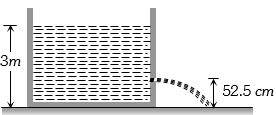
- 4Water is filled in a cylindrical container to a height of $3m. $ The ratio of the cross-sectional area of the orifice and the beaker is $ 0.1. $ The square of the speed of the liquid coming out from the orifice is ....... $m^2/s^2$ ($g = 10 m/s^2$)View Solution
- 5The reading of pressure metre attached with a closed pipe is $4.5 \times 10^4 \mathrm{~N} / \mathrm{m}^2$. On opening the valve, water starts flowing and the reading of pressure metre falls to $2.0 \times 10^4 \mathrm{~N} / \mathrm{m}^2$. The velocity of water is found to be $\sqrt{\mathrm{V}} \mathrm{m} / \mathrm{s}$. The value of $\mathrm{V}$ is__________View Solution
- 6Two communicating vessels contain mercury. The diameter of one vessel is $n$ times larger than the diameter of the other. A column of water of height $ h$ is poured into the left vessel. The mercury level will rise in the right-hand vessel ($s =$ relative density of mercury and $\rho = $ density of water) byView Solution

- 7During a blood transfusion a needle is inserted in a vein where the gauge pressure is $2000\,Pa$. At what height must the blood container be placed so that blood may just enter the vein ?View Solution
[Density of blood $= 1.06 \times 10^3\,kgm^{-3}$ ].
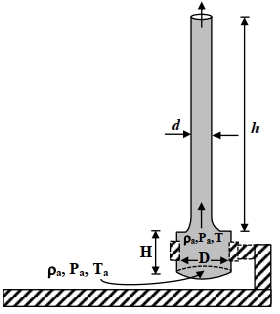
- 8A cylindrical furnace has height $(H)$ and diameter $(D)$ both $1 \mathrm{~m}$. It is maintained at temperature $360 \mathrm{~K}$. The air gets heated inside the furnace at constant pressure $P_a$ and its temperature becomes $T=360 \mathrm{~K}$. The hot air with density $\rho$ rises up a vertical chimney of diameter $d=0.1 \mathrm{~m}$ and height $h=9 \mathrm{~m}$ above the furnace and exits the chimney (see the figure). As a result, atmospheric air of density $\rho_a=1.2 \mathrm{~kg} \mathrm{~m}^{-3}$, pressure $P_a$ and temperature $T_a=300 \mathrm{~K}$ enters the furnace. Assume air as an ideal gas, neglect the variations in $\rho$ and $T$ inside the chimney and the furnace. Also ignore the viscous effects.View Solution
[Given: The acceleration due to gravity $g=10 \mathrm{~ms}^{-2}$ and $\pi=3.14$ ]
(image)
($1$) Considering the air flow to be streamline, the steady mass flow rate of air exiting the chimney is
. . . . .$\mathrm{gm} \mathrm{s}^{-1}$.
($2$) When the chimney is closed using a cap at the top, a pressure difference $\Delta P$ develops between the top and the bottom surfaces of the cap. If the changes in the temperature and density of the hot air, due to the stoppage of air flow, are negligible then the value of $\Delta P$ is. . . . .$\mathrm{Nm}^{-2}$.
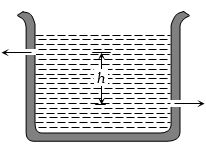
- 9There are two identical small holes of area of cross-section a on the opposite sides of a tank containing a liquid of density $\rho $. The difference in height between the holes is $h$. Tank is resting on a smooth horizontal surface. Horizontal force which will has to be applied on the tank to keep it in equilibrium isView Solution
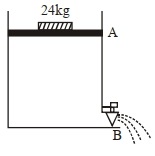
- 10Consider a water tank as shown in the figure. It's cross-sectional area is $0.4\, m ^{2}$. The tank has an opening $B$ near the bottom whose cross-section area is $1\, cm ^{2}$. A load of $24\, kg$ is applied on the water at the top when the height of the water level is $40\, cm$ above the bottom, the velocity of water coming out the opening $B$ is $v\, ms ^{-1}$. The value of $v$, to the nearest integer, is ......$m/s$. [Take value of $g$ to be $10 \,ms ^{-2}$ ]View Solution