Assertion : The current density $\vec J$ at any point in ohmic resistor is in direction of electric field $\vec E$ at that point.
Reason : A point charge when released from rest in a region having only electrostatic field always moves along electric lines of force.
AIIMS 2016, Medium
Download our app for free and get started
From relation $\vec J = \sigma \,\vec E$, the current density $\vec J$ at any point in ohmic resistor is in direction of electric field $\vec E$ at that point. In space having non-uniform electric field, charges released from rest may not move along $ELOF$. Hence Assertion is correct while Reason is incorrect.

Download our appand get started for free
Experience the future of education. Simply download our apps or reach out to us for more information. Let's shape the future of learning together!No signup needed.*
Similar Questions
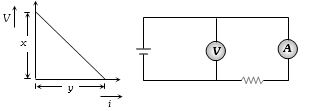
- 1In an experiment, a graph was plotted of the potential difference $V$ between the terminals of a cell against the circuit current $i$ by varying load rheostat. Internal conductance of the cell is given byView Solution
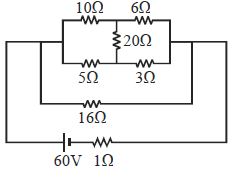
- 2The current from the cell for the given circuit is ................ $\mathrm{A}$View Solution
- 3Find the number of photons emitted per second from of source of light which results in a photocurrent with drift velocity of $1.5\ m/s$ in a conductor with cross-section area $0.25\ m^2$ , volume density of electrons $10^{20}\ per \ m^3$ , (Assume that $60\%$ of photons emitted result in electron emission)View Solution
- 4Four identical cells each having an electromotive force $(e.m.f.)$ of $12\,V$, are connected in parallel. The resultant electromotive force $(e.m.f.)$ of the combination is .............. $V$View Solution
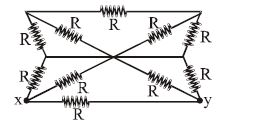
- 5What will be equivalent resistance of circuit between $x$ and $y$View Solution
- 6A piece of wire of resistance $4\, ohms$ is bent through $180^o$ at its mid point and the two halves are twisted together, then the resistance is ............ $ohms$View Solution
- 7A $10\,m$ long potentiometer wire has a potential gradient of $0.0025\, V/cm$. Calculate the distance of null point when the wire is connected to a $1.025\,V$ standard cell ............... $\mathrm{m}$View Solution
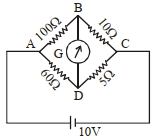
- 8The four arms of a Wheatstone bridge have resistances as shown in the figure. A galvanometer of $15\, \Omega$ resistance is connected across $BD$. Calculate the current through the galvanometer when a potential difference of $10\, V$ is maintained across $AC.$View Solution
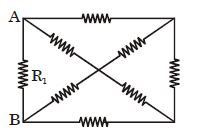
- 9As shown, the circuit is made of $8$ different resistors. It is found that when $R_1 = 4\,\,\Omega,$ the resistance between $A$ and $B$ is $2\,\,\Omega.$ Now replace $R_1$ by a $6\,\,\Omega$ resistor, what is the resistance between $A$ and $B$?View Solution
- 10View SolutionIf the length of potentiometer wire is increased, then the length of the previously obtained balance point will