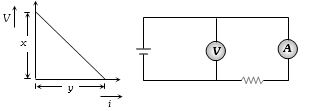
In an experiment, a graph was plotted of the potential difference $V$ between the terminals of a cell against the circuit current $i$ by varying load rheostat. Internal conductance of the cell is given by
Medium
Download our app for free and get started
(b) Here internal resistance is given by the slope of graph i.e. $\frac{x}{y}$. But conductance $ = \frac{1}{{{\rm{Resistance }}}} = \frac{y}{x}$

Download our appand get started for free
Experience the future of education. Simply download our apps or reach out to us for more information. Let's shape the future of learning together!No signup needed.*
Similar Questions
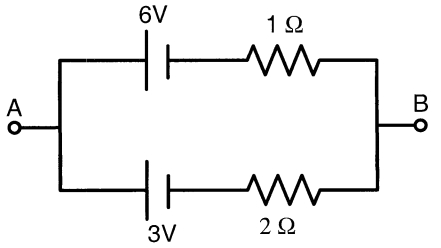
- 1Two batteries of different emfs and different internal resistances are connected as shown. The voltage across $A B$ in volts isView Solution
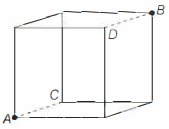
- 2A cube is formed with ten identical resistances $R$ (thick lines) and two shorting wires (dotted lines) along the arms $A C$ and $B D$ as shown in the figure below. Resistance between point $A$ and $B$ is ...........$\Omega$View Solution
- 3$A$ brass disc and a carbon disc of same radius are assembled alternatively to make a cylindrical conductor. The resistance of the cylinder is independent of the temperature. The ratio of thickness of the brass disc to that of the carbon disc is [$\alpha$ is temperature coefficient of resistance and Neglect linear expansion ]View Solution
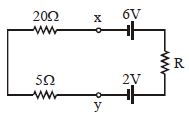
- 4The current flowing in the given circuit is $0.1\,A$ . The potential difference between the points $X$ and $Y$ is ................ $\mathrm{V}$View Solution
- 5$n$ identical cells are joined in series with its two cells $A$ and $B$ in the loop with reversed polarities. $EMF$ of each shell is $E$ and internal resistance $r$. Potential difference across cell $A$ or $B$ is (here $n > 4$)View Solution
- 6The temperature coefficient of resistance for a wire is $0.00125\,^oC$. At $300\,K$ its resistance is $1\, ohm$. The temperature at which the resistance becomes $2\, ohm$ is .......... $K$View Solution
- 7Two identical cells each of emf $1.5\,V$ are connected in series across a $10\,\Omega$ resistance. An ideal voltmeter connected across $10\,\Omega$ resistance reads $1.5\,V$. The internal resistance of each cell is $......\Omega$.View Solution
- 8A battery of $e.m.f.$ $3\, volt$ and internal resistance $1.0\, ohm$ is connected in series with copper voltameter. The current flowing in the circuit is $1.5\, amperes$. The resistance of voltameter will be ........... $ohm$View Solution
- 9View SolutionThe lead wires should have
- 10The Kirchhooff's first law $\left(\sum i=0\right)$ and second law ( $\left.\sum i R=\sum E\right)$, where the symbols have their usual meanings, are respectively based onView Solution