MCQ
Assertion : The logic gate $NOT$ can be built using diode.

Reason : The output voltage and the input voltage of the diode have $180^o$ phase difference.

  • A
    If both Assertion and Reason are correct and the Reason is a correct explanation of the Assertion.
  • B
    If both Assertion and Reason are correct but Reason is not a correct explanation of the Assertion.
  • C
    If the Assertion is correct but Reason is incorrect.
  • If both the Assertion and Reason are incorrect.

Answer

Correct option: D.
If both the Assertion and Reason are incorrect.
d
The diode is unidirectional it allows current to pass through it in a particular direction. It does not change the phase of input signal.

Need a full question paper?

Generate a complete, print-ready paper with questions like this in minutes — across 16+ boards, with answer keys.

Start Generating Free

Similar questions

A light wave is propagating with plane wave fronts of the type $x+y+z=$ constant. The angle made by the direction of wave propagation with the $x$-axis is :
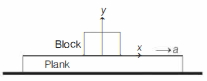
A plank is moving in a horizontal direction with a constant acceleration $\alpha \hat{ i }$. A uniform rough cubical block of side $l$ rests on the plank and is at rest relative to the plank. Let the centre of mass of the block be at $(0, l / 2)$ at a given instant. If $\alpha =g / 10$, then the normal reaction exerted by the plank on the block at that instant acts at
A mass of $0.5\,kg$ moving with a speed of $1.5 \,m/s$ on a horizontal smooth surface, collides with a nearly weightless spring of force constant $k = 50\;N/m$. The maximum compression of the spring would be ............. $\mathrm{m}$
A travelling microscope is used to determine the refractive index of a glass slab. If $40$ divisions are there in $1 \; cm$ on main scale and $50$ Vernier scale divisions are equal to $49$ main scale divisions, then least count of the travelling microscope is $\dots \; \times 10^{-6} \; m$
A block with mass $M$ is connected by a massless spring with stiffiess constant $k$ to a rigid wall and moves without friction on a horizontal surface. The block oscillates with small amplitude $A$ about an equilibrium position $x_0$. Consider two cases: ($i$) when the block is at $x_0$; and ($ii$) when the block is at $x=x_0+A$. In both the cases, a perticle with mass $m$ is placed on the mass $M$ ?

($A$) The amplitude of oscillation in the first case changes by a factor of $\sqrt{\frac{M}{m+M}}$, whereas in the second case it remains unchanged

($B$) The final time period of oscillation in both the cases is same

($C$) The total energy decreases in both the cases

($D$) The instantaneous speed at $x_0$ of the combined masses decreases in both the cases

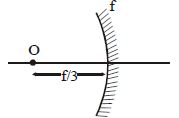
A short linear object $O$ is placed on the principal axis of convex mirror of focal length $f$ as shown in the figure. The ratio of transverse magnification to longitudinal magnification is
In a mixture of $\mathrm{H}-\mathrm{He}^{+}$gas ( $\mathrm{He}^{+}$is singly ionized $\mathrm{He}$ atom), $\mathrm{H}$ atoms and $\mathrm{He}^{+}$ions are excited to their respective first excited states. Subsequently, $\mathrm{H}$ atoms transfer their total excitation energy to $\mathrm{He}^{+}$ions (by collisions). Assume that the Bohr model of atom is exactly valid.

$1.$ The quantum number $\mathrm{n}$ of the state finally populated in $\mathrm{He}^{+}$ions is

$(A)$ $2$ $(B)$ $3$ $(C)$ $4$ $(D)$ $5$

$2.$ The wavelength of light emitted in the visible region by $\mathrm{He}^{+}$ions after collisions with $\mathrm{H}$ atoms is

$(A)$ $6.5 \times 10^{-7} \mathrm{~m}$ $(B)$ $5.6 \times 10^{-7} \mathrm{~m}$

$(C)$ $4.8 \times 10^{-7} \mathrm{~m}$ $(D)$ $4.0 \times 10^{-7} \mathrm{~m}$

$3.$ The ratio of the kinetic energy of the $\mathrm{n}=2$ electron for the $\mathrm{H}$ atom to that of $\mathrm{He}^{+}$ion is

$(A)$ $\frac{1}{4}$ $(B)$ $\frac{1}{2}$ $(C)$ $1$ $(D)$ $2$

Give the answer question $1,2$ and $3.$
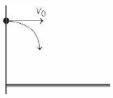
Two balls of mass $M$ and $2 \,M$ are thrown horizontally with the same initial velocity $v_{0}$ from top of a tall tower and experience a drag force of $-k v(k > 0)$, where $v$ is the instantaneous velocity. then,
A tennis ball is dropped on a horizontal smooth surface. It bounces back to its original position after hitting the surface. The force on the ball during the collision is proportional to the length of compression of the ball. Which one of the following sketches describes the variation of its kinetic energy $K$ with time $t$ most appropriately? The figures are only illustrative and not to the scale.
Which one of the following planet has the longest day