$Assertion$ : The number of significant figures depends on the least count of measuring instrument.
$Reason$ : Significant figures define the accuracy of measuring instrument.
$Reason$ : Significant figures define the accuracy of measuring instrument.
AIIMS 2016, Easy


Download our appand get started for free
Experience the future of education. Simply download our apps or reach out to us for more information. Let's shape the future of learning together!No signup needed.*
Similar Questions
- 1In electromagnetic theory, the electric and magnetic phenomena are related to each other. Therefore, the dimensions of electric and magnetic quantities must also be related to each other. In the questions below, $[E]$ and $[B]$ stand for dimensions of electric and magnetic fields respectively, while $\left[\varepsilon_0\right]$ and $\left[\mu_0\right]$ stand for dimensions of the permittivity and permeability of free space respectively. $[L]$ and $[T]$ are dimensions of length and time respectively. All the quantities are given in $SI$ units.View Solution
($1$) The relation between $[E]$ and $[B]$ is
$(A)$ $[ E ]=[ B ][ L ][ T ]$ $(B)$ $[ E ]=[ B ][ L ]^{-1}[ T ]$ $(C)$ $[ E ]=[ B ][ L ][ T ]^{-1}$ $(D)$ $[ E ]=[ B ][ L ]^{-1}[ T ]^{-1}$
($2$) The relation between $\left[\varepsilon_0\right]$ and $\left[\mu_0\right]$ is
$(A)$ $\left[\mu_0\right]=\left[\varepsilon_0\right][ L ]^2[ T ]^{-2}$ $(B)$ $\left[\mu_0\right]=\left[\varepsilon_0\right][ L ]^{-2}[ T ]^2$ $(C)$ $\left[\mu_0\right]=\left[\varepsilon_0\right]^{-1}[ L ]^2[ T ]^{-2}$ $(D)$ $\left[\mu_0\right]=\left[\varepsilon_0\right]^{-1}[ L ]^{-2}[ T ]^2$
Give the answer or quetion ($1$) and ($2$)
- 2The velocity $v$ (in $cm/\sec $) of a particle is given in terms of time $t$ (in sec) by the relation $v = at + \frac{b}{{t + c}}$ ; the dimensions of $a,\,b$ and $c$ areView Solution
- 3Match List $I$ with List $II$View Solution
LIST$-I$ LIST$-II$ $(A)$ Torque $(I)$ $ML ^{-2} T ^{-2}$ $(B)$ Stress $(II)$ $ML ^2 T ^{-2}$ $(C)$ Pressure of gradient $(III)$ $ML ^{-1} T ^{-1}$ $(D)$ Coefficient of viscosity $(IV)$ $ML ^{-1} T ^{-2}$ Choose the correct answer from the options given below
- 4If the measurement errors in all the independent quantities are known, then it is possible to determine the error in any dependent quantity. This is done by the use of series expansion and truncating the expansion at the first power of the error. For example, consider the relation $z=x / y$. If the errors in $x, y$ and $z$ are $\Delta x, \Delta y$ and $\Delta z$, respectively, thenView Solution
$z \pm \Delta z=\frac{x \pm \Delta x}{y \pm \Delta y}=\frac{x}{y}\left(1 \pm \frac{\Delta x}{x}\right)\left(1 \pm \frac{\Delta y}{y}\right)^{-1} .$
The series expansion for $\left(1 \pm \frac{\Delta y}{y}\right)^{-1}$, to first power in $\Delta y / y$, is $1 \mp(\Delta y / y)$. The relative errors in independent variables are always added. So the error in $z$ will be $\Delta z=z\left(\frac{\Delta x}{x}+\frac{\Delta y}{y}\right)$.
The above derivation makes the assumption that $\Delta x / x \ll<1, \Delta y / y \ll<1$. Therefore, the higher powers of these quantities are neglected.
($1$) Consider the ratio $r =\frac{(1- a )}{(1+ a )}$ to be determined by measuring a dimensionless quantity a.
If the error in the measurement of $a$ is $\Delta a (\Delta a / a \ll<1)$, then what is the error $\Delta r$ in
$(A)$ $\frac{\Delta a }{(1+ a )^2}$ $(B)$ $\frac{2 \Delta a }{(1+ a )^2}$ $(C)$ $\frac{2 \Delta a}{\left(1-a^2\right)}$ $(D)$ $\frac{2 a \Delta a}{\left(1-a^2\right)}$
($2$) In an experiment the initial number of radioactive nuclei is $3000$ . It is found that $1000 \pm$ 40 nuclei decayed in the first $1.0 s$. For $|x|<1$, In $(1+x)=x$ up to first power in $x$. The error $\Delta \lambda$, in the determination of the decay constant $\lambda$, in $s ^{-1}$, is
$(A) 0.04$ $(B) 0.03$ $(C) 0.02$ $(D) 0.01$
Give the answer or quetion ($1$) and ($2$)
- 5Error in the measurement of radius of a sphere is $1\%$. The error in the calculated value of its volume is ......... $\%$View Solution
- 6View SolutionWhich of the following is a dimension of volt
- 7The force is given in terms of time $t$ and displacement $x$ by the equationView Solution
${F}={A} \cos {Bx}+{C} \sin {Dt}$
The dimensional formula of $\frac{{AD}}{{B}}$ is -
- 8View SolutionThe unit of permittivity of free space is
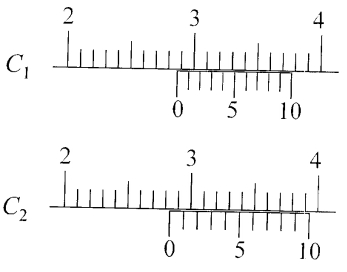
- 9There are two Vernier calipers both of which have $1 \mathrm{~cm}$ divided into $10$ equal divisions on the main scale. The Vernier scale of one of the calipers $\left(C_1\right)$ has $10$ squal divisions that correspond to $9$ main scale divisions. The Vernier scale of the other caliper $\left(C_2\right)$ has $10$ equal divisions that correspond to $11$ main scale divisions. The readings of the two calipers are shown in the figure. The measured values (in $\mathrm{cm}$ ) by calipers $C_1$ and $C_2$, respectively, areView Solution
- 10If force $({F})$, length $({L})$ and time $({T})$ are taken as the fundamental quantities. Then what will be the dimension of densityView Solution