MCQ
Assertion : The temperature coefficient of resistance is positive for metals and negative for P-type semiconductor.
Reason : The effective charge carriers in metals are negatively charged whereas in P-type semiconductor they are positively charged.
  • A
    If both assertion and reason are true and the reason is the correct explanation of the assertion.
  • If both assertion and reason are true but reason is not the correct explanation of the assertion.
  • C
    If assertion is true but reason is false.
  • D
    If the assertion and reason both are false.

Answer

Correct option: B.
If both assertion and reason are true but reason is not the correct explanation of the assertion.
 If both assertion and reason are true but reason is not the correct explanation of the assertion.

Need a full question paper?

Generate a complete, print-ready paper with questions like this in minutes — across 16+ boards, with answer keys.

Start Generating Free

Similar questions

A potentiometer is connected between $A$ and $B$ and the balance point is obtained at $203. 6\,cm$. When the end of the potentiometer connected to $B$ is shifted to $C$, then the balance point is obtained at $24.6\,cm$. If now the potentiometer be connected between $B$ and $C$, the balance point will be at ................. $cm$
If 2.2 kilowatt power is transmitted through a 10 ohm line at 22000 volt, the power loss in the form of heat will be
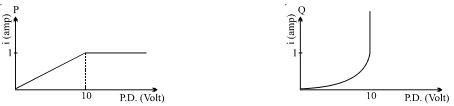
Two current elements $P$ and $Q$ have current voltage characteristics as shown below :

Which of the graphs given below represents current voltage characteristics when $P$ and $Q$ are in series.

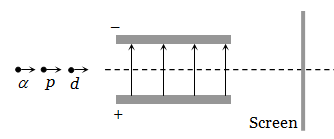
A proton, a deutron and an a-particle having the same momentum, enters a region of uniform electric field between the parallel plates of a capacitor. The electric field is perpendicular to the initial path of the particles. Then the ratio of deflections suffered by them is
The wave-like character was experimentally proved for light by:
Huygens principle of secondary waves:
A uniform electric field of $20\, N/C$ exists along the $x$ -axis in a space. The potential  difference $(V_B -V_A)$ for the point $A(4\,m, 2\,m)$ and $B(6\,m, 5\,m)$ is.....$V$
In nuclear reaction $_2H{e^4}{ + _z}{X^A}{ \to _{z + 2}}{Y^{A + 3}} + A,\;A$ denotes
Two identical short bar magnets, each having magnetic moment M, are placed a distance of 2d apart with axes perpendicular to each other in a horizontal plane. The magnetic induction at a point midway between them is
If two waves represented by ${y_1} = 4\sin \omega t$ and ${y_2} = 3\sin \left( {\omega t + \frac{\pi }{3}} \right)$ interfere at a point, the amplitude of the resulting wave will be about