MCQ
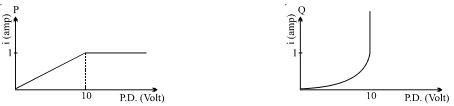
Two current elements $P$ and $Q$ have current voltage characteristics as shown below :

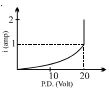
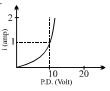
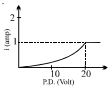
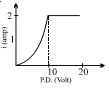
Which of the graphs given below represents current voltage characteristics when $P$ and $Q$ are in series.
  • A

  • B


  • D

Answer

Correct option: C.

c

Need a full question paper?

Generate a complete, print-ready paper with questions like this in minutes — across 16+ boards, with answer keys.

Start Generating Free

Similar questions

A plane electromagnetic wave of frequency $35\  \mathrm{MHz}$ travels in free space along the $\mathrm{X}$-direction.

At a particular point (in space and time) $\overrightarrow{\mathrm{E}}=9.6\  \hat{\mathrm{j}} \mathrm{V} / \mathrm{m}$. The value of magnetic field at this point is:

In a transistor configuration b-parameter is
In electromagnetic induction, the induced $e.m.f$. in a coil is independent of
A semiconductor is a material with a small but non$-$zero band gap that behaves as an insulator at absolute zero but allows thermal excitation of electrons into its $.........$ at temperatures that are below its melting point.
The total charge of the electric dipole is:
What happens to the mass number and atomic number of an element when it emits $\gamma$-radiation?
One proton beam enters a magnetic field of ${10^{ - 4}}$ $T$ normally, Specific charge = ${10^{11}}\,C/kg.$ velocity = ${10^7}\,m/s$. What is the radius of the circle described by it....$m$
$\frac{{2.5}}{\pi }\mu F$ capacitor and $3000-ohm$ resistance are joined in series to an $ac$ source of $200\, volt$ and $50se{c^{ - 1}}$ frequency. The power factor of the circuit and the power dissipated in it will respectively
Given below are two statements :

Statement $I:$ If the Brewster's angle for the light propagating from air to glass is $\theta_{ B }$, then Brewster's angle for the light propagating from glass to air is $\frac{\pi}{2}-\theta_B$.

Statement $II:$ The Brewster's angle for the light propagating from glass to air is $\tan ^{-1}\left(\mu_{ g }\right)$ where $\mu_{ g }$ is the refractive index of glass.

In the light of the above statements, choose the correct answer from the options given below :

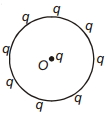
A point charge $q$ is surrounded by eight identical charges at distance $r$ as shown in figure. How much work is done by the forces of electrostatic repulsion when the point charge at the centre is removed to infinity?