$Assertion :$ The velocity of flow of a liquid is smaller when pressure is larger and vice-versa.
$Reason :$ According to Bernoulli’s theorem, for the stream line flow of an ideal liquid, the total energy per unit mass remains constant.
$Reason :$ According to Bernoulli’s theorem, for the stream line flow of an ideal liquid, the total energy per unit mass remains constant.
AIIMS 2013,AIIMS 2014Easy
Download our app for free and get started
According to Bernoulli's theorem, for the stream line flow of an ideal liquid, the total energy per unit mass is constant.
That is $P+\frac{\rho v^{2}}{2}+\rho g h=C$
velocity of liquid depends on pressure as well as potential height available.

Download our appand get started for free
Experience the future of education. Simply download our apps or reach out to us for more information. Let's shape the future of learning together!No signup needed.*
Similar Questions
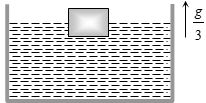
- 1A cubical block is floating in a liquid with half of its volume immersed in the liquid. When the whole system accelerates upwards with acceleration of $g/3,$ the fraction of volume immersed in the liquid will beView Solution
- 2A horizontal pipe line carries water in a streamline flow.At a point along the tube where the cross-sectional area is $10^{-2}$ $m^2$, the water velocity is $2$ $ms^{^{-1}}$ and the pressure is $8000 $ $Pa$. The pressure of water at another point where the cross-sectional area is $0.5$ $\times 10^{-2}$ $m^2$ is ........ $Pa$View Solution
- 3A hollow sphere has inner volume half the outer volume. Its $4/5\,th$ part is submerged when placed in water. The density of material isView Solution
- 4A beaker is filled in with water is accelerated $a $ $m/s^2$ in $+x$ direction. The surface of water shall make on angleView Solution
- 5A vessel of area of cross-section A has liquid to a height $H$ . There is a hole at the bottom of vessel having area of cross-section a. The time taken to decrease the level from ${H_1}$ to ${H_2}$ will beView Solution
- 6A copper ball of radius $'r'$ travels with a uniform speed $'v'$ in a viscous fluid. If the ball is changed with another ball of radius $'2r'$ , then new uniform speed will beView Solution
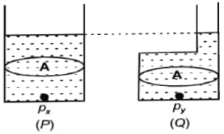
- 7Figure shows two containers $P$ and $Q$ with same base area $A$ and each filled upto same height with same liquid. Select the correct alternative .............View Solution
- 8At shallow depth $h$, the pressure in the ocean is simply given by $P = P_0 + \rho gh$, in which $\rho$ is the density of water and $P_0$ is the air pressure. As we go deeper, the high pressure causes the water to compress and become denser. Which of the following sketches illustrates the correct dependence of the pressure on the depth $h$ ?View Solution
- 9A spherical ball of radius $r$ and relative density $0.5$ is floating in equilibrium in water with half of it immersed in water. The work done in pushing the ball down so that whole of it is just immersed in water is : (where $\rho $ is the density of water)View Solution
- 10A homogeneous solid cylinder of length $L$$(L < H/2)$. Cross-sectional area $A/5$ is immersed such that it floats with its axis vertical at the liquid-liquid interface with length $L/4$ in the denser liquid as shown in the fig. The lower density liquid is open to atmosphere having pressure ${P_0}$. Then density $D$ of solid is given byView Solution